






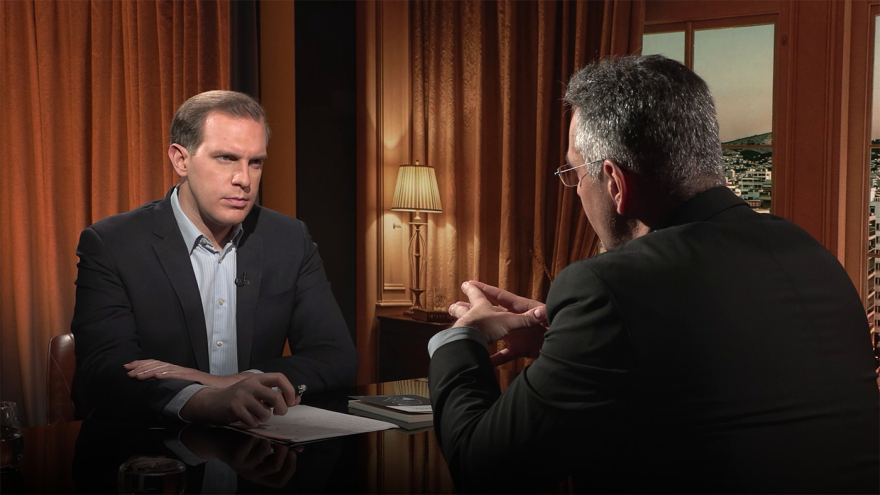
He spoke to Direct of protothema’s Protothema and Giorgos Eugenidis, the government’s special secretary for long-term planning, Giannis Mastrogeworgiou, on the occasion of his book “Man and robot, the bet of artificial intelligence”.
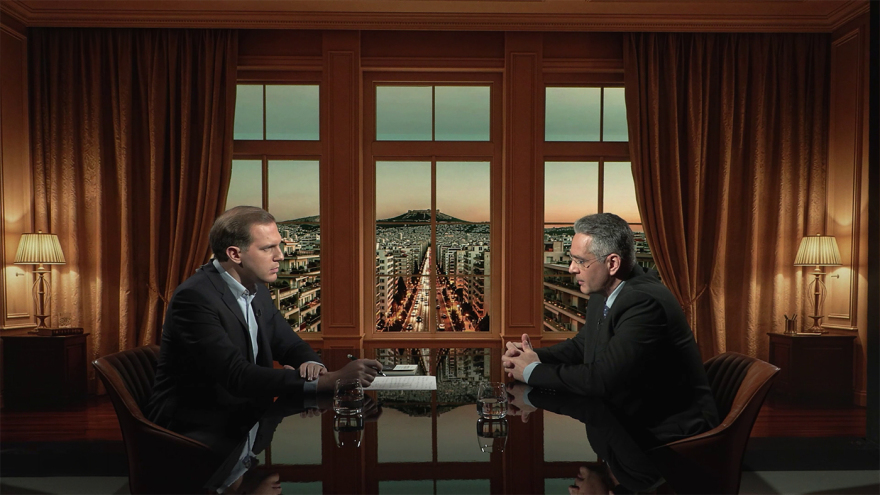
Yannis Mastrogiorgiou described artificial intelligence as “the most well-known unknown topic”, explaining that despite much public debate, few really understand either its depth or practical utility. As he said, it is “the most mind-blowing technology humanity has ever known”, a broad-spectrum technology that is already changing the way we work, inform, and make decisions.
Referring to tools like ChatGPT, he noted that “what we were to take evolutionarily from chats and large language models, we have taken,” though he was quick to point out that the critical thing is to use them with control and not to uncritically accept their responses. “Under no circumstances do we take what is given to us unheeded,” he said.
As for basic risks, he stood particularly on two areas: anthropomorphism and spiritual weakening. As he said, there is a risk that humans will begin to treat AI as a “colleague, companion, partner, psychotherapist”, while there is also a risk that they will completely place their thinking in the algorithm. He warned that these dangers are already present, citing tragic cases in the US, including teenagers who have committed suicide. “We will live with artificial intelligence, but as a tool for collaboration, not as an ontological coexistence with the machine,” he said.
He made particular reference to the threat of deepfakes to public life and especially to elections, noting that doctored videos are now the most obvious threat. He stressed, however, that Greece is taking the issue seriously and that he sees no danger to the electoral process itself, explaining that there is mobilisation of many state structures, from cybersecurity to cybercrime. In the same context, he noted that the National Cybersecurity Authority is “constantly scanning the whole horizon of challenges.”
On the defence front, he set clear limits on the use of artificial intelligence in warfare. “It is unthinkable for humanity to put artificial intelligence as the final arbiter of target selection in a war process,” he said, stressing that the final say should always belong to humans and never to the autonomous system. At the same time, he pointed out that artificial intelligence is already influencing geopolitics and, through propaganda, since it can produce highly influential content very quickly.
Regarding the national strategy for AI and Greek initiatives underway, he explained that of the proposals submitted to the government, several are already moving forward, with the Greek AI Factory “Faros” being the most emblematic. “Faros” will act as an ecosystem for AI applications in health, sustainability, Greek language and culture, and will mainly support small and medium enterprises. “It is not an academic project,” he said, explaining that businesses will be able to use the computing power of “Daedalus” to test their applications in a safe environment.
He also placed special emphasis on the need for a strong presence of the Greek language in the major artificial intelligence platforms, noting that the goal is to create a model for the correct translation of Greek in the major language models. As he said, Greek is not just another language system, but a language with historical, cultural and cognitive depth that must be properly reflected in the digital world as well.
On labour, he acknowledged that the fear of job losses is real. He stressed that “there will be occupations that will be lost”, but assessed that the dominant scenario is the rearrangement of work, not its abolition. He said many individual processes within each occupation would be automated, while others would remain in human hands. In a phrase that encapsulated the central existential dilemma of the age, he said that soon artificial intelligence will ask us: “And what will you do?”
In closing, the Special Secretary for Long-Term Planning noted that even large technology companies are now looking beyond IT and law for answers, turning to philosophy and theology as well. “The future of artificial intelligence is much more humanities and social sciences,” he said, concluding that humans must answer the basic question for themselves: what do they ultimately want to do with this powerful tool?
Ask me anything
Explore related questions




