





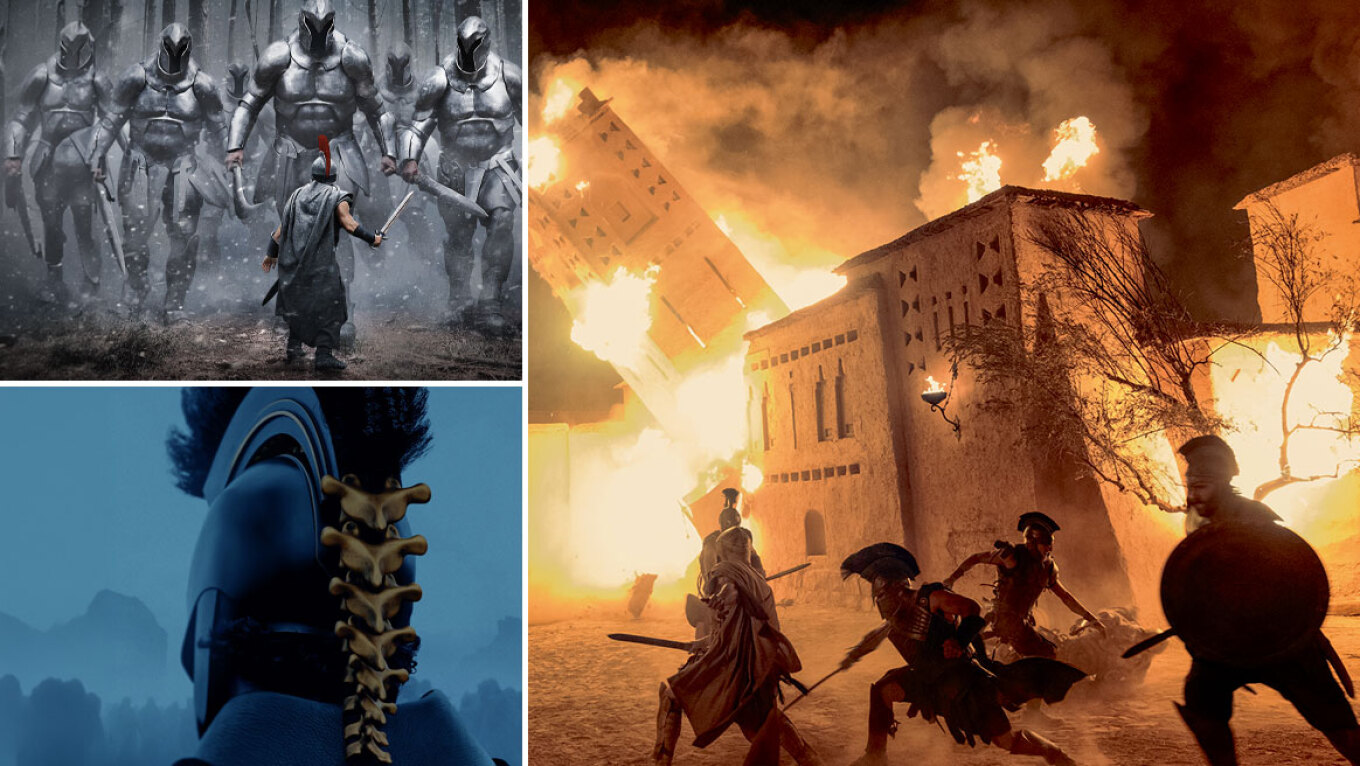
A towering wooden horse, 10 metres high, is dragged again and again across the dunes of Essaouira, battling the waves, sinking into the sand and slowly falling apart before the anxious eyes of the people who spent countless hours building it. On the other side of the world, in Iceland, a film crew works through rain, waiting for the eerie glow of the midnight sun so they can shoot Odysseus’s descent into Hades.
Between these two images, technicians, engineers and camera operators were wrestling with what looked like an entirely different problem: how to make an IMAX camera, a machine powerful enough to capture every pore on a human face, quiet enough to film even the softest scene of dialogue.
These stories are all part of the same production: Christopher Nolan‘s The Odyssey, a filmmaking venture that did not simply set out to bring Homer’s epic to the big screen, but to redefine how a blockbuster can be made today, not inside the safety of a digital studio, but amid wind, dust, sea, fire and the real physical texture of the world.
Nolan’s 13th feature film was shot across six countries with a sprawling cast led by Matt Damon, Tom Holland, Anne Hathaway, Robert Pattinson, Lupita Nyong’o, Zendaya and Charlize Theron. Behind the star power, though, the real story of the shoot lies in the director’s determination to avoid the easy route of digital effects and to make, for the first time, an entire feature film shot exclusively on IMAX cameras.
Nolan used some of the most advanced filmmaking tools of the 21st century to return to an almost primal idea of spectacle, a kind of cinema in which cities are built, gates open, horses are hauled, fires burn and actors are genuinely standing inside the landscape the audience sees on screen. IMAX technology captures reality with such precision that the image takes on an almost tactile quality.
The Fall of Troy
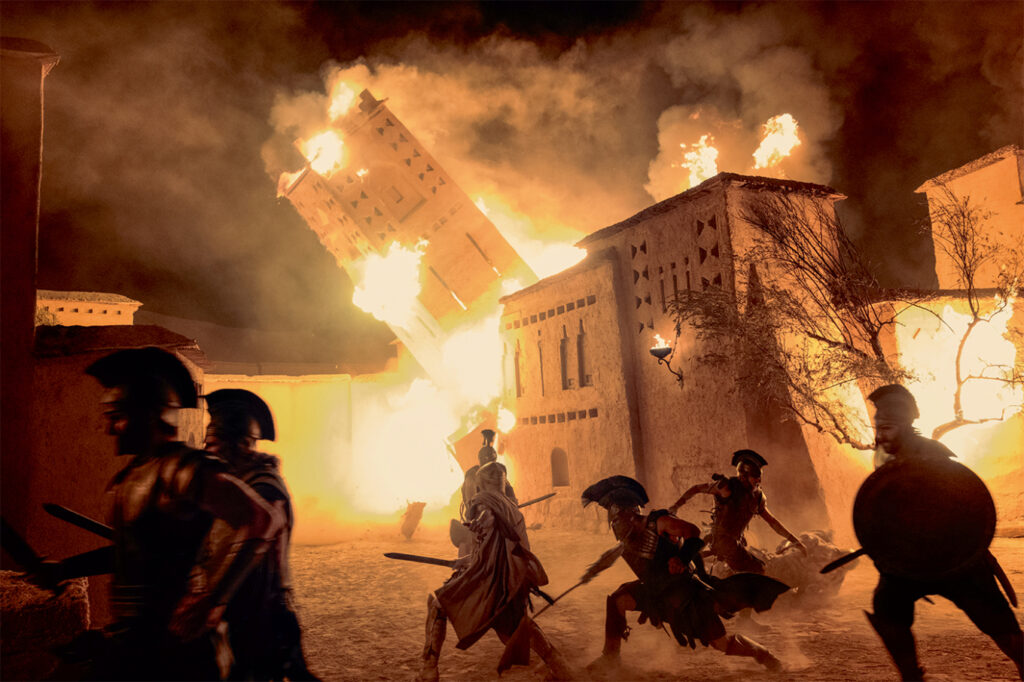
Among the most demanding sequences were those depicting the fall of Troy, which is where filming began. The choice was not accidental: a convincing depiction of the mythical city’s fall would set the aesthetic and technical standard for the whole production that followed. Nolan had decided from the outset that he did not want a Troy generated by computers.
“We knew we wanted to build as much of the set as possible inside a real location,” he explained, insisting that the production did not want to rely on digital effects to artificially extend the sets. The challenge was considerable, since the city had to look ancient, lived in and authentic, while also being able to be destroyed in front of the cameras.
To find a location that could stand in convincingly for Troy, the production chose Aït Benhaddou in Morocco, a fortified village whose architecture could be woven organically into the world of the film. Production designer Ruth De Jong and her team treated the landscape as a living entity that every new structure had to be in dialogue with. The Troy set covered more than 10,000 square metres, included more than 60 individual structures and could hold up to 2,000 extras.
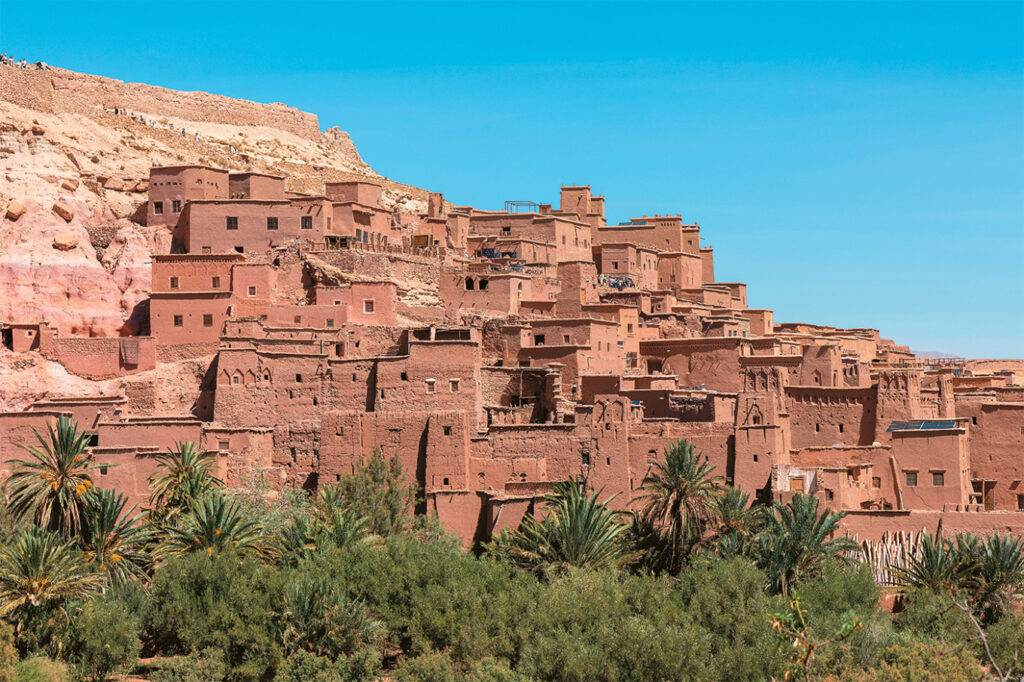
At the centre of the city stood the Temple of Athena, the largest structure built for the production, standing more than 11 metres tall, while the stone steps leading up to the square and the temple were carved by hand.
The production also built the Gates of Troy at full working scale, along with sections of the city walls fitted with custom-designed battlements. Even the olive trees were not left to chance: 15 mature trees were lifted in by crane so that the city would not look newly built, but like a place that had been inhabited for generations. This detail is telling of how Nolan works.
At a time when a digital program could simply multiply the trees on screen, Nolan insisted on bringing in real olive trees, because he knows that an IMAX camera captures not just the appearance of an object, but its weight, its texture and its imperfect truth.
The fall of Troy was, therefore, more than a battle scene. It was a test of the film’s entire philosophy: whether a spectacle on this scale could still be created in front of the lens, the way it was in the great productions of the silent film era, without turning its back on the possibilities of modern technology.
The dramatic problem of the Trojan Horse
Central to these questions, which shaped Nolan’s whole approach to the film, was the pivotal scene involving the Trojan Horse, which reveals a great deal about the character and cunning of Odysseus. For Nolan, it was not enough to simply recreate the familiar image of a wooden horse on wheels. He wanted to solve the dramatic problem at the heart of the myth: why and how were the Trojans persuaded to bring a suspicious object, abandoned by the enemy, inside their own walls?
The director’s answer was to turn the horse into an offering to Poseidon and place it half buried in the sand. Rather than arriving in Troy on convenient wheels, it would have to be dragged, with great effort, from the beach to the city, like an enormous war trophy. “If you want the audience to believe the Trojans would really bring this offering inside their city, then it has to be a genuinely clever trick,” Nolan has explained.
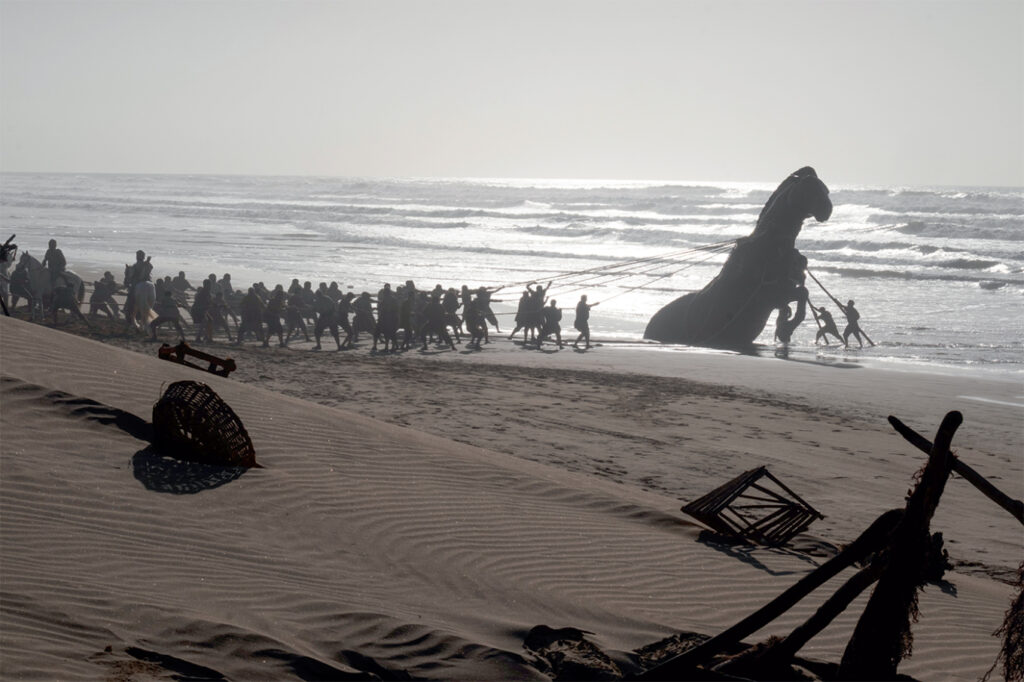
His decision to present the horse as half buried and battered by the sea is not simply a visual flourish, but a way of restoring uncertainty to the myth. Odysseus himself does not know whether the Trojans will take the bait, and it is here that the director shows just how deeply he studied the spirit of his hero. He thinks, in other words, the way Odysseus himself would have thought, working out which trick would be clever enough to overcome the Trojans’ suspicion.
Several full-size replicas of the horse were built for the different requirements of the shoot, each one standing 10 metres tall. The horse had to be big enough to hold the warriors the story required, and sturdy enough to actually be hauled across the sand. That requirement nearly derailed the entire plan, since the horse used on the beaches of Essaouira suffered heavy damage during the repeated takes.
Every time it was dragged across the dunes, the structure took further punishment, much to the distress of production designer Ruth De Jong. She recalls that the joke on set was that the horse should have been built like a cat, because it would need seven lives to survive. “It was falling apart in front of our eyes, and it genuinely pained me to watch,” she has said, adding that it nonetheless held together until the end of the shoot.
It is a story that, in many ways, sums up the entire philosophy of the production. The fact that the horse was genuinely wearing down was not treated as an accident to be hidden, but as part of the truth the camera was after. The sand, the seawater and the strain of the ropes left marks on it that no digital filter could ever recreate. The horse looks battered because it genuinely went through everything the audience sees on screen. That same commitment to physical authenticity ran through every part of the design.
Matt Damon has said he truly understood what it meant to be Odysseus when he had to face the rough seas of the Mediterranean. It is precisely this that sets Nolan’s Odyssey apart from a merely impressive production and turns it into a wager: whether something on this colossal scale can still feel human, whether, among 2,000 extras, the audience can still feel the dust on the skin of a single, specific soldier.
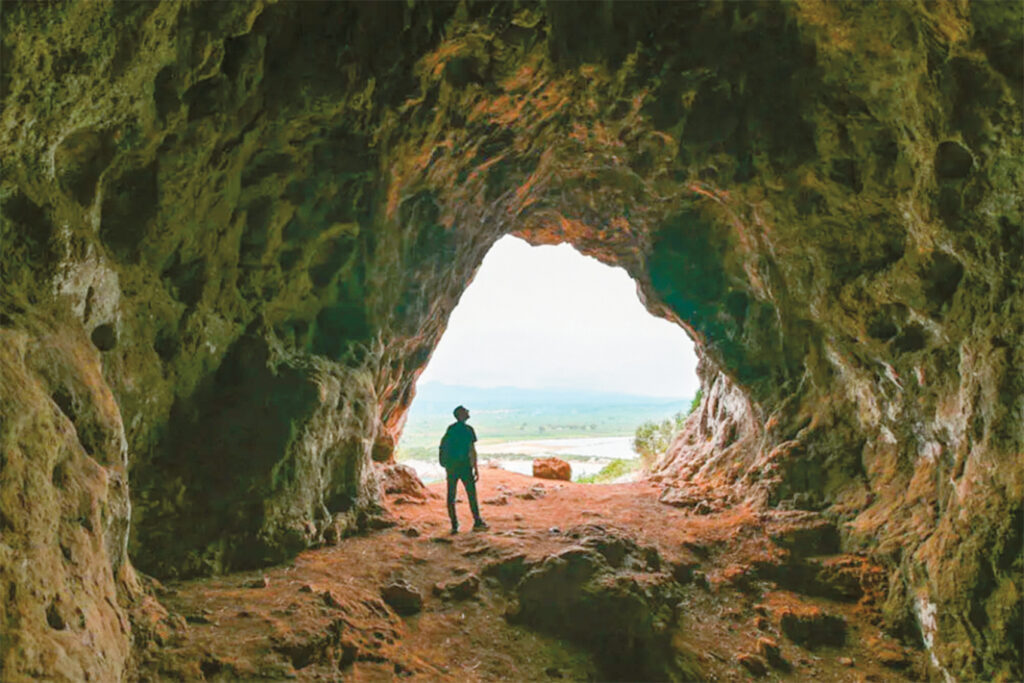
Nestor’s Cave
The same commitment shaped the production’s choice of real locations tied directly to Greek mythology. For Odysseus’s encounter with the Cyclops, the production chose Nestor’s Cave. Filming there was not easy, but it was as close as one could get to what people imagine the Cyclops’s cave to look like. Local tradition around the site, which has been inhabited since the Neolithic period, also links it to the myth in which Hermes hid the cattle he had stolen from Apollo.
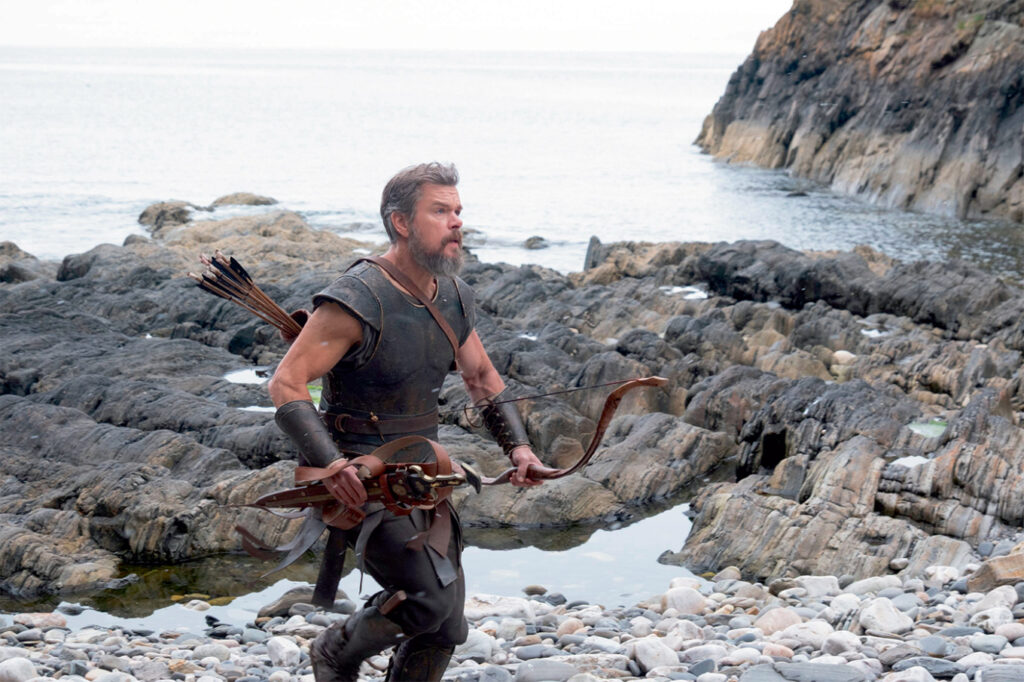
Iceland’s Hades
For the Underworld, Nolan travelled as far as possible from Ithaca. The scenes of Odysseus’s descent into Hades were filmed in Iceland in June, under the strange light of the midnight sun, in a landscape battered by wind and hostile to human presence.
“I knew very early on that the Icelandic landscape would be the ideal setting for Hades,” the director has said, describing how he chooses locations as dramatic tools in their own right. Geography takes on psychological weight in the film, much as it does in Homer, where every place is at once a physical obstacle and a test of the hero’s inner world.
Odysseus and Athena, location: Iceland. Christopher Nolan gives direction as the IMAX camera captures a dialogue scene between Odysseus and Athena (Matt Damon and Zendaya)
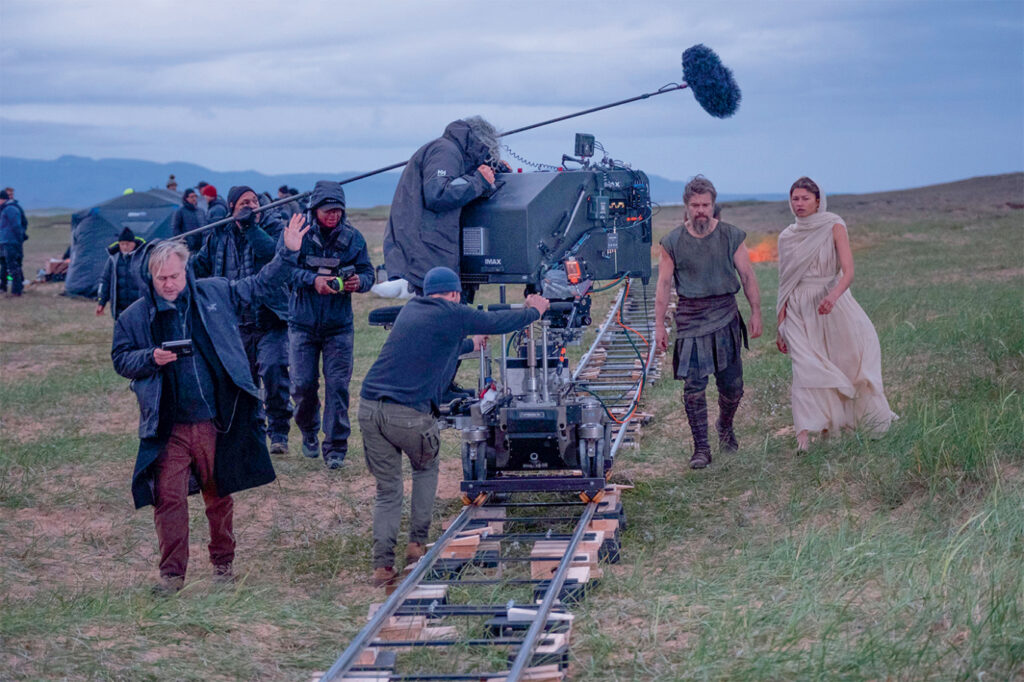
Why Nolan insists on IMAX
If the Trojan Horse is the most recognisable story behind the shoot, IMAX technology represents the production’s deeper technical and artistic gamble. The Odyssey is the first feature film ever shot entirely on IMAX cameras, fulfilling an ambition Nolan has held since he was 16 years old.
The director’s relationship with the format began during visits to the Science Museum in London. Since The Dark Knight, he had used IMAX cameras for selected scenes. This time, he pushed the format’s limits further alongside cinematographer Hoyte van Hoytema. “We were always the ones testing out whatever was new that IMAX had to offer,” Nolan has said.
Why does this technology matter so much to him? IMAX offers extremely high resolution, enormous depth and an image that, when projected at the appropriate scale, does not simply get watched but envelops the viewer. The camera captures a level of detail that can reveal the sheer scale of a landscape or a monumental set, as well as the smallest shift in an actor’s expression.
That same unforgiving precision is exactly what makes IMAX so well suited to Nolan’s aesthetic, and also so demanding. When every stitch, every seam and every flaw can be seen clearly, nothing can be treated as secondary. Sets have to withstand close scrutiny, costumes have to look authentic, and make-up has to remain invisible even in the tightest close-ups.
The biggest obstacle, however, was sound. Traditional IMAX cameras are extremely loud in operation, which for years made them almost impossible to use in dialogue scenes. The Odyssey became the catalyst for new technology, most notably a soundproofing system called The Blimp, which allowed the cameras to be used even in the film’s most emotionally sensitive scenes.
The toughest test came roughly halfway through the shoot, in a lengthy dialogue scene between Matt Damon and Anne Hathaway set in the palace of Ithaca. According to van Hoytema, whether that scene succeeded would determine whether the production could genuinely complete the entire film on IMAX.
Fortunately, the test succeeded, meaning the crew could reload film with almost ritual precision and in complete silence. When they left for the international leg of the shoot, they took no other camera with them. The production used both classic IMAX cameras and the new IMAX Keighley film camera, which incorporates carbon fibre components similar to those used in Formula 1 cars.
In total, the production used around 640 kilometres of film, a length greater than the distance between Toronto and New York. Those figures are striking, but the point is not technological showmanship. For Nolan, IMAX is a way of restoring to cinema a sense of wonder, the certainty that what audiences are watching genuinely happened, if only for a few seconds, in front of the lens.
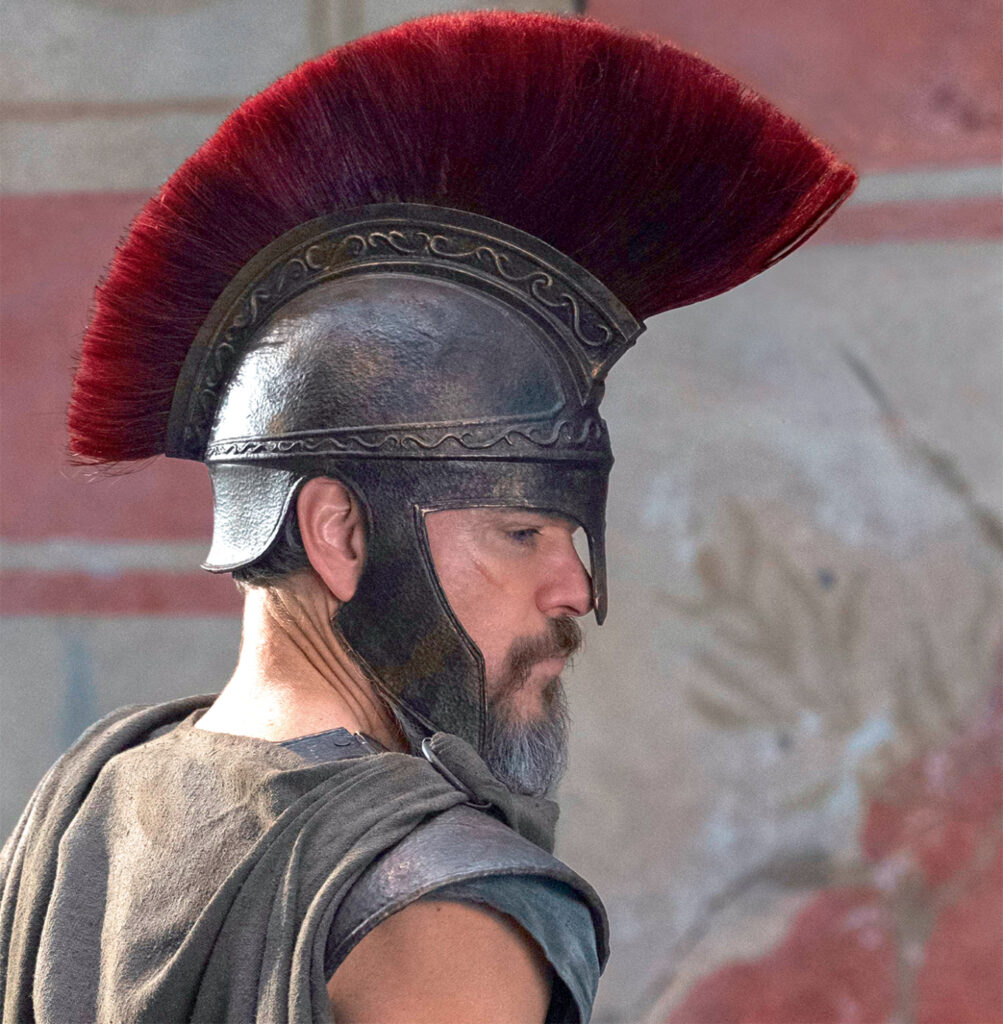
A return to hands-on filmmaking
This links directly to Nolan’s absolute commitment to the craft of cinema. As he has said, he never forgets that film won over audiences precisely because everything was created in front of the camera rather than on a computer. With the rise of digital effects, part of that experience was lost. The image may have become limitless, but it also became less dangerous, less unpredictable and, perhaps, less tangible.
Nolan’s aim was to combine whatever technology could offer him to render the truly fantastical elements of the story, not to replace everything that can be built, burned, transported or filmed in a real location.
And this is exactly where the great paradox of The Odyssey lies: the most cutting-edge technology is being used to return cinema to an older, almost primal state, one in which the image draws its power from the physical existence of things in front of the lens. Audiences may never know that 15 olive trees were lifted in by crane, that the Trojan Horse nearly fell apart, or that suits of armour were being repaired between takes, but that knowledge is embedded in the image itself, as a sense of weight, exhaustion and truth.
Nolan as the cunning strategist
Which is why the most interesting secret behind the shoot has nothing to do with the Trojan Horse or the IMAX cameras, but with the way the director gradually came to resemble his own hero. Odysseus does not prevail because he is the strongest of the warriors, but because he turns every obstacle into a problem to be solved, adapting and finding solutions that others cannot see.
In much the same way, Nolan treated every difficulty in the production as an opportunity for invention. When the traditional image of the Trojan Horse did not feel convincing enough, he rethought the trick from scratch. When IMAX technology could not be used across an entire film because of the noise, he helped push it forward. When Troy risked becoming just another digital set, he built it in a real place. When Hades needed to take physical form, he travelled north, into the cold and the midnight light.
Just as the ancient rhapsodes reshaped the Odyssey each time for their audience, adapting the language and emphasising different elements, Nolan has remade the epic for a contemporary audience, refusing to settle for simply illustrating Homer. In doing so, he seems to draw on the same cunning, resourceful methods as Odysseus himself, proving that the most technologically ambitious film of his career ultimately rests on one of the oldest human skills of all: the art of invention.
Ask me anything
Explore related questions




