





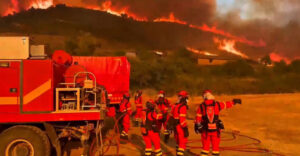
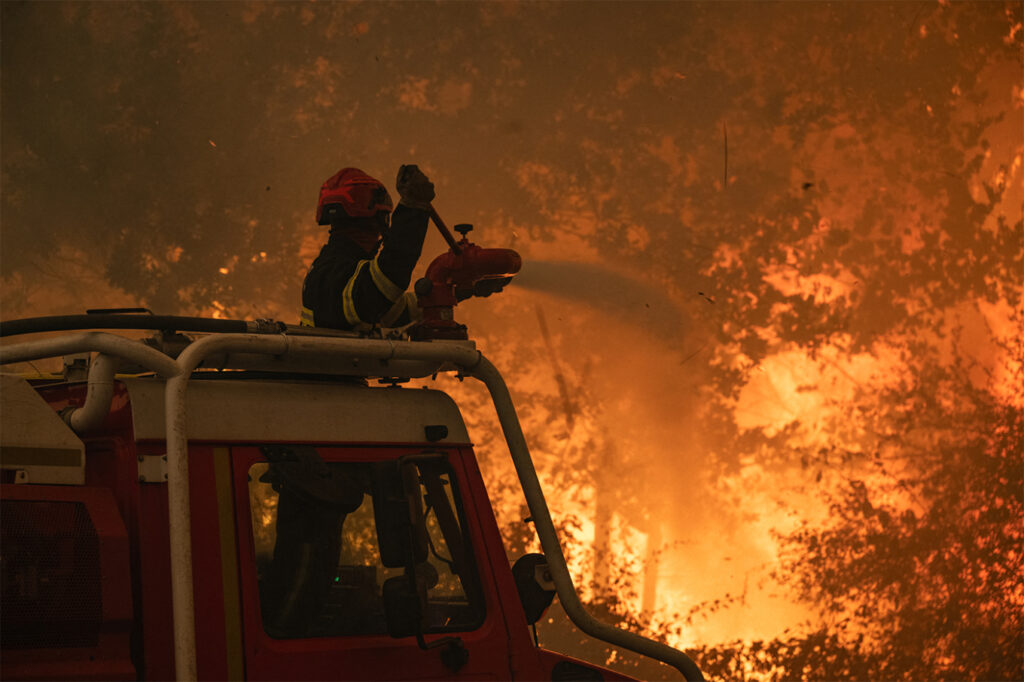
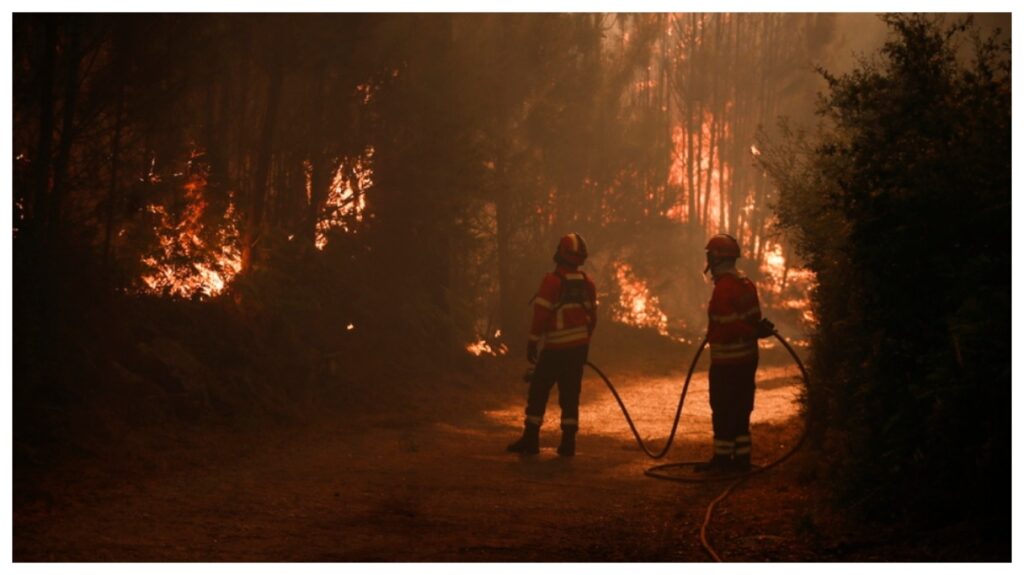
In a forest near Cap Ferret, west of Bordeaux, Mathieu Jomain directs his crews as they blast jets of water into the undergrowth. Thick grey smoke hangs low over the forest floor.
Jomain, a fire commander with the Gironde fire service, was deployed to the area last week and quickly realised this was no ordinary blaze. The fire was spreading at extraordinary speed, constantly shifting direction and intensity.
Last Friday night, as his team moved between the upmarket resort town of Cap Ferret and Bordeaux, they were caught out by a wall of flame and had to fight their way clear, Bloomberg reports.
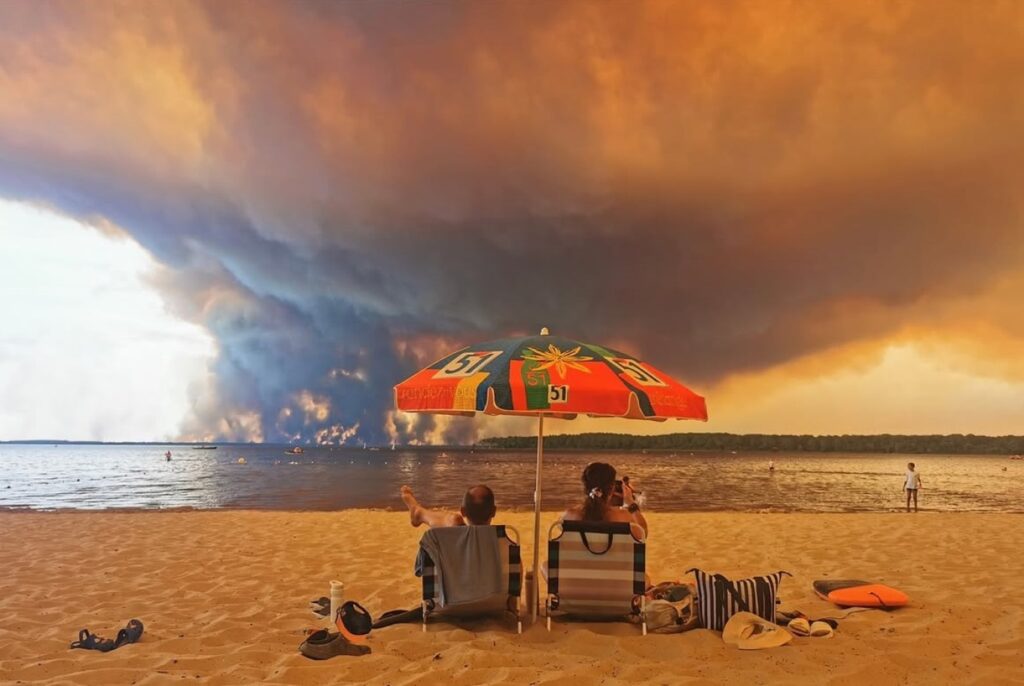
“This is a war against wildfires,” he said. “I’ve been a firefighter for 26 years and I’ve never seen fires of this scale.”
The Gironde fire broke out on 22 July and spread with unprecedented speed, tearing through forests and farmland. It burned around 420 square kilometres and destroyed roughly 200 homes.
It grew so large that it began to influence weather conditions themselves, generating its own fire tornadoes.
More than 220,000 people were evacuated as firefighters battled to contain the flames and stop them reaching Bordeaux’s western suburbs.
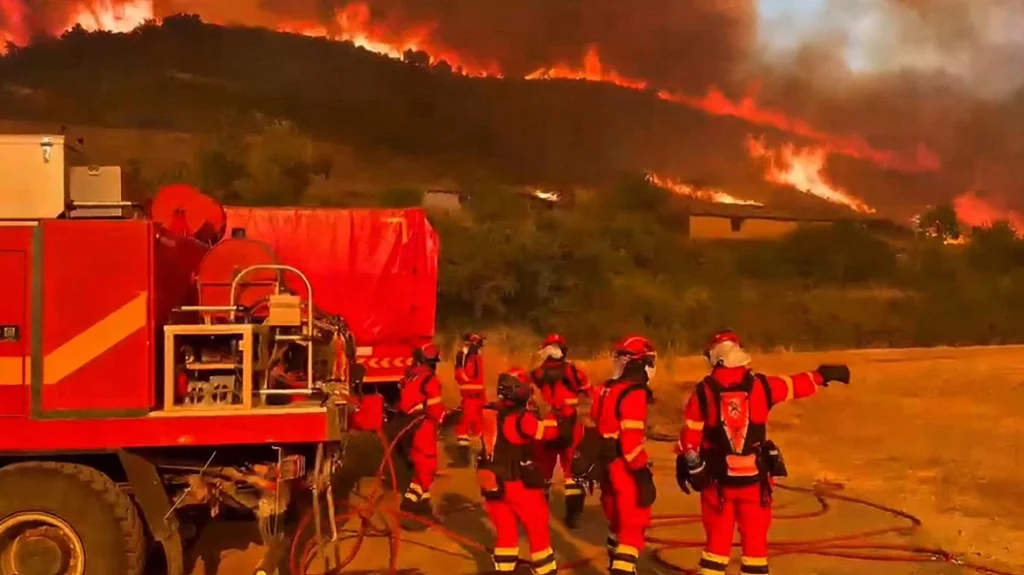
Around the same time, two separate fires broke out in rural areas west and southwest of Madrid. They merged into one over the past weekend, forcing tens of thousands of people to abandon their homes.
In the UK, authorities declared a major incident as fire crews tackled a blaze near the Sizewell B nuclear power station.
Meanwhile Greece, Portugal, Italy and Albania are also fighting large wildfires, the result of four consecutive heatwaves that have turned the landscape into tinder. A wet winter that drove excessive vegetation growth, strong winds fanning the flames, and the abandonment of farmland leaving fields uncultivated have all compounded the problem.
Another heatwave is already under way, and meteorologists say much of Europe is unlikely to get relief before the rains of late autumn or early winter arrive. The fire risk is spreading further north and east, putting even cities such as London and Paris on alert.
Climate change has made these “fire weather” conditions more frequent and more extreme. Europe is warming faster than any other continent, meaning fires on the scale of the Gironde blaze could become the new normal, straining firefighting capacity to its limits and threatening urban areas and critical infrastructure, with huge knock on costs for businesses, communities and economies.
“It’s not a question of money. It’s not a question of investment. It’s not a question of how heroic the firefighters are,” said climate researcher Raul Cordero Carrasco of the University of Groningen. “You simply cannot stop a fire when conditions are as extreme as those we’ve seen in Europe over the past few days.”
Carlos Bravo and his family run the beachside bar Chiringuito El Serengueti on Lake San Juan, a popular summer destination often dubbed “Madrid’s beach”. When he saw the flames approaching last Thursday, he called the emergency services. He was told they could not come and that he needed to evacuate.
“At first I didn’t believe it. I stayed until the last minute because I thought someone would come, the firefighters, the police, someone. But then the fire started closing in around me,” he said.
“That’s when I got in the car and left, because I realised it was true: nobody was coming.”
He later learned that fire crews had been unable to reach him because they were tied up fighting fires in neighbouring areas already engulfed in flames. The blaze destroyed the lakefront at San Juan, wiping out restaurants, boats and campsites and leaving only ruins behind. His bar was completely destroyed.
Emergency services set up an operations centre in the village of Navalonguilla, two hours west of Madrid.
They described a fire behaving with extreme unpredictability. Firefighters faced winds of 50 kilometres an hour, while helicopter pilots found that winds near the ground were blowing in a different direction from those at higher altitude. Flames reached heights of 40 to 50 metres.
At one point the fire was advancing at around five kilometres an hour. Firefighters were shocked to see the flames tear through well maintained land and abandoned properties alike, even so called “mosaic landscapes”, a patchwork of forest, farmland, vineyards and pasture that normally acts as a natural barrier against large fires.
Firefighters also reported witnessing two pyrocumulonimbus eruptions, storm clouds generated by the fires themselves when extreme heat forces hot air and water vapour high into the atmosphere, triggering their own storms. When these clouds collapse, they set off blasts that hurl burning debris and ash outward, while powerful gusts scatter the fire in every direction.
Experts explain that such fires typically start from a small source, a campfire or even a spark from a hunting rifle. The flames catch pine needles, dry grass or leaves on the forest floor and begin spreading through the low vegetation.
Many fires die out at this stage. But if conditions are favourable, over the following days the fire climbs into tree trunks, spreading through dead wood, pine cones and hanging vegetation until it reaches the canopy and jumps from tree to tree with growing intensity.
As more of the forest burns, the fire’s temperature rises. At this stage it creates its own microclimate, drawing in oxygen and altering wind direction. Flames can reach up to four metres in length. Beyond that point, according to scientist Theo Keeping of Imperial College London, most firefighting methods are essentially futile. The only hope is to steer the fire away from populated areas, toward a coastline or a river. “The only thing you can really do is cut firebreaks with bulldozers ahead of the front,” he said.
The risk of such extreme wildfires is rising as the climate warms. Average temperatures in Europe are already around 2.5 degrees Celsius higher than pre industrial levels, and weather patterns are shifting, with very wet winters increasingly followed by unusually hot, dry summers.
Last winter was exceptionally wet in western Europe. A drier than normal spring followed, along with a particularly hot start to summer, with June recorded as the hottest ever registered in the region. Shrubs and grasses grow vigorously through wet winters, but the drought that follows turns them into abundant fuel. Prolonged dry spells also dry out branches, trunks and trees, creating fuel for even fiercer fires. At the same time, the abandonment of the countryside and the decline of traditional farming allow vegetation to build up unchecked.
“Every time a fire breaks out there’s a chance it will get out of control, it’s like rolling dice,” said Thomas Smith, associate professor of environmental geography at the London School of Economics. “Climate change is loading the dice in favour of major wildfires, so when ignition happens, the odds of it turning into a catastrophic fire are far higher.”
The World Weather Attribution scientific group found that climate change made the weather conditions behind the French fires at least twice as likely, and around 20 times more likely in Spain.
The fire near Madrid started on 22 July in the province of Toledo and moved northeast toward the capital, where it merged with a second fire that broke out the following day. By 24 July the combined front was threatening the town of Navas del Rey.
Victor Martin, who keeps a goat farm outside the village, heard the fire before he saw it. “You could hear the pines and branches burning. It was like a raging river coming down,” he said.
Police ordered an evacuation and pressed him and his family to leave, even if it meant abandoning their animals. They initially refused. “They told me straight: either you leave or we remove you in handcuffs,” he recalled. They eventually moved their herd to safety and spent the night sleeping in their cars and in the streets of a nearby town.
After the evacuation order was lifted, Navas del Rey’s mayor, Jaime Peral, waited for residents to return.
Throughout the crisis he had fielded constant calls from people asking whether their homes had survived. The municipal team had believed the river would act as a natural barrier. Instead, the flames jumped from one bank to the other.
Around 50 homes were completely destroyed and a similar number seriously damaged. “You can count the houses,” the mayor said. “But how do you put a price on a burnt forest?”
Experts point out that wildfires are among the most destructive natural hazards. Unlike other disasters, they can wipe out entire neighbourhoods.
Insurers typically measure damage through insured losses. But much of the real loss, forests, ecosystems and public land, goes uninsured, meaning the true economic and social cost is far higher than what shows up in insurance claims.
Insurance and reinsurance firms now regard climate linked wildfires as a permanent shift in risk. As AXA chief executive Thomas Buberl put it: “We have to learn to live with the fact that these fires are going to happen more and more often. They’re now part of our everyday reality.”
Experts say it is still too early to calculate the full cost of the 2026 fire season. Forecasts suggest hot, dry conditions will persist longer than usual, particularly around the Mediterranean, while the risk gradually shifts further north, toward areas such as Paris and southeast England.
In France, although the fires ultimately did not reach the Bordeaux urban area, they have already caused significant economic damage. The finance minister described the disaster as an “economic thunderbolt”. Factories temporarily halted operations, transport was disrupted and tourism took a heavy hit.
Gironde, where tourism is a key pillar of the economy, saw thousands of visitors cancel their bookings.
Oyster farmer Denis Beluc, whose family has farmed oysters in the Arcachon basin for six generations, describes the disaster as an existential threat. The evacuations coincided with the most lucrative period of the year, wiping out a large share of the family’s income.
The picture is similar for the area’s campsites, hotels and restaurants. Business owners report mass cancellations, losses running into hundreds of thousands of euros and uncertainty over state support. Many fear several small family businesses will not survive.
In Bordeaux itself, squares and streets that are normally packed with tourists remain nearly empty. Businesses say takings feel more like winter than the height of summer.
Tourism industry representatives warn that losing the summer season could force many businesses to close for good. Despite talks with the government and banks over financial support and loan repayment deferrals, many fear help will come too late.
For many families, what’s at stake is not just money but the survival of a tradition passed down through generations. Beluc says he hopes his son will carry on the family business, even knowing that such disasters will only become more frequent.
“We have to carry on,” he concludes. “With climate change, we know disasters like this will happen again. Even so, we have to keep moving forward.”
Ask me anything
Explore related questions




