





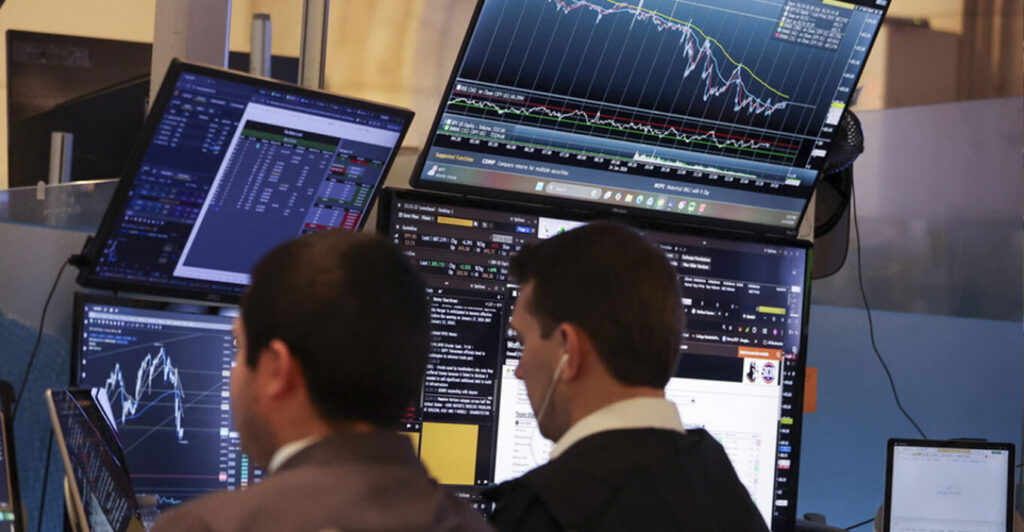
Democratic control of Congress fuels gains in banking, healthcare and clean energy, while Musk-linked companies and data centre operators face heavy selling.
Wall Street staged a powerful rally on Wednesday, with the Dow Jones Industrial Average climbing more than 1,000 points as investors welcomed the Democrats‘ sweeping victory in the US midterm elections and the prospect of new constraints on US President Donald Trump’s economic agenda.
The market’s sharp rebound, following early losses, reflected expectations that a Democrat-controlled Congress would make it harder for the White House to pursue major policy changes, potentially easing uncertainty over taxation, tariffs and government spending.
The Dow rose 1,005.68 points, or 1.94%, to 52,792.40, while the S&P 500 advanced 1.29% to 7,666.82. The technology-heavy Nasdaq gained 1.14% to 25,661.29, although losses among artificial intelligence and data centre companies limited its advance.
Why investors are welcoming the Democrats’ victory
The Democrats’ capture of both the House of Representatives and the Senate, including unexpected victories in traditionally Republican strongholds, has dramatically altered the political landscape in Washington.
The result represents a major setback for Trump, whose second term has been dominated by sweeping tax measures, aggressive trade tariffs and the US-Israeli war against Iran.
Trump acknowledged that the conflict with Iran contributed to his party’s defeat and indicated that he would accept the election outcome. He also signalled a willingness to work with Democrats, helping reassure investors concerned about a prolonged political confrontation.
Markets appear to be betting that divided government will curb the administration’s ability to implement substantial legislative changes over the remaining two years of Trump’s presidency.
With Democrats controlling Congress but Republicans retaining the White House, major new initiatives could face substantial obstacles, potentially reducing the risk of sudden shifts in economic policy.
That expectation has encouraged investors to move beyond the technology companies that have dominated market gains in recent years and increase exposure to businesses more closely tied to the wider US economy.
Banks, healthcare and renewable energy lead gains
Financial stocks were among the beneficiaries of the broad market recovery, with Bank of America rising 1.9%.
Retail giant Walmart gained 2%, reflecting renewed interest in companies exposed to domestic consumer spending.
Several major technology groups also advanced. Amazon climbed 3.7%, while Meta Platforms and Alphabet recorded more modest gains.
Healthcare companies performed particularly strongly as investors anticipated a more favourable legislative environment for insurers and hospital operators under the new congressional leadership.
UnitedHealth rose 1.4%, Molina Healthcare jumped 6.3%, Centene advanced 4.7% and HCA Healthcare gained 1.44%.
Renewable energy stocks were another major beneficiary of the election outcome.
Investors expect Democratic control of Congress to strengthen efforts to preserve federal support for clean energy investment, particularly after the Trump administration’s attempts to scale back incentives for the sector.
The Invesco Solar ETF climbed approximately 5%, reflecting renewed confidence in the prospects for solar power and other renewable technologies.
Musk’s companies and Trump Media suffer heavy losses
The political shift proved much less favourable for businesses closely associated with Trump and his allies.
Elon Musk’s companies came under considerable pressure after the billionaire spent almost $500 million supporting Republican candidates, including efforts to preserve Republican control in Texas.
SpaceX shares fell 6.5%, while Tesla declined 4.7%, as investors reassessed the potential consequences of the Democrats’ victories for companies linked to the president’s political network.
Trump Media & Technology Group, the parent company of the Truth Social platform, suffered an even steeper decline of 11%.
Trump holds a 41% stake in the business, which has frequently traded as a barometer of investor sentiment towards the president and his political fortunes.
The losses highlighted a sharp divide between companies expected to benefit from greater congressional oversight and those whose valuations have been supported partly by expectations of favourable treatment under the Trump administration.
AI stocks hit by fears of tougher data centre restrictions
One of the most significant market reactions occurred among companies involved in building and operating artificial intelligence infrastructure.
The Democrats’ victories at both federal and state level have raised concerns that new restrictions could slow the rapid expansion of data centres across the United States.
Particular attention has focused on Texas, where Democrat Gina Hinojosa defeated Republican Governor Greg Abbott after campaigning on a pledge to impose an immediate temporary moratorium on new data centre developments.
The result has heightened uncertainty for an industry that has committed enormous sums to expanding computing capacity to meet growing demand for AI services.
Goldman Sachs warned that Democratic victories in state and local elections could result in temporary suspensions of data centre construction projects, potentially affecting approximately 45% of planned capacity expansion across the US.
Texas and Georgia are especially exposed because both states have attracted substantial investment in large-scale facilities.
Their rapid development has also generated growing opposition from communities concerned about electricity demand, water consumption and the impact on local infrastructure.
Shares in IREN, Hut 8, Applied Digital and Core Scientific dropped between 5.2% and 10%.
CoreWeave declined 8%, Nebius lost 6% and Oracle also traded lower.
The political concerns have emerged at an already difficult moment for the AI investment boom, with investors increasingly questioning whether the extraordinary capital expenditure planned by technology companies will generate sufficient financial returns.
Nvidia and chipmakers struggle despite AMD’s outlook
Semiconductor stocks also faced selling pressure, even as some companies continued to report strong demand for AI-related products.
AMD traded close to its previous closing level, surrendering much of its earlier pre-market advance despite an optimistic forecast for faster-than-expected growth in 2027.
The company’s outlook was supported by expectations of rising sales of chips and other products used in data centres.
Nvidia fell 1.2%, while Marvell Technology, Intel and Micron Technology also registered declines.
The mixed performance illustrated the growing distinction investors are drawing between the long-term commercial potential of artificial intelligence and the immediate financial and regulatory risks associated with developing the necessary infrastructure.
Defence contractors were another group to suffer from the election outcome.
Shares in Northrop Grumman, RTX and Lockheed Martin fell sharply amid expectations that the Democratic majority in Congress could complicate Trump’s efforts to secure approval for a proposed $1.5 trillion defence budget.
McDonald’s and Block rise on earnings
Corporate earnings provided further support to selected stocks.
McDonald’s shares gained approximately 2% after the fast-food group reported adjusted earnings of $3.57 per share, beating analysts’ expectations of $3.38.
Revenue of $7.16 billion, however, fell short of the anticipated $7.29 billion.
Payments company Block surged 9.7% after raising its full-year gross profit forecast, offering investors another positive development outside the sectors most directly affected by the election result.
US private sector adds 86,000 jobs in October
Investors were also assessing fresh evidence of resilience in the US labour market.
Private employers created 86,000 jobs in October, according to payroll processor ADP, exceeding expectations and matching September’s revised figure.
Hiring gains were recorded across several sectors, suggesting that employment conditions may be stabilising despite months of relatively subdued recruitment.
The trade, transport and utilities sector added 39,000 jobs, while education and healthcare contributed another 28,000.
The figures offered some reassurance about the health of the world’s largest economy, although employment growth remains considerably weaker than in previous years.
The ADP release comes ahead of the government’s broader employment report, which will provide a more comprehensive assessment of labour market conditions.
Dollar weakens and Treasury yields fall
The election results also triggered substantial movements across currency and bond markets.
The US dollar recorded its sharpest daily decline since September, losing ground against all major currencies as investors reassessed the outlook for American fiscal policy.
The benchmark 10-year Treasury yield fell four basis points to 4.93%, reflecting expectations that a Democratic-controlled Congress could constrain government spending and reduce future borrowing requirements.
The Treasury yield curve steepened after the US Treasury Department announced that it would maintain the size of its scheduled debt auctions over the coming weeks.
Oil prices also retreated after Trump indicated that he had no immediate plans to launch further attacks against Iran.
The remarks eased some concerns about an escalation of the conflict and its potential impact on global energy supplies.
For Wall Street, the combination of falling bond yields, a weaker dollar and stronger equity prices points to a significant reassessment of the economic outlook following the elections.
The rally suggests that investors see opportunities in a Washington where presidential power faces stronger institutional constraints.
Yet the contrasting performance of different sectors also reveals the potential costs of the political transition, particularly for AI infrastructure, defence contractors and businesses closely associated with Trump.
The central question for markets is whether the prospect of greater political stability will be enough to sustain the rally as investors turn their attention back to corporate profits, interest rates and the strength of the US economy.
Ask me anything
Explore related questions