





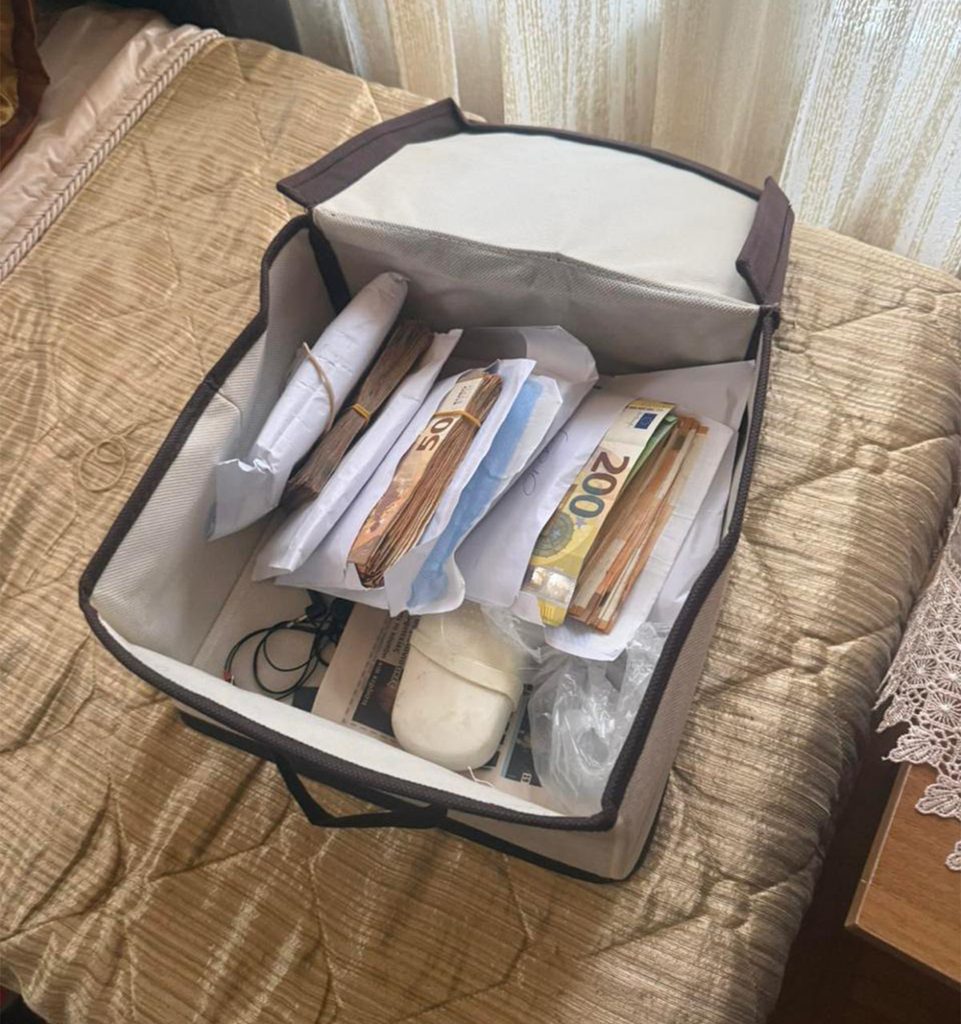
Revealing conversations between members of an alleged corruption ring operating within the planning department in Katerini, northern Greece, have shed light on how building permits were reportedly issued in exchange for illegal payments.
Eleven people have been arrested by officers from the Hellenic Police Internal Affairs Directorate, while a further 64 individuals are named in the case file.
The investigation has uncovered conversations between private engineers and planning officials discussing payments of thousands of euros to secure permits and legalise unauthorised buildings, including structures that did not meet the legal requirements.

‘They’re all a gang’
One particularly revealing conversation took place between two private engineers discussing a permit to complete an illegally constructed building. The permit had allegedly been issued in violation of planning regulations because the property was built after 2011.
According to investigators, the department’s director and a female employee received an unlawful payment of €5,000 to approve the permit.
During the conversation, one of the engineers explicitly described the existence of an organised corruption network within the Katerini planning department, declaring: “They’re all a gang.”
The following exchange was recorded:
Engineer 1: Who issues those, M.?
Engineer 2: M. and S. did it, you know, in Poroi or in, in…
Engineer 1: Well, they’re all a gang.
Engineer 2: In Platamonas.
Engineer 1: You’ve also got a permit that had…
Engineer 2: They did it in Platamonas.
Engineer 1: …from one of my clients.
Engineer 2: I obviously wouldn’t have issued it because it was one of those cases where you can’t get a permit to complete an unauthorised building… (…) because the unauthorised building wasn’t there before 2011. Anyway, he took it on, no problem at all. I transferred the unauthorised construction declaration to him as well so he could add the extra floor… And they assigned it, even though they’d arranged everything between themselves, they assigned it to M. instead of letting M. take it. And he issues it, and M. goes and looks at it with M. And M. tells her, “No, this permit can’t be issued”, because she didn’t want to lose the money she was going to get… (…) And M. raises an objection, saying it can’t be done because there’s no load-bearing structure. Afterwards I tell her, why are you getting involved? You’re going to get yourself into trouble. (…) She says, “That’s what S. and M. told me, that it has to have one. Why are they assigning these things to me?”
Engineer 1: And she registers it again, and they assign it to M… (…) and M. gets the five thousand euros. I don’t know how they split it between themselves.
‘Seven for you, seven for me’
Another conversation, between the accused department director and a private engineer, allegedly captures an agreement under which the official would receive €7,000 to facilitate the legalisation of unauthorised construction work.
The engineer describes a property involving construction far beyond what could legally be authorised through a small-scale building permit, before suggesting a payment arrangement.
Engineer: S.?
Director: Yeah.
Engineer: There’s a case which, er, is worth more than a hundred grand.
Director: What sort of case is it? (Inaudible).
Engineer: Here we need (inaudible) and we’ve got (inaudible) a small-scale permit, ten square metres. It might not even be that, and he’s built two hundred and fifty. On a plot that’s just under, just under, just under two stremmas [approximately 2,000 square metres]. Just under.
Director: What do you mean, small-scale permit? (Inaudible).
Engineer: (Inaudible).
Director: Yes.
Engineer: For the small-scale permit, he’ll pay whatever it takes to get it done, (inaudible) whatever’s needed? Two thousand seven hundred, and he’s built two hundred and fifty, one excellent, very beautiful building, very beautiful, ground floor.
Director: Well, that’s not small-scale construction now.
Engineer: No, mate, (inaudible) it’s completely illegal. How can it cover the whole plot? (Inaudible). I’ll tell him. (Inaudible). Seven for you, seven for me. (Inaudible).
Director: What can I say? How?
Engineer: Think about it, er, think about it and I’ll think about it too and we’ll (inaudible). Think about it. (…) Sort it out, I’ll think about it too, do (inaudible). (…) Don’t you remember when we did the other one? That’s why I thought of it.
Director: All right.
Engineer: Have a look at it. I’ll come by tomorrow.
According to the investigation, the exchange concerned the proposed payment of €7,000 to the planning department director in return for facilitating the regularisation of illegal building work.
‘We’ve reached five grand, have we?’
In another case, the department director allegedly demanded €5,000 to arrange for an unauthorised building to be registered and legalised under Category 5 of Greece’s planning legislation.
Category 5 covers serious planning violations, with restrictions on the circumstances in which such properties can be brought into the legalisation system.
The conversation suggests that the official was being asked to make arrangements allowing an otherwise problematic property to be entered into the electronic registration system.
Engineer: Can you make your magic phone calls for a Category 5, eh? [Referring to securing access to electronic registration and legalisation for a Category 5 unauthorised building.]
Director: Well, let me see what’s available, what’s going around.
Engineer: Final price, yes?
Director: At what price, yes, yes, okay, I’ll let you know.
Engineer: Done, done…
Director: There is one, but it’s five. [Referring to a payment of €5,000 to enable electronic registration and legalisation of a Category 5 unauthorised building.]
Engineer: Five grand, eh? We’ve reached five grand.
Director: Yes, yes, yes. Even D. had told me it was going up to six, seven, yes, yes.
The exchange is among the conversations investigators are examining as evidence of an alleged system in which officials and private engineers arranged payments to overcome planning restrictions.
Cash hidden in envelopes, diaries and courier parcels
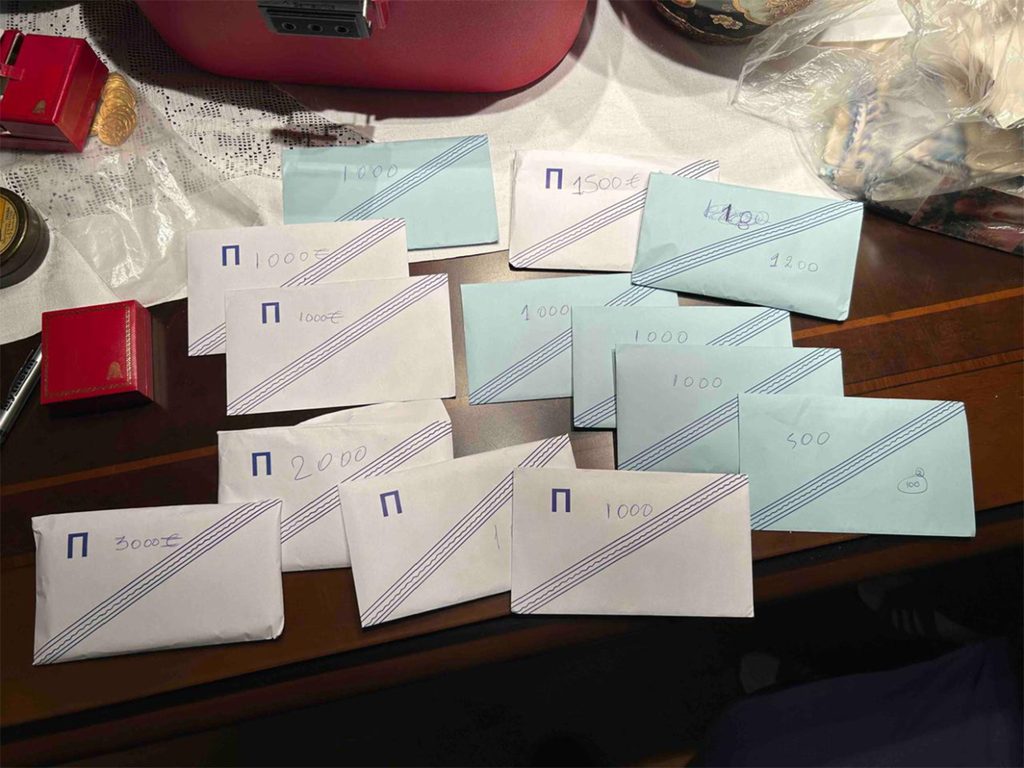
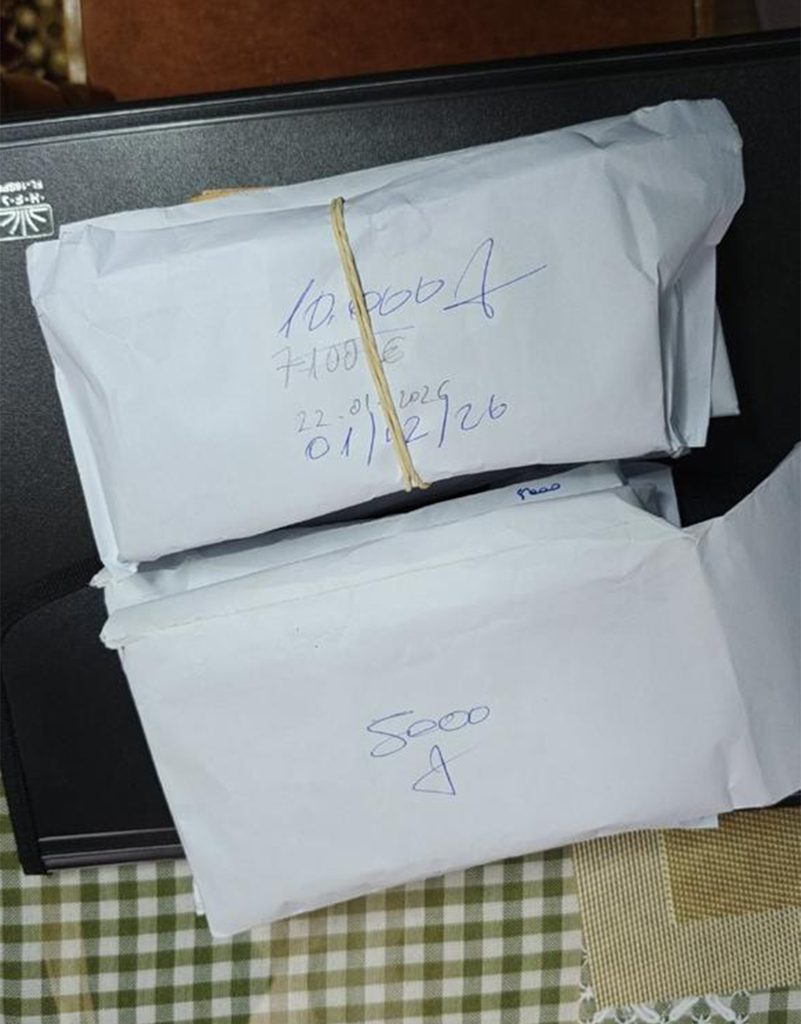
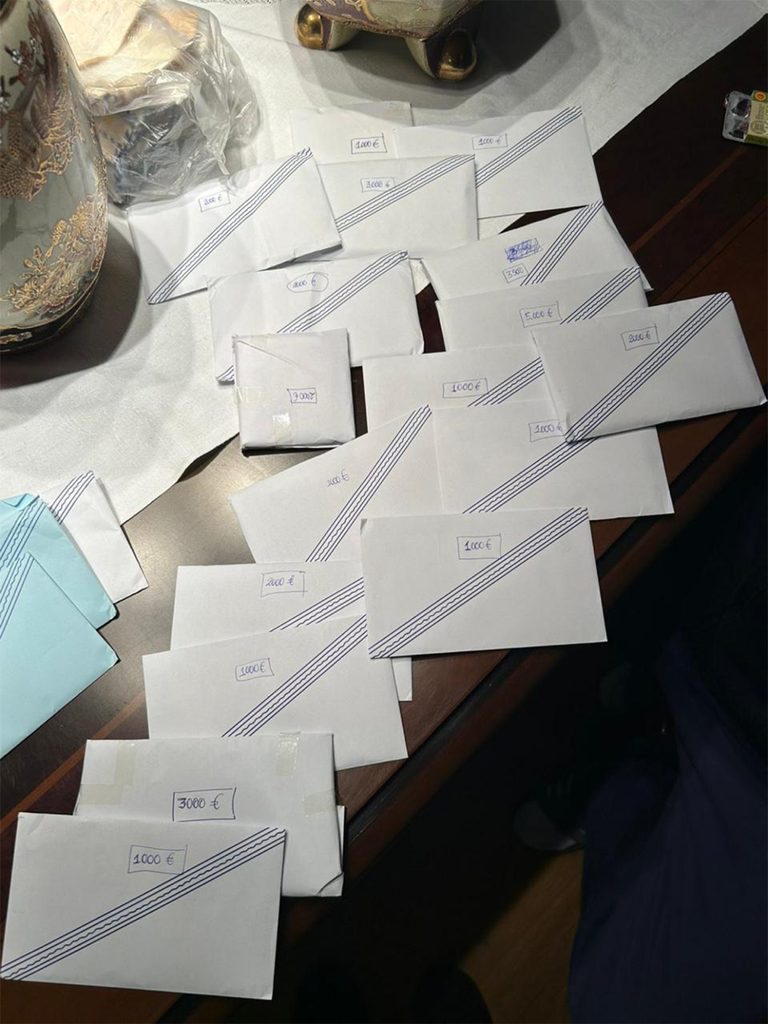
Photographs obtained during the investigation also show envelopes containing money allegedly collected by members of the organisation from their clients.
According to evidence gathered by the Hellenic Police Internal Affairs Directorate, illegal payments were concealed inside envelopes, diaries and other everyday objects to avoid attracting attention.
In some cases, the money was allegedly delivered through intermediaries rather than handed directly to the officials involved.
Investigators also identified instances in which parcels containing money were sent through courier companies, sometimes addressed to relatives of those allegedly receiving the payments.
The use of relatives as recipients was reportedly intended to prevent an obvious connection between the money transfers and the individuals involved in the suspected corruption scheme.
Members of the alleged network are also believed to have used hand gestures and coded expressions when communicating with one another, seeking to conceal the true purpose of their dealings.
Private engineers involved in the arrangements allegedly disguised the illegal payments as legitimate fees for technical services.
These methods, according to investigators, formed part of a broader effort to conceal the flow of money and facilitate the issuing of building permits or the legalisation of unauthorised structures in circumstances where planning regulations would otherwise have prevented approval.
The investigation has resulted in 11 arrests, while the case file includes another 64 people suspected of involvement in the alleged activities.
Ask me anything
Explore related questions




