





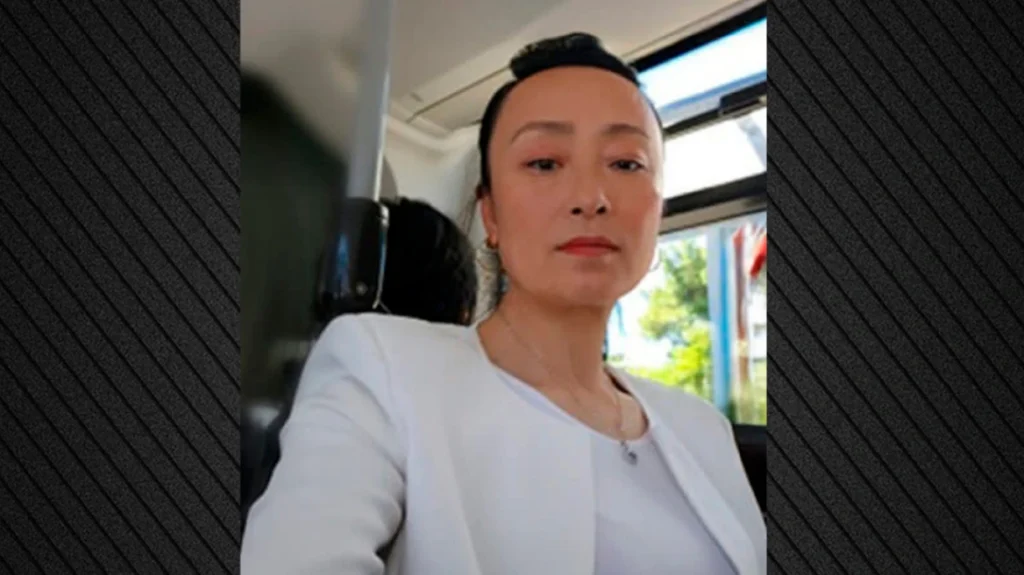
New details have emerged in the disappearance of 50-year-old Chinese translator Yu Ting, who went missing from Artemida, Attica, on 20 May 2026. The latest developments were revealed on the television programme Fos sto Tounel (Light at the End of the Tunnel). A passport bearing her photograph but a different name, a bank safe deposit box containing €100,000 in cash, and witness accounts of her business activities in Albania have added further pieces to the puzzle surrounding her disappearance.
Almost six months after her last confirmed communication, her whereabouts remain unknown, while her husband, Vassilis Karavasilis, says he is convinced that his wife is no longer alive.
Passport bearing her photograph and the name ‘Li Fang’
At the beginning of the program, an unidentified source, who requested anonymity, sent in a photograph of what was alleged to be a forged passport. The travel document bears Yu Ting’s photograph, but the personal details give a different name: ‘Li Fang’.
The date of birth and certain other personal details appear to match those of the missing woman. Of particular significance is the fact that, according to information presented on the program, the document was reportedly issued approximately one month after her disappearance.
As reported on Fos sto Tounel, checks were subsequently carried out using the available information in Greek databases and those of countries within the Schengen Area. According to the findings presented on the program, the passport number does not correspond to the name Li Fang or to any other registered individual.
Furthermore, there is no recorded entry into or exit from Greece under that name or using the document’s number.
The origin of the photograph, the identity of the sender and the reason why this particular material was passed on to the program at this stage remain unclear.
The bank safe deposit box containing €100,000
Another detail revealed concerns a bank safe deposit box held in Yu Ting’s name, in which, according to her husband, €100,000 in cash was found.
Vassilis Karavasilis said he was informed about it by the authorities investigating her disappearance. He maintained that, until then, he had known neither of the safe deposit box’s existence nor the origin of the money.
As he explained, the investigation has gradually revealed aspects of his wife’s life and activities about which he had not been informed.
The program also relayed information from a witness who reportedly has access to sensitive data, according to which another item of particular significance to the case was found in the safe deposit box. However, neither its nature nor the role it may play in the investigation was clarified.
Passport found in pieces in Galatsi
The last day on which Yu Ting was definitely seen was Wednesday, 20 May.
At 9.55 am, CCTV footage captured her leaving her home in Loutsa. She was wearing white clothing and carrying a small handbag.
Approximately an hour later, at 11.10 am, she contacted her husband via WeChat and sent him documents she had collected from the municipality. There has been no further confirmed communication with her since that moment.
On 7 September, almost four months after her disappearance, her passport was found in Galatsi Grove, destroyed and scattered in pieces.
The first fragment of the document was discovered by a man who was walking his dog in the area.
Vassilis Karavasilis returned to the location with the program’s camera crew, pointing out the area near the fire hydrants where the remains of the passport had been found.
He stressed that his wife had no apparent reason to visit that particular grove.
DNA evidence and how the document was destroyed
According to her husband’s account, laboratory testing of the passport fragments showed that they contained genetic material belonging to Yu Ting.
“I don’t know whether any other person’s DNA was also found and whether it can be identified,” he said, describing the information he claimed to have received from the forensic laboratories.
He did not rule out the possibility that the document fragments had been brought to the grove along with recyclable waste.
Questions have also been raised about the way the passport was destroyed, as it appears to have been put through a paper shredder.
Her husband questioned why someone wishing to get rid of the travel document would have chosen this method rather than burning it.
In any case, he does not consider it likely that Yu Ting herself arranged her disappearance.
Mobile phone changed hands in Attiki Square
Another significant finding concerns the 50-year-old’s mobile phone, which was located in Attiki Square on 22 July, two months after her disappearance.
According to Vassilis Karavasilis, a man of Bulgarian origin reportedly found the device and subsequently sold it to an Albanian man.
The phone was switched on and had battery power, but remained locked.
During the program, the man of Albanian origin who reportedly switched off the device and carried out a factory reset was located.
He claimed that he had never managed to gain access to the data stored on it.
The missing woman’s husband said that both men had been repeatedly summoned by the authorities to provide explanations.
Contacts in Albania and plans for a bottled water plant
The investigation has extended to Albania, where Yu Ting had established business contacts before she went missing.
With the assistance of journalist Doriela Tsule of television station Top Channel, the reporting team traveled to Kuçovë, in central Albania.
There, they spoke to a businessman who owns a hotel and had met Yu Ting through his cousin, who works as a real estate agent in Greece.
The two sides had discussed various potential business partnerships, including an investment in a bottled water production plant.
Approximately one month before her disappearance, the 50-year-old had visited the hotel accompanied by her mother-in-law and a Chinese investor to assess the project’s prospects.
The hotel owner also said that Yu Ting had introduced him to two fellow Chinese nationals, a man and a woman, who were expected to work as chefs at the hotel. However, neither of them eventually turned up to take up the positions.
Referring to his contacts with the Albanian authorities over the case, he said: “I’ve told the lawyer. I’ve told the police. I’ve told the intelligence services too. They came as well.”
His reference to Albania’s intelligence services provided another detail in his account, although the reasons for their alleged interest in the case have not been clarified.
Trip to China and Albanian residence permit
The businessman had previously described the friendly relationship he had developed with Yu Ting. As he said, they had traveled together to China for ten days, while also exploring potential business partnerships.
He also made particular reference to her wish to obtain a residence permit in Albania, despite already holding an equivalent document in Greece.
“I asked her why she wanted an Albanian residence permit when she already had a Greek one, and she replied, ‘I want to have both’,” he said.
He insisted that he did not know what had happened to the 50-year-old and that their relationship had not been close enough for him to know about all her activities. His wife, meanwhile, expressed her hope that the missing woman would be found alive.
Findings from the investigations in Bogovë and Korçë
The journalistic investigation continued in Bogovë, central Albania, where the team looked into information that a Chinese businesswoman was planning to invest in a bottled water production plant.
A local worker confirmed that discussions about such an investment had taken place.
“These discussions about the investment have been going on for four to five months,” he said.
When shown a photograph of Yu Ting, he clarified that he had never met her and therefore could not confirm that she was the person connected with the investment plan.
The team also traveled to Korçë, following information suggesting that the missing woman may have contacted an apple-packaging business in August, several months after her disappearance.
The business owner refused to meet the journalists, claiming that he did not know Yu Ting and did not employ anyone of Chinese origin.
This particular information could not be verified.
Why her husband rules out the possibility that she is in Albania
Despite the business contacts Yu Ting appears to have maintained in the neighbouring country, Vassilis Karavasilis does not believe that his wife voluntarily left Greece to settle there.
As he explained, her work permit was inside the bag she was carrying on the day she disappeared, and that bag has never been found.
He also pointed out that she would have needed her passport to cross the border and enter Albania. That passport was subsequently discovered, destroyed, in Galatsi Grove. He believes the scenario of her voluntarily travelling to Albania makes little sense.
The appearance of the allegedly forged passport, the unexplained origin of the money reportedly found in the safe deposit box, the destruction of her genuine passport and the trail of her mobile phone have now emerged as separate elements in a case that still lacks the most important answer: what happened to Yu Ting after 11.10 am on 20 May?
Ask me anything
Explore related questions




