





Stories about mysterious creatures that delve into the depths of the seas never cease to amaze us. There are many accounts of strange carcasses washing up on shores around the world.
Some of them are easy to identify and have been explained by science, but some of them are weirder and don’t have any recognizable body parts. The second kind of carcass is called a “globster,” and it is defined as an unknown organic mass that washes up on the shoreline of an ocean or another body of water.
The term was coined by biologist and writer Ivan T. Sanderson in 1962. Because of their state of decay, globsters have always been a matter of controversy. People have connected them with all sorts of mythical creatures and monsters.
One such globster was found on the shores of Stronsay in the Orkney Islands, Scotland, on 25 September 1808, after a very stormy night. Stories about creatures appearing on the coast of the Orkney Islands are nothing new.
There is an abundance of well-documented strange creature sightings from the islands and many of them are part of the lore of the area. One of the most famous stories is the one about the Stronsay Monster.
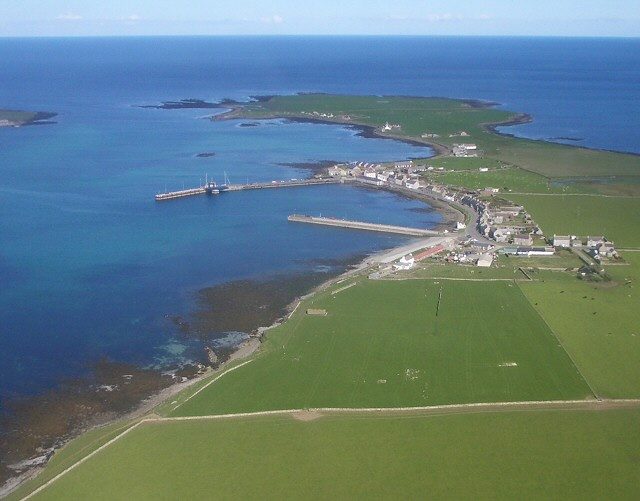
(An aerial view of Whitehall, with Grice Ness at the end of Stronsay’s north-eastern peninsula)
On the morning of 25 September 1808, a local fisherman called John Peace was fishing just off the coast at Rothiesholm Head, in the southeast of the island of Stronsay. When he looked at the shore, he noticed some seabirds gathering around what appeared to be an animal carcass lying on the rocks. John was intrigued and rowed his boat closer to the shore.
George Sherar, another local, was also present in the vicinity and observed John. When he was close enough, Peace saw the remains of something that he had never encountered before.
The “animal” was big, with a serpent-like body, long neck, and three pairs of legs. This was the first one of a series of similar “beastly” carcasses found on the shores of Stronsay.
The carcass that John found was in a place that is hard to reach because of the rocks and waves. Ten days later, the high winds typical for this parts, brought the remains of the beast ashore. This time, they were found by George Sherar, the other witness that was present at the first sighting.

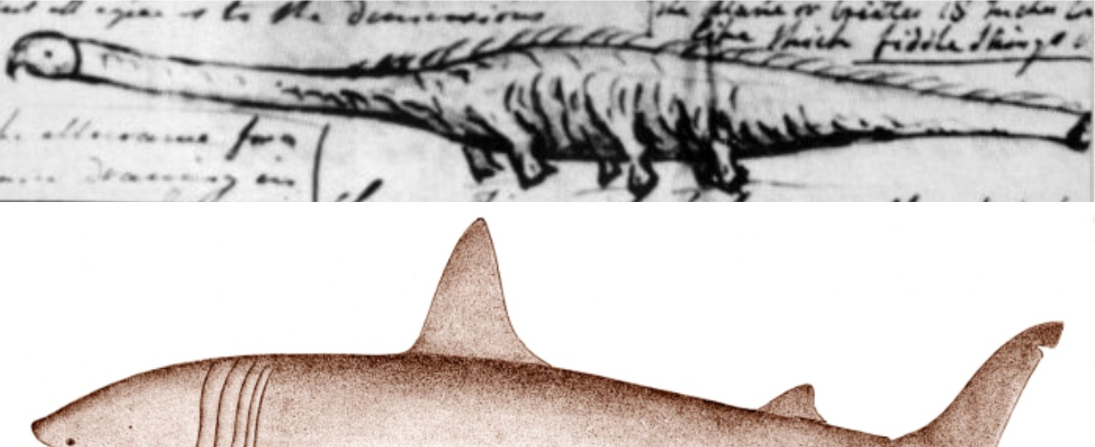
(Sketch of the Stronsay Beast made by Sir Alexander Gibson in 1808)
Sherar, together with three other men, studied the creature in details and measured its dimensions. The “sea monster” measured 55 ft (16.8 m) in length. Its neck alone was 10.3 ft long.
Part of the tail of the beast was missing, which suggested that the animal might be even longer. It was four feet (1.2 m) wide and had a circumference of about ten feet (3.1 m). George noticed that its head was similar to a sheep’s head, and had eyes bigger than a seal’s.
The color of its skin was gray, and it was rough to touch. The creature had six limbs (resembling ‘paws’ or ‘wings’) and bristly; long hair was growing from its shoulders all the way to the tail. The bristles glowed in the dark when they were wet. The insides of the beast were red.
By the end of September, news about the sea monster from Stronsay had spread across the country. News reporters were interested about the creature and came to take the statements of the witnesses.
With no means to keep the remains fresh, all that was left of the beast had rotted away. To verify the truthfulness of their story, the witnesses were taken to Kirkwall (the capital of the Orkneys), where they had to swear an oath to the magistrate.

(Another sketch of the Stronsay Beast)
In November 1808, the information about the beast came to the Natural History Society (Wernerian Society) of Edinburgh. After reading all the gathered information, they couldn’t identify it with any known species at that time.
They finally decided to record it as a new species, probably in the family of sea serpents. Scottish anatomist John Barclay named it Halsydrus pontoppidani (Pontoppidan’s sea-snake). Later, the anatomist Sir Everard Home revisited this case and suspected the measurements of the beast. He declared that it must have been around 36 ft (11 m) and recognized it as a decayed basking shark. According to Home, basking sharks can look like strange Jurassic creatures while decaying. Another scientist, Professor John Goodsir, came to the same conclusion in 1849.
The largest reliably recorded basking shark was 40 ft (12.2 m) in length. The Stronsay beast is close to this number, but it still poses some questions.
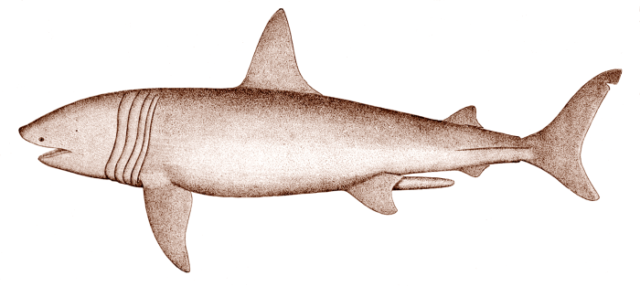
(A basking shark)
Whatever the truth may be, this is a strange case that reminds one of the famous Loch Ness monster. It was maybe just a decaying shark, but who knows, there is always a possibility that it was some ancient creature that decided to come closer to the surface. Maybe one day we will have the chance to examine another one.
Ask me anything
Explore related questions




