





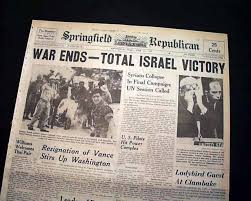
Israelis are celebrating 50 years since the Six-Day War — and with good reason. That victory saved us from destruction and reunited our holiest city. Ultimately, it also brought us peace with Egypt and Jordan and a strategic alliance with the United States. The Palestinians, by contrast, are mourning a half-century of suffering. They claim that Israel’s occupation of the West Bank and Gaza subjected them to colonization and denied them statehood.
While the war certainly shaped the modern Middle East, it alone cannot account for the contradictory ways Israelis and Palestinians commemorate it. The chasm can only be explained by events that preceded it. Far beyond 1967, the Israeli-Palestinian dispute is in fact about 1917, 1937 and 1947. Those anniversaries can teach us much about the origins of the Israeli-Palestinian dispute and why peace has proved so elusive.
A century ago this November, Britain, anticipating Turkey’s defeat in the Middle East, issued the Balfour Declaration. Endorsed by the League of Nations, the declaration pledged to create a “national home for the Jewish people” in Palestine. Britain did not commit to creating a Jewish state in all of Palestine — the national home could have been tiny — and promised to uphold “the civil and religious rights of existing non-Jewish communities.” Still, the Palestinians vehemently rejected the document. “We Arabs,” wrote Jerusalem notable Musa al-Husayni, would never accept “such a nation.”
This year, Israelis are also celebrating the centenary of the Balfour Declaration because it formalized the international community’s recognition of a Jewish nation and our 3,000-year attachment to our homeland. But the Palestinians are mourning it — their leaders have even called on Britain to apologize. Today, as in 1917, they view Jews not as a people with rights to a national homeland but as a religious group and, throughout much of Islamic history, an inferior one at that. Understanding this reality helps explain why, in the 1920s, Arab rioters murdered Palestinian Jews, desecrated synagogues and eradicated the ancient Jewish communities of Hebron and Safed.
Despite persistent Arab rejection of Jewish identity, the Zionist leadership recognized that the Palestinian Arabs were a people with sovereign rights. That acknowledgment was codified 80 years ago, in July 1937, with the Peel Commission in Britain, which divided Palestine into separate Jewish and Arab states. Though the Jews were allotted only one-third of the land, the Zionist leader David Ben-Gurion supported the plan. The Arabs rejected it, proclaiming that the only acceptable solution would be “the complete cessation of the experiment of the Jewish National Home.” Buckling to Arab pressure, the British cut off almost all Jewish immigration to Palestine, shutting European Jewry’s last escape route from Hitler.
Finally, in 1947, after six million Jews had been murdered in Europe, the United Nations stepped in. This November marks 70 years since the General Assembly passed the Partition Resolution creating independent Arab and Jewish states in Palestine.
The Zionist leadership, welcoming the United Nations’ recognition of the Jewish people’s rights but also respecting Arab claims, embraced the plan. But the Palestinian Arabs once again rejected the idea of Jewish peoplehood and independence. Their leader, Haj Amin al-Husseini, a Nazi collaborator who met with Hitler to ask him to extend his anti-Jewish plan into the Middle East, swore that the Arabs would not only block partition but would “continue fighting until the Zionists were annihilated.” And indeed they fought, ambushing Jewish buses and car bombing public institutions. Arab militias besieged Jewish Jerusalem, denying food and water to 100,000 civilians.
But the Jews fought back. Hundreds of thousands of Palestinian Arabs became refugees. Historians debate the causes and dimensions of what Palestinians refer to as the “Nakbah,” or catastrophe, yet these tragedies never would have occurred if the Arabs in Palestine had accepted partition. Instead, the Arab states supported their intransigence and invaded Israel at the moment of its birth.
What began as a clash between Palestinian Arabs and Palestinian Jews changed overnight into the Arab-Israel conflict. The two-state solution twice turned down by the Palestinians, in 1937 and 1947, would be forgotten as Egypt occupied the Gaza Strip and Jordan annexed East Jerusalem and the West Bank. Yet the Palestinians showed no interest in establishing sovereignty in those areas. Instead, they rejected Israel within any borders. “We shall destroy Israel and its inhabitants” swore Ahmed Shukairy, chairman of the Palestine Liberation Organization, on the eve of the Six-Day War.
Israel’s shocking victory over three Arab armies, paradoxically, produced opportunities for breakthroughs. Israel accepted the principle of territory-for-peace contained in United Nations Resolution 242 and reunited the West Bank and Gaza under its rule. Nevertheless, Palestinian groups continued to seek Israel’s elimination through large-scale terrorist attacks. When President Anwar Sadat of Egypt visited Jerusalem in November 1977 — yet another anniversary — Yasir Arafat, the P.L.O. chairman, threatened any Palestinian in the territories who supported the initiative. Palestinians who openly supported Sadat were shot. The P.L.O. attempted to thwart the subsequent Egypt-Israeli peace treaty by launching the Coastal Road Massacre that killed 38 Israelis, 13 of them children.
But the P.L.O. could not stop peace. Israel reconciled with Egypt in 1978 and, later, with Jordan in 1994, reverting the Arab-Israel conflict into an Israeli-Palestinian dispute. Efforts to address this were undoubtedly complicated by the construction of Israeli settlements, but they never accounted for more than a fraction of the territories and the P.L.O. eventually accepted Resolution 242 and signed the Oslo Accords with Israel. These agreements created the Palestinian Authority and, in 2000, led to a United States-Israeli offer of statehood in Gaza, East Jerusalem and almost the entire West Bank. But the Palestinians rejected the proposal with violence that killed and maimed thousands — just as they did in 1937 and 1947. The reason was not 1967, but 1917.
Because of the legacy of 1917 — the Palestinians’ refusal to recognize the existence and rights of the Jewish people — Palestinian Authority President Mahmoud Abbas ignored an even more generous offer for a West Bank-Gaza state in 2008. For the same reason, Israel’s withdrawal from Gaza in 2005, uprooting 21 settlements, brought no peace but thousands of terrorist rockets fired at Israeli towns. Because of 1917, Abbas has paid over $1 billion to terrorists over the past four years and names public squares and schools after Dalal Mughrabi, perpetrator of the Coastal Road Massacre. And because of 1917, Israelis fear that Palestinians will respond to any future offer of statehood in the lands captured in 1967 much as they did 1937 and 1947. The conflict is not about the territory Israel captured in 1967. It is about whether a Jewish state has a right to exist in the Middle East in the first place. As Mr. Abbas has publicly stated, “I will never accept a Jewish state.”
We’ll hear a lot this week about occupation and lack of Palestinian independence. Israel has a clear policy on this score: It does not want to rule over another people and is ready to begin immediate negotiations. Yet while Palestinian leaders claim they support a two-state solution, until they state that they favor “two states for two peoples,” affirming both Jewish and Palestinian peoplehood and rights, the conflict will tragically persist. It is only through mutual recognition that Israelis and Palestinians will both be able to celebrate, rather than mourn, future anniversaries.
Ask me anything
Explore related questions




