





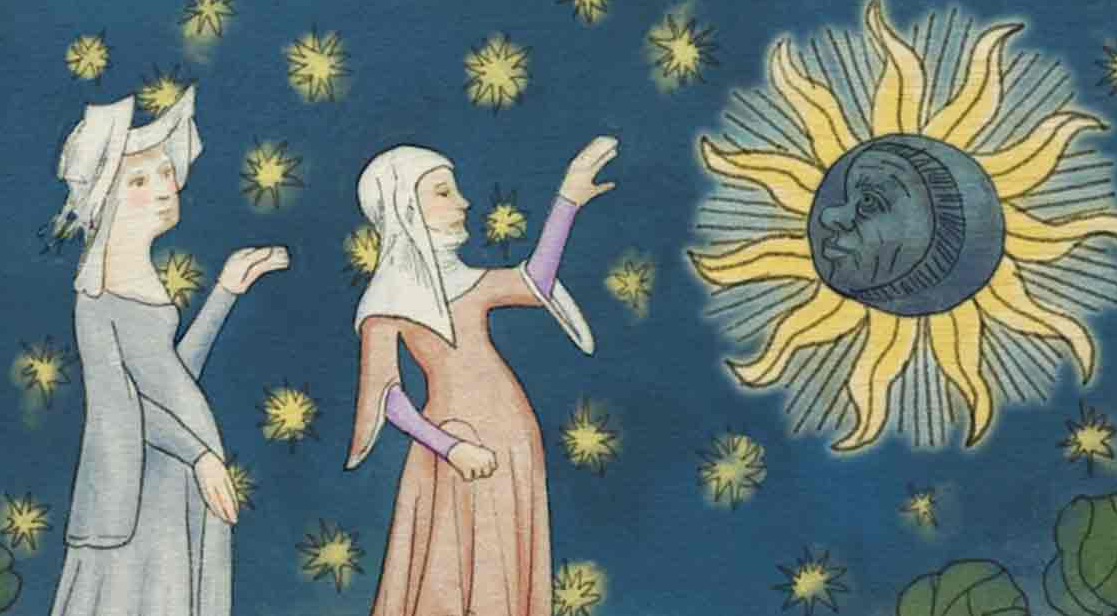
In medieval and Renaissance society and culture, celestial events were not mere spectacles in the sky. Rather, they were omens, predictors of the future, and windows into the workings of the universe.
University of Rochester historian Laura Ackerman Smoller and librarian Anna Siebach-Larsen, director of the Rossell Hope Robbins Library, shed light on how the people of the (falsely labeled) “Dark Ages” actually understood, interpreted, and experienced eclipses, planetary conjunctions, and other astronomical phenomena.
Eclipses were well understood in medieval Europe—at least mathematically
Forget the idea of flat earthers and the notion that medieval people “were generally stupid, ignorant, and superstitious,” says Smoller, a professor of history at Rochester and a fellow of the Medieval Academy of America. Ancient and medieval astronomers “knew quite well how to predict when conjunctions and eclipses were going to happen,” she says.
They understood that if the Moon was either new or full, and when its path crossed the ecliptic—the Sun’s path—you had an eclipse (a solar eclipse with the new moon and a lunar eclipse with the full moon). During an eclipse, the Sun and Moon are either in opposition (180 degrees opposite each other) or in conjunction in the exact same degree. But their paths have to be on the exact same plane and need to have crossed, explains Smoller. “That’s mathematically pretty sophisticated to conceive,” she says.
Space Force orders orbital service station to revive dead satellites
That said, medieval Europe still held a strictly Earth-centric view that considered the Sun and the Moon to be planets that orbit Earth—along with the five then-known planets Venus, Mercury, Mars, Jupiter, and Saturn. This geocentric model was not just specific to the Middle Ages—indeed, it was the predominant model in several classical civilizations, including ancient Greece and Rome.
Continue here: Ancient Origins
Ask me anything
Explore related questions




