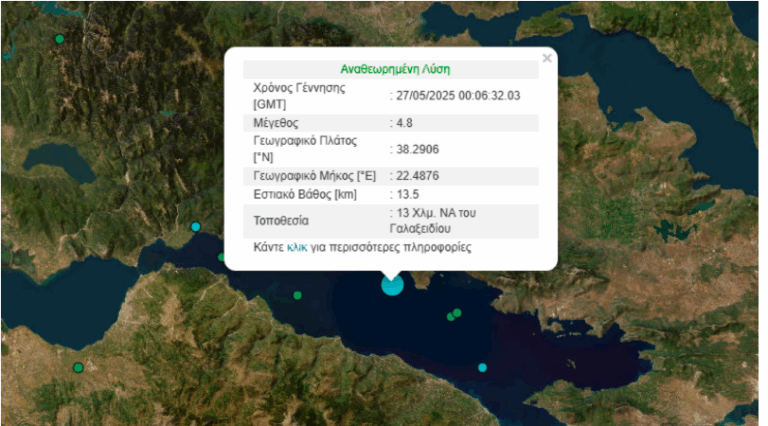
Authorities and seismic experts are closely monitoring the seismic event, which registered a magnitude of 4.8, with particular caution given the area’s high seismicity risk. The initial focus remains on assessing aftershock patterns and potential structural impacts.
Euthymios Lekkas, President of the Earthquake Planning and Protection Organization (OASP) and Professor of Geology, stated on ERΤ: “The seismic event occurred within the active tectonic zone at the entrance of the Corinth Gulf, an area with a history of significant seismic activity. Such events are consistent with the region’s geological dynamics.”
He further emphasized, “Given the tectonic complexity and ongoing stress accumulation, continuous surveillance of the region is essential. While there’s currently no cause for alarm, the high seismicity inherent to the Corinth Gulf necessitates vigilant monitoring to ensure public safety and preparedness for potential aftershocks.”
The epicenter was pinpointed approximately 13 kilometers southeast of Galaxidi, with a revised focal depth of 16.8 kilometers, according to the latest data from the Geodynamic Institute. The seismic waves were felt across parts of Attica, Patras, Nafpaktos, and Nafplio, with some reports indicating perceptibility even in Athens, due to the directional propagation of the seismic energy.
Ask me anything
Explore related questions