





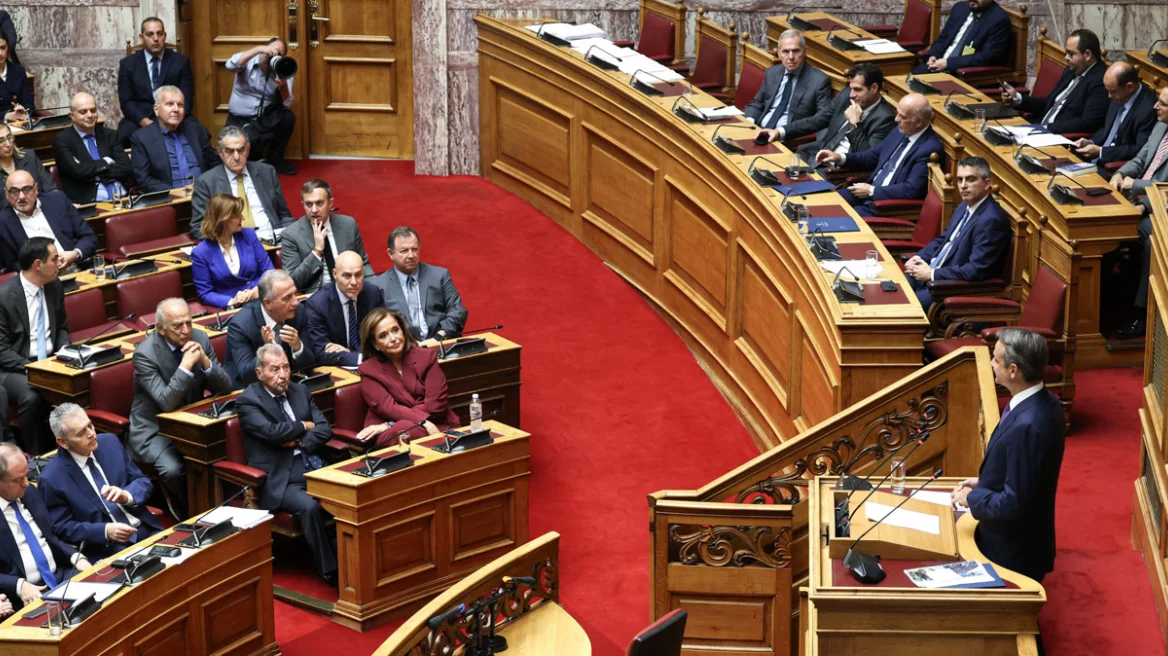
Kyriakos Mitsotakis announced the start of constitutional revision procedures in a Monday morning address, expressing his intention for bold changes, including:
- Revision of Article 86 regarding lifting ministers’ immunity
- Ending the outdated monopoly in higher education by allowing private universities (Article 16)
- Establishing a single six-year term for the President of the Republic
- Involving judges in selecting the leadership of the highest courts
Mitsotakis’ Address
The Prime Minister also calls “parties and citizens to a constructive reflection,” emphasizing that “the Constitution itself compels us to seek consensus.”
Alongside the address, Mitsotakis sent a letter to ND MPs asking for proposals and observations for the constitutional revision. The letter also mentions “the universal introduction of evaluation in the public sector and redefining the concept of tenure for public employees.”
Full Address Excerpt
Today we open the dialogue for Constitutional Revision, fulfilling another institutional commitment. As leader of New Democracy, I wanted first the opinions of our Parliamentary Group. Thus, I write to them so their positions can be incorporated in our final proposal by March. This is an issue concerning the whole public life and each citizen individually.
The 1975 Constitution has ensured stability for 50 years. It is a “living” document but belongs to the 20th century. It is time to undertake bold reforms to strengthen institutions’ prestige and citizens’ trust, introducing provisions for better governance, addressing modern challenges such as artificial intelligence and the climate crisis.
I deeply believe in stronger participation of regular judges in cases of ministers’ criminal responsibility during their term. I have defended changing Article 86 for 20 years. I am also committed to fighting the “deep state.” A friendly and effective public administration must be driven by continuous evaluation and redefine tenure on a new basis.
I have supported lifting the outdated monopoly in higher education by allowing private universities, as well as protecting the institution of the President by establishing a single six-year term. I have also proposed greater involvement of judges in selecting court leadership, enhancing judicial independence.
Our goal is a bold constitutional revision that meets current needs. It must include safeguards ensuring permanent fiscal balance, consistent government action, and political accountability, so the country never slips back into dangerous populism with its disastrous consequences.
I share these first thoughts, calling parties and citizens to constructive reflection, with positive proposals and a sense of shared responsibility toward the nation and the future. Society demands broader consensus, beyond party interests, aiming for a modern European democracy — a step forward we must take together.
The Constitution itself demands consensus to achieve these important changes.
I hope this revision process will respond to the political toxicity and sterile partisanship currently prevailing.
Letter from Mitsotakis to ND MPs
Dear Colleagues,
More than fifty years since the 1975 Constitution, key demands of Greek constitutional history — from free elections to the protection of individual rights — have shaped our constitutional legacy.
The 1975 Constitution has proven remarkably foresighted, including principles of modern European constitutionalism, from environmental protection to European integration.
Over decades, the Constitution has adapted well through four revisions and its application by state institutions.
However, it still comes from the 20th century. The world of 2026 is different, posing new challenges. Already in 2018, New Democracy presented a comprehensive revision plan. Recent experience highlights issues needing revision:
- Limited judicial role in investigating ministers’ criminal responsibility requires strengthening impartial judgment safeguards.
- Large inefficiencies in state operations require universal evaluation and redefinition of tenure in public service.
- The possibility of a second presidential term risks politicizing the office, undermining its nonpartisan character.
Even where progress has been made, the Constitution sets limits:
- Although high courts express opinions on their leadership, final power remains with the government.
- Private university branches are allowed under EU law, but overall establishment requires constitutional change.
Beyond specific issues, our Constitution focuses on past problems and is silent or insufficient on current and future challenges:
- It ignores artificial intelligence and underestimates urgent issues like affordable housing and climate change.
- It is cautious about the younger generation and neglects future generations.
- It does not ensure timely judicial decisions, often delayed for years, overturning citizens’ expectations.
- It lacks sufficient guarantees for fiscal balance and sustainability.
- It does not codify several necessary government operation rules established recently by law and practice.
The time has come for a bold constitutional revision toward a functional democracy for today and tomorrow.
Such a revision will cleanse unnecessary provisions, modernize the Constitution as the fundamental law of the future, and restore citizens’ trust in the state, institutions, political system, administration, and justice.
This revision is a great opportunity for a modern governance model. All parliament members must contribute meaningfully to this major challenge.
These are some key thoughts on New Democracy’s revision proposal. We aim to present the full proposal by March, with parliamentary procedures starting in April. Please send your thoughts and comments by the month-end.
Kyriakos Mitsotakis
Timeline
According to the schedule revealed by “THEMA,” ND MPs should submit proposals by February. The governing party’s proposal will be presented in March, aiming to form a parliamentary pre-revision committee in April.
A 3/5 majority (180 MPs) is needed in either the pre-revision or revision Parliament to amend a constitutional article.
Task Force
Foreign Minister Giorgos Gerapetritis coordinates the effort and is in close contact with PM’s Secretary-General Stelios Koutnatzis, a Public Law professor. Former minister Evripidis Stylianidis will be ND’s rapporteur in the expected parliamentary committee. A first meeting of ND revision team officials is expected on Tuesday.
The new head of ND’s Organizing Committee, Theodoros Roussopoulos, recently submitted a question to the Venice Commission regarding Article 86 and political immunity in other European countries. Maximos Mansion officials involved include Minister of State Akis Skertsos, Deputy Minister Giorgos Mylonakis, and government spokesperson Pavlos Marinakis.
Ask me anything
Explore related questions




