

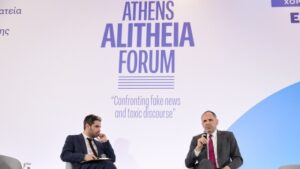
Foreign Minister Giorgos Gerapetritis, participating in a discussion at the Athens Alitheia Forum on the topic “Can a fake post create an international crisis?”, announced that on April 1, the Global Media Center of the Ministry of Foreign Affairs will become operational. Through this platform, the Ministry will collect news to understand how Greece’s image is perceived internationally. It will also monitor potential misinformation to address it and help shape communication strategies.
He explained that the Global Media Center, whose purpose is to gather all news from any medium and any source regarding Greece, “will cleanse this news so that we know the origin and integrity of the information, allowing for processing and immediate response through public diplomacy. This project, funded by the Recovery and Resilience Fund, will soon enable the country to know, first, which news is circulating, second, its level of integrity, and third, the recommended actions to respond to it.”
On the topic of misinformation, the Foreign Minister said: “What can we do about misinformation? We must counter it with the truth and cultivate the value of truth. Truth is a condition for genuine coexistence among people. Modern manipulation aims to subjugate perception to emotion. Verifying any information must become second nature.”
He emphasized: “Democracy cannot exist without freedom and integrity of information. It is a prerequisite. Deliberate misinformation is a modern form of totalitarianism.”
Gerapetritis noted that “unfortunately, false news relies on a very legitimate tool, which is technological development,” and added:
“As with all major discoveries and progress in the world, there is a price to pay. High technology comes with a cost, linked to misinformation, which today has become extremely aggressive. The vast majority of people now get their information from social media, resulting in unverified, unsupported news. Furthermore, accuracy and integrity are increasingly sacrificed for speed. Speed has become an endemic characteristic, and it haunts us all.”
He shared a personal example of a post showing a camera tracking a bomb falling on a Japanese WWII battleship, which was obviously fake due to its high-definition, colored footage. “Five million unique views in a few hours. Five million views, most of whom probably believed it was real. Then I saw something even worse—photos from bombings in Ukraine circulated today in the Middle East. Comments claimed they were bombings in Gulf countries, Iran, Lebanon, Israel. And it was entirely believable. For a specialist, it takes 15–30 seconds to create such a false depiction. So we all understand how low the cost and time are for production, and how high the price is for democracy and peace.”
He assessed that, in most cases, the goal is to create a crisis, referring to the “international arena” where, he said, “this type of false information dissemination is done deliberately—not just to mislead citizens, but to distort democracy or create an international crisis.”
“Imagine that in the past year alone we had multiple election processes affected by tens of thousands of bots and false information, proven to have specific senders attempting to infiltrate citizens’ democratic choices,” he said. He underlined that every day he encounters fake news about Greece, clarifying that criticism is valid and necessary, but the issue is the truth and real facts.
“Real facts, because they have an ontological dimension, cannot be distorted. You can criticize as much as you like, but real facts must be acknowledged by all. Unfortunately, the osmosis between reality and criticism creates problems. […] I’m not only talking about public image—I’m also referring to infiltration by foreign countries to exert influence, which may appear under a democratic guise, affecting citizens’ consciousness and infiltrating the collective subconscious. Given the tectonic shifts we are experiencing in international security, we must all remain vigilant. Verification of information must become second nature for those involved in public affairs,” Gerapetritis said.
Concluding, he addressed the situation in the Middle East, stating that the war’s consequences are now visible globally and will have multiplying effects on the economy, migration, and geopolitics. He estimated that we might be entering a phase of relative de-escalation, as there is growing recognition that this war will have no winners.
Ask me anything
Explore related questions