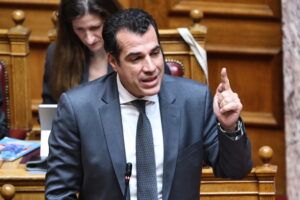
The government is considering introducing legislation to ban the burqa, according to Migration and Asylum Minister Thanos Plevris.
Speaking during a plenary session of Parliament, Plevris said the issue is still under review and that no final decision has been made regarding the scope or timing of the proposed regulation.
“We are still at the examination stage. I cannot give you an exact timetable or define the scope of the measure yet. In the near future we will be ready to present our position,” he said. “At this stage, we are studying the regulatory frameworks adopted in other countries and the relevant jurisprudence.”
He added that different European countries have adopted varying approaches to the issue. “Some countries prohibit the burqa in schools, others extend the ban to public spaces or public transport. We are reviewing these different frameworks as a whole and will formulate a clear position in the coming period.”
Responding to a topical question by MP Fotopoulos of Hellenic Solution, Plevris also referred to a survey conducted by Deputy Minister of Migration and Asylum Sevi Voloudaki, which found that the use of the burqa is not widespread among the Muslim population living in Greece.
According to the minister, only a small number of girls living in juvenile facilities or semi-autonomous accommodation structures wear burqas. “In many cases they are pressured into making these choices because otherwise they may become targets of male harassment,” he noted, while stressing that issues related to rights should not be approached purely through quantitative criteria.
Debate over migrant return hubs
Plevris also referred to developments at the European level, noting that the competent EU committee has approved the new Return Regulation. The regulation incorporates an initiative promoted by Greece and four other countries allowing for the creation of “return hubs” for illegal immigrants in countries outside the European Union, such as in Africa.
“The regulation was approved without the support of the left-wing parties. I will be interested to see the position PASOK takes when the regulation comes before the Greek Parliament,” he said.
The minister added that a growing number of European countries are also beginning to support Greece’s proposal that the granting of international protection should consider not only conditions in migrants’ countries of origin, but also additional factors such as gender and age.
“If Iranian women arrived tomorrow, we would all accept that they are facing persecution,” Plevris said. “But we are seeing men arriving from countries such as Afghanistan and Sudan, and questions arise as to how it is that, in places experiencing turmoil or war, it is primarily men—often of military age—who are leaving, rather than women, children or the elderly. Fortunately, this discussion is evolving, and more countries are now saying that gender and age should also be taken into account when assessing asylum applications.”
Ask me anything
Explore related questions