





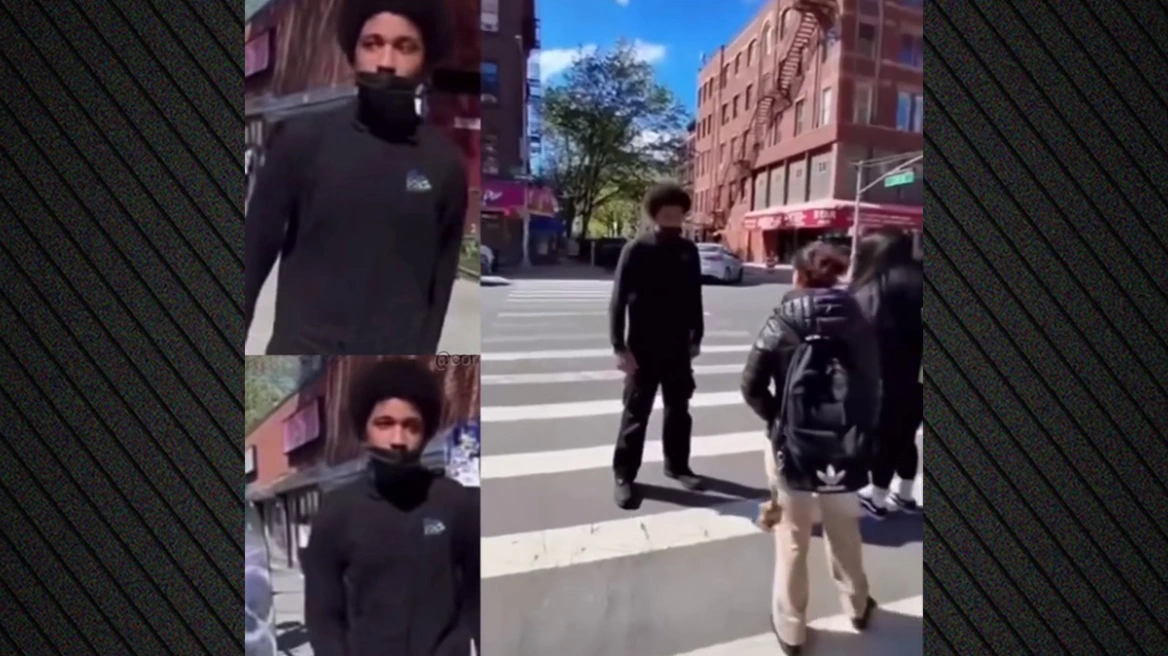
A disturbing video shows a black teenage boy throwing a white girl to the ground and kicking her in the head after she allegedly refused to give him her phone number in New York.
The video circulating on social media shows the 14-year-old speaking to the 15-year-old in East Harlem, at the intersection of 107th Street and 3rd Avenue last Monday, after school hours, according to the New York Post.
“I’ll beat you up right now,” the 14-year-old says while blocking the girl from crossing the street, as one of his friends urges him to “do it.”
“Stand right here,” he orders, pointing to the ground at his feet. She tries to walk past him, but he extends his arm and pushes her back. “Get out of my way, a**hole,” she says, turning her back on him.
The 14-year-old then grabbed the girl, lifted her, and slammed her onto the pavement. While she was on the ground, he stepped on her head and then left.
According to the same reports, the 15-year-old suffered a concussion and was taken by ambulance to Harlem Hospital, where she was listed in stable condition.
The suspect was arrested and charged with assault. According to sources, he is expected to appear in court on Thursday.
This is one of the many such anti-white violent incidents that have become a trend in the USA.
Specifically, there are higher crime rates (specifically violent crimes and homicides) from individuals of African/Black origin relative to their share of the population (about 13.7%–14.4% of the U.S. according to Census/Pew 2023–2025).
In single-victim, single-offender homicide cases, the data show notable differences in victim–offender patterns across racial groups.
Out of 3,299 white victims, 566 were killed by Black offenders, meaning roughly 17% of white victims were killed by someone Black.
In contrast, among 2,906 Black victims, only 246 were killed by White offenders, or about 8.5%.
When adjusting for population size—given that White individuals make up roughly five to six times the Black population in the United States—the disparity becomes more pronounced.
On a per capita basis, the rate of Black-on-White homicide is estimated to be around ten times higher than the reverse scenario.
This pattern is not isolated to a single dataset or year, but appears consistently across multiple years of available data.
Ask me anything
Explore related questions




