





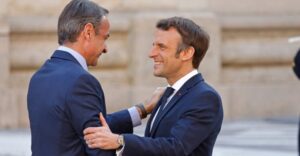
With the shadow of the Middle East hanging heavily over the European agenda, the informal EU summit in Cyprus is turning into one of the most crucial political meetings of recent months.
On the table are not only the immediate geopolitical developments, but also the question of how Europe will react if the crisis becomes more prolonged, passes with greater intensity to the economy, and tests the limits of its strategic autonomy.
That is why the debate in the Cypriot capital has, from the very first moment, had three clear fronts: plan B for the economic consequences of a protracted war, the operational activation of the mutual assistance clause, and the need for the Union to acquire a more visible role in the region.
Messages from Mitsotakis
The Greek side comes to the summit with a clear line that the focus is now increasingly shifting from the military aspect to the economic implications. This is exactly what Kyriakos Mitsotakis captured in his interview with Breitbart News, where he expressed hope that the US and Iran will reach an agreement to end the war, noting that international concern is now focused on the energy and stability implications.
In the same interview, the prime minister linked the crisis to the need for Europe to become more pragmatic in its energy strategy and more ready to deal with disruptions that start with geopolitics and end with the economy.
This thinking also permeates the line Athens is taking in Cyprus. The government staff believes that if the crisis is prolonged, the side effects will not be limited to energy costs or maritime transport, but will affect inflation, supply chains, production, and ultimately European households.
This is why the so-called plan B is not seen as a general exercise in preparation, but as a necessary framework for reacting to a new wave of pressure. High on the agenda is also the next step in implementing the mutual assistance clause, with mobilisation for the protection of Cyprus as the reference point.
The debate is now focusing less on theory and more on the operational question: how Europe could respond more quickly, more effectively, and with greater coordination if a similar scenario were to recur.
Kyriakos Mitsotakis himself has described the stakes by saying that the answer must be “how, in case something like this were to happen again, we could respond more effectively. Because this will be a clear indication that we are serious about our strategic autonomy.”
The Greek-French alliance
This is where the positions of Athens and Paris meet with increased intensity. The Greek-French line in favour of a more coherent European defence, with an emphasis on interoperability, strategic autonomy and operational readiness, is now taking on new depth at the bilateral level as well.
Ask me anything
Explore related questions




