





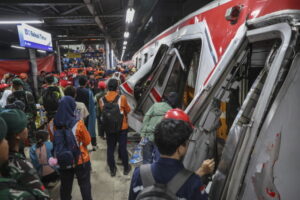
Rescue operations continue today near Indonesia’s capital following the collision of two passenger trains, in which at least 14 people lost their lives and dozens more were injured, according to the latest toll.
According to Anna Purba, spokesperson for Indonesia’s state railway company KAI, two people who are still alive remain trapped in the mangled metal of a carriage.
The accident occurred at the end of the day near Bekasi Timur railway station, about 25 kilometers east of the Indonesian capital.
Jakarta police chief Asep Edi Suheri explained that a long-distance train collided with the last carriage—reserved exclusively for women—of a commuter train that had been stationary.
So far, it is known that the accident resulted in 14 deaths and 81 injuries, Ms. Purba told an Indonesian TV network today.
Earlier, an AFP journalist at the scene saw people being removed from the wreckage of a carriage on stretchers and loaded into waiting ambulances, under the watch of nearby residents, some of whom appeared to be in shock.
“I thought I would die”
A passenger on the commuter train described the horrifying moments she experienced. “I thought I would die,” said 29-year-old Sausan Sarifa from her hospital bed at RSUD, where she was taken with a broken arm and a deep cut on her leg.
“Everything happened so fast, in a split second,” added the young woman, who was returning from work when the train stopped at Bekasi Timur station. “There were two announcements on our train. Everyone was preparing to get off, and suddenly we heard a deafening crash. We didn’t have time to get out. We were trapped, falling on top of one another inside the train. I don’t know what happened to the person underneath me.”
She feared she would suffocate and expressed concern for the women and other passengers who were trapped. “Thank God, I was higher up and they were able to get me out quickly.”
Practically all the victims were in the last carriage of the commuter train, and rescue teams were cutting parts of the train body to free trapped passengers.
During the night, rescuers shouted for oxygen tanks, while ambulances waited with their sirens on.
“Severe damage”
The accident caused “severe damage,” the Jakarta search and rescue agency said. According to another KAI spokesperson, Franoto Wibowo, preliminary findings suggest that a taxi crashed into the commuter train at a level crossing, immobilizing it on the tracks where it was then struck by the long-distance train.
“We are still collecting data and evidence (…) A detailed timeline (…) will be released later by the authorities,” the spokesperson said.
All 240 passengers on the train that collided with the commuter train are safe, KAI assured.
At RSUD hospital, 39-year-old Eva Chairista told AFP she rushed there after learning that her sister-in-law, 27-year-old Fira, had been injured in the accident.
“The doctor told us to be patient,” she said, noting that priority is being given to patients “far more seriously injured than her.”
In the previous comparable railway accident in Indonesia, four people were killed and about twenty injured in West Java province in January 2024.
Transport accidents are not uncommon in the Southeast Asian country, a vast archipelago where cars, trains, aircraft, and ferries are often not maintained as they should be.
In 2015, a collision between a train and a small bus at a level crossing in Jakarta killed 16 people.
Ask me anything
Explore related questions




