





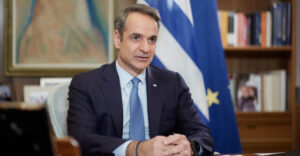
With reference to Mother’s Day and a personal mention of his mother, Marika Mitsotaki, the Prime Minister began his Sunday review via Facebook and then presented the week’s key interventions.
From the new framework for Renewable Energy Sources (RES) and the early repayment of €6.9 billion in debt, to geopolitical contacts in the Gulf, agreements on Artificial Intelligence, the “Untouched Beaches”, transport, culture, and the microsatellite space program, Kyriakos Mitsotakis referred to the most important actions of the past week.
As the Prime Minister wrote, “another 13 areas were added to the list of the ‘Untouched Beaches’,” bringing the total number to “251”. These are, as he states, beaches of “special ecological and geomorphological value”, where “any activity is prohibited” that alters their character, referring to a list accompanying his post.
Moving on to “the most important events and interventions of the past week”, the Prime Minister spoke about the “new regulations of the Ministry of Environment and Energy”, which he links to “international uncertainty and the crisis in the Persian Gulf”.
As he states, the goal is “to increase the capacity for energy storage from RES to 700 MW by the end of the year and to 1 GW in 2027”. He argues that “the new law provides for more RES, cleaner and more affordable energy”, with “protection of areas within the Natura network” and “more functional solutions for citizens and businesses”, noting that the regulations come as a continuation of “our collective achievement” for Greece to “have in the last 2 years… become a country that exports energy instead of importing it”.
As a “significant news item of the week”, he records the decision for “another early repayment of debt, amounting to €6.9 billion, against the first bailout loans” from European countries. He acknowledges that this may “sound technical or distant from everyday life”, but he directly links it to the ability to support citizens and businesses: “The more public debt decreases, the more the stability of the economy is strengthened… without relapsing into the dead ends of the past.” He also sets the goal that “by 2027 we will cease to be the country with the highest debt in Europe as a percentage of GDP”.
Referring to Abu Dhabi, he notes that a “strategic cooperation” was signed with the government of the UAE in “Artificial Intelligence, new technologies and digital infrastructure”, with provisions for “investments in the field of emerging technologies”, cooperation “in education and health”, and the “development of tools” to enhance the efficiency of public administration. In the education section, he states that Greece is “developing into one of the first countries” to acquire a “comprehensive framework” for the introduction and utilization of AI in secondary education. He emphasizes that the Joint Ministerial Decision signed by the competent ministers “sets the rules for the responsible, safe and creative use of AI in the classroom”, while also referring to comments by Andreas Schleicher (OECD), who, as he writes, “praised Greece” for the introduction of new technologies in education.
In the same review, he also includes “space news”, stating that Greece now has “17 microsatellites in orbit” after the launch of “6 new ones”, of which “2 from the Hellenic Space Dawn mission” and “4 thermal” for “early detection and monitoring of fires in near real time”. As he notes, the data are integrated into the Government Earth Observation Hub, as a “unified operational tool” for Civil Protection and Public Administration, while the microsatellites can detect “ships, floods and environmental changes”.
Ask me anything
Explore related questions




