





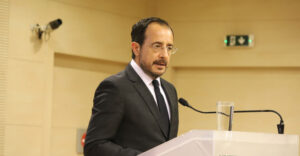
The President of the Republic of Cyprus, Nikos Christodoulides, sent a clear political signal regarding the next steps in the Cyprus issue, confirming that an initiative by UN Secretary-General António Guterres is underway, aimed at achieving a concrete outcome by the end of the year.
Christodoulides, responding to a journalist’s question about reports of a possible solution plan before year’s end, noted that the UN Secretary-General is “absolutely committed” to making progress on the Cyprus issue.
He said António Guterres had already conveyed to him last March, during their meeting in Brussels, that an initiative was underway aimed at a positive outcome. The Cypriot President even linked the timing to the end of the Secretary-General’s term around December, suggesting that Nicosia considers the current period particularly critical.
“We are not just talking for the sake of talking”
Nikos Christodoulides sought to distinguish the current momentum from previous low-intensity efforts around the Cyprus issue that did not lead to substantive negotiations.
“It’s not just ‘we talk, we talk, we talk’,” he said, stressing that the process must ultimately lead to results.
This remark is significant, as Nicosia aims to signal that it is not pursuing dialogue for appearances, but a meaningful process that can be judged by its outcome.
No arbitration
President Christodoulides placed particular emphasis on rejecting any scenario involving arbitration. When asked whether such a process was being considered, he categorically denied making any such reference.
He referred to the terms of reference of the UN Secretary-General, as derived from the Security Council, noting that they define a specific framework for a settlement, as outlined in relevant UN resolutions on the Cyprus issue.
In this way, Nicosia seeks to prevent interpretations that the process could move outside the agreed framework. The Greek Cypriot position remains that the basis for a solution is a bizonal, bicommunal federation with political equality, as defined by UN resolutions, and not a two-state or confederation model, as promoted by the Turkish side.
Role of the European Union
The President of the Republic of Cyprus also referred to the role of the European Union, stressing that the EU must play a crucial role in the process.
As a member state, Cyprus insists that any solution must be compatible with the EU acquis. Nicosia maintains that the EU cannot remain a bystander, especially when the issue concerns the reunification of a member state and the application of European law across its entire territory.
“There is no plan B”
Christodoulides also emphasized that the Greek Cypriot side is ready for the next phase, noting that “we will all be judged by the final outcome” and reaffirming Nicosia’s full readiness.
He stressed that there is “no plan B” for the Republic of Cyprus. As he said, there is no alternative to ending the occupation and reunifying the island.
This statement is addressed simultaneously to multiple audiences: the Greek Cypriot community, where skepticism toward new initiatives remains; the United Nations, to which Nicosia signals its readiness to engage; and the Turkish side, which in recent years has promoted a “sovereign equality” stance and a two-state solution.
Guterres’ initiative
The reference to the end of Guterres’ term provides the broader political context for the current momentum. The UN Secretary-General is deeply familiar with the Cyprus issue, having played a central role in the last major effort in Crans-Montana in 2017. Nicosia believes this experience could be an asset, provided there is genuine willingness from all parties.
The key question remains whether the Turkish side will operate within the UN framework or continue to insist on recognition of “two states” as a precondition for meaningful talks. This will determine whether the current window of opportunity is real or yet another diplomatic opening that closes before it can be utilized.
Nicosia signals readiness
With his remarks, President Christodoulides made clear that the Republic of Cyprus supports the Secretary-General’s initiative. At the same time, he also set clear boundaries: no arbitration, no departure from Security Council resolutions, and no solution outside the European framework.
The coming period will show whether the Guterres initiative can lead to real political progress or remain at the level of exploratory contacts. For now, Nicosia is choosing to support the process, insisting that its sole objective is the end of the occupation and the reunification of Cyprus.
Ask me anything
Explore related questions




