





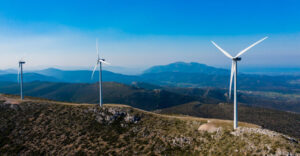
Almost all of the Cyclades, with the exception of Andros and Naxos, are being excluded from plans for new wind farms under the new special spatial planning framework for renewable energy sources (RES), which the Ministry of Environment and Energy put out for public consultation yesterday. For the first time, the framework introduces clear geographic exclusions and stricter siting criteria for both wind and solar energy projects.
Similarly, in the Dodecanese, opportunities for new wind farm development are being drastically reduced, with essentially only Rhodes and Karpathos remaining eligible. The new framework reshapes the energy map of Greece’s island regions overall.
The central provision of the new spatial plan is a blanket ban on new wind farms on islands smaller than 300 square kilometers. This effectively removes nearly the entire Aegean island complex from future development plans, leaving only 15 large islands eligible for wind projects: Crete, Euboea, Lesbos, Chios, Lemnos, Samos, Corfu, Kefalonia, Zakynthos, Lefkada, Thassos, Karpathos, Rhodes, Andros, and Naxos.
This measure is considered one of the strongest interventions of the new framework, as it responds to years of local opposition to the widespread installation of wind turbines on small islands with strong tourism, environmental, and cultural significance, such as Tinos and Skyros.
The only exceptions for islands under 300 square kilometers will concern special public-interest needs, such as desalination projects, grid security, or energy sufficiency requirements for non-interconnected or vulnerable islands.
New restrictions for wind and solar projects
Beyond the islands, restrictions are also becoming stricter on the mainland. For the first time, wind farms will be prohibited at elevations above 1,200 meters. Protected “untouched mountains” — mountainous areas without road infrastructure — are also excluded. These include the White Mountains of Crete, Smolikas, Tymfi, Taygetus, Agrafa, Parnon, Dikti, and other protected mountain regions.
Three main restrictions are being introduced specifically for wind energy:
- Wind potential: Wind farms will not be permitted in municipal areas where wind speeds are below 4 meters per second. According to Deputy Energy Minister Nikos Tsafos, this rule excludes about half the country geographically, although many of those areas already lacked serious investor interest.
- Altitude: A horizontal ban applies above 1,200 meters, based on scientific and administrative criteria linked to alpine ecosystems and high-altitude landscapes.
- Special Protection Zones (SPAs): Natura bird-protection zones will generally be off-limits to wind farms. In practice, about two-thirds of projects in such areas were already rejected during environmental assessments.
Exceptions may only apply if:
- the area’s special environmental study explicitly allows it, and
- the site has very strong wind potential, around 7.5 meters per second.
The framework also strengthens restrictions in protected areas more broadly. In addition to zones of absolute protection, exclusions are extended to nature protection zones, priority habitats, and many bird-protection areas.
Changes for solar energy
The new spatial framework also significantly changes the rules for solar projects. For the first time, solar parks will be completely banned in Natura 2000 areas, forests and forest lands, untouched mountains, and terraced landscapes. However, they will still be allowed on highly productive agricultural land.
New visual and spatial integration criteria are also being introduced for solar projects. Special visibility studies will now be required when projects are located near archaeological sites, monuments, or historic areas. Safety distances from settlements and restrictions on visual horizon coverage are also being introduced to reduce visual disturbance.
Stricter framework, but mature investments remain protected
The new framework maintains land coverage limits for both wind and solar projects. For wind farms, the maximum percentage per municipal unit remains at 8%, while for solar parks a maximum land coverage rate of 1.5% is introduced at the regional-unit level.
For example, if a regional unit already has 3% land coverage by solar projects, that becomes the baseline. Another 1.5% may still be added, bringing the total to 4.5%. Once that additional margin is filled, no further projects will be allowed.
Despite the stricter rules, however, the new spatial plan is expected to have limited immediate impact on the existing investment map. Projects already in the licensing pipeline — including those with complete applications submitted by May 20 — are essentially exempt from the new restrictions.
About 50 GW unaffected by the restrictions
Investments totaling more than 50 GW are estimated to remain outside the scope of the new restrictions, while around 18 GW are already installed and operational. This far exceeds Greece’s current electricity demand and raises concerns about grid saturation.
Deputy Minister Nikos Tsafos described the new framework as an attempt to tighten siting rules without endangering the country’s energy sufficiency or overturning mature investments. He explained that the stricter approach mainly targets wind projects, where environmental and visual concerns have generated the strongest public opposition.
He clarified that the new rules do not affect projects that already have environmental approvals or have substantially entered the licensing process.
Project categories
Under the new framework, projects are divided into four main categories:
- Operational projects
- Projects with grid connection terms
- Projects with approved environmental permits (AEPO)
- Projects with only producer certification or at an early stage without AEPO
Projects that already hold environmental approval will not be reconsidered. As Tsafos stated, “If the state has spent years saying a project can proceed and has granted environmental approval, it cannot now suddenly declare it illegal.”
Projects without AEPO will be subject to the new restrictions. However, the ministry distinguishes between speculative proposals and projects that have spent years in development, completed studies, and submitted full licensing dossiers.
According to the figures presented, the new restrictions affect projects totaling around 37 GW — including 21 GW of solar and 16 GW of wind capacity.
Concerns from the wind industry
Representatives from both the wind and solar sectors said they were surprised by aspects of the proposal despite the long consultation process. The strongest objections from the wind industry focus on the broad, horizontal bans introduced by the new framework.
Particular criticism centers on the decision to prohibit wind turbines above 1,200 meters without exemptions for areas with exceptionally high wind potential.
Industry representatives argue the altitude threshold is too low and stricter than expected. Similarly, the ban on wind projects on islands smaller than 300 square kilometers overturns plans across many Aegean islands.
The industry argues that the islands contain some of Greece’s strongest wind resources and should remain strategic areas for renewable energy development, especially given the new electrical interconnections.
The Ministry of Environment and Energy, however, says these decisions are linked to environmental protection and the need to relieve pressure on areas already heavily burdened by tourism, residential growth, and energy development.
Ask me anything
Explore related questions




