





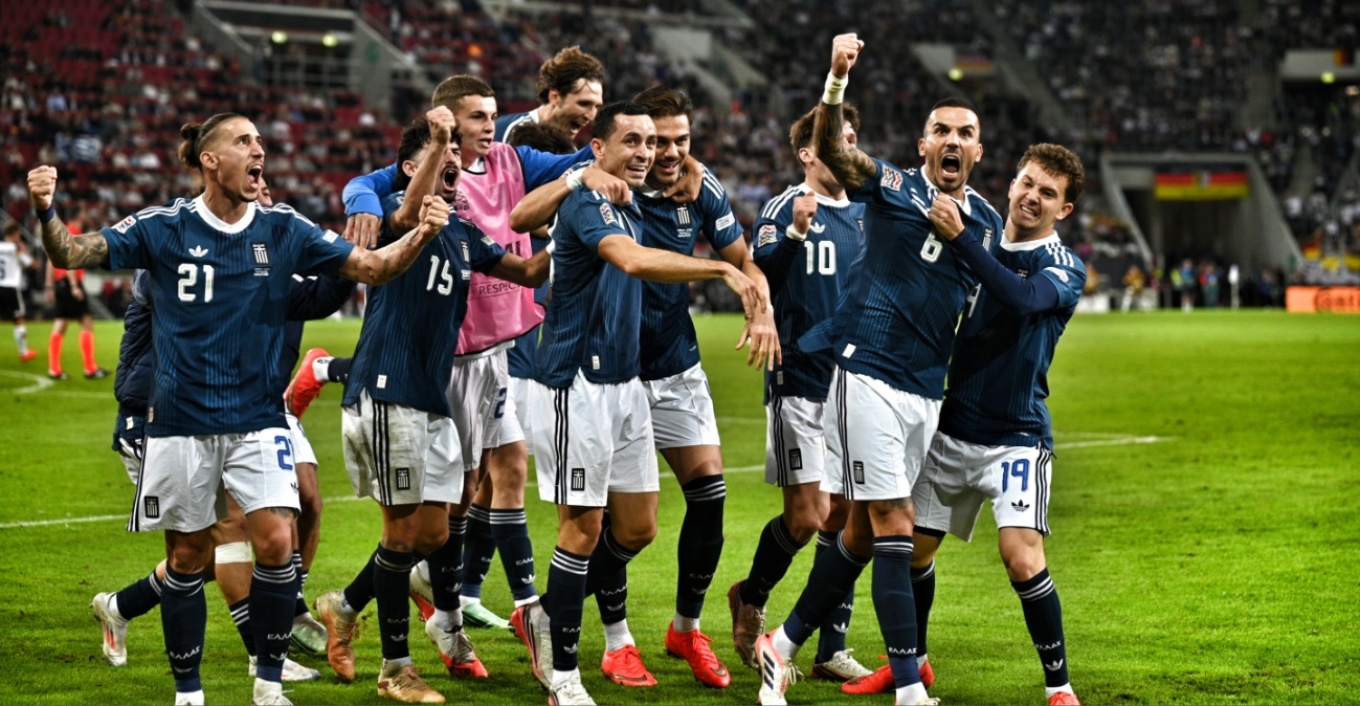
Greece have beaten Germany for the first time ever, winning 1-0 at Augsburg’s WWK Arena on Sunday night to move clear at the top of their Nations League group.
Midfielder Dimitris Kourbelis scored the only goal in the 74th minute. The substitute finished after winger Christos Tzolis raced into the area and pulled the ball back for him, with the shot taking a deflection on its way in. It was Greece’s only effort on target all night. The result makes it two wins from two in Serbia League A and sent a ripple of surprise across European football.
FT: 🇩🇪 Germany 0-1 Greece 🇬🇷
— Hellas Football (@HellasFooty) September 27, 2026
For the first time in history Greece defeat Germany! A 2nd half finish from Dimitris Kourbelis gave the Ethniki a crucial victory away in Augsburg!#Greece #Ethniki #GERGRE pic.twitter.com/p7uWRi4Mu2
Some victories are worth three points and little more; others change the mood of a squad and of a whole country. Sunday night in Augsburg belonged firmly in the second category.
At one of Europe’s most daunting grounds, and against one of the great powers of world football, Greece head coach Ivan Jovanovic’s side showed character, concentration and a new maturity. Goalkeeper Konstantinos Tzolakis made several decisive saves, particularly during Germany’s strongest spell early in the second half, before Kourbelis settled the match. The win also ended a run of four consecutive defeats against Germany.
Greece top the group, with the Netherlands next
After victories over Serbia, in Belgrade, and Germany, Greece sit alone at the top of League A Group 2 with six points from two matches. The Netherlands are second on four points, Germany third on one, and Serbia are yet to get off the mark.
Jovanovic’s side face their next big test on Thursday 1 October (9.45pm Greek time), when they host the Netherlands aiming for a perfect three wins from three. Germany host Serbia in Munich the same evening.
Jovanovic: “To win games like this, you have to suffer”
Jovanovic focused mainly on his players’ mentality and the mental readiness that made the result possible.
“I’m very happy. It’s a huge win, for our football, for the future of our football and for this competition. Two wins is the ideal start,” he said.
He explained what Greece had needed to leave with the win: “The key thing is that to win games like this, you have to suffer. We knew we would have to suffer. My players gave everything on the pitch.”
Jovanovic admitted his side had struggled to create in the first half but said they were more proactive after the break.
“In the second half we were better and more active, and we managed to win. We suffered a lot, but the players were ready to suffer, and that made a huge difference in the game.”
Shock in Germany and Klopp’s response
The defeat was a heavy blow for Germany and spoiled Germany head coach Jürgen Klopp’s first home match in charge. Klopp took over in July after Germany’s early exit from the World Cup, and began his tenure with a 1-1 draw in the Netherlands on Thursday, when his former Liverpool player Cody Gakpo equalised late on.
Klopp, who made five changes to his side, accepted the blame. “With all the changes I made, the defeat is of course my responsibility,” he said.
He acknowledged that his team had been unable to carry out their game plan. “We weren’t able to implement our plan today. Football needs training, football needs automatisms. We don’t have enough of them yet.”
Despite his disappointment, he struck a measured tone: “I’ve lost far more games in my life than I would have liked. I can deal with it. After games like this, you simply have to draw your conclusions and get better.”
He added: “I’d rather have a bad start than a bad ending.”
A moving scene: the national anthem at the WWK Arena
The result was only part of the story; the moments around it mattered just as much.
In stoppage time, Greek supporters in the stands began singing the national anthem. With Kourbelis’s goal having silenced the
The party continued in the dressing room, where the players celebrated one of the most significant wins in the modern history of the national team.
Greece left Germany with more than three points; they left with a different kind of confidence. Jovanovic’s side have shown they can look any opponent in the eye, and they now await the Netherlands from a position of strength.
German media reaction and a barbed Bild
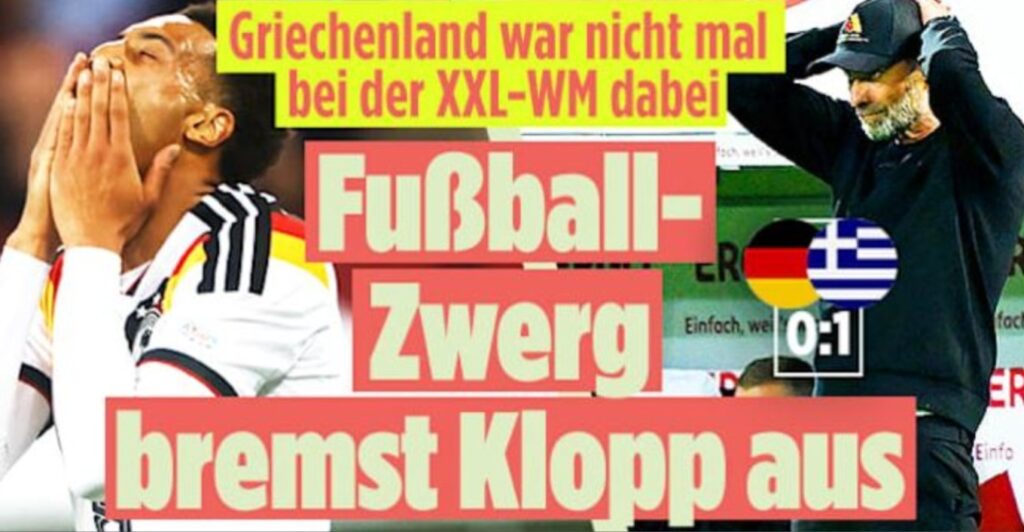
Greece’s success also drew a sharp response from the German press.
“Jürgen Klopp fails on his home debut: football minnows put the brakes on Klopp,” Bild declared in the story that led its website for hours. The tabloid noted that the new coach had warned against underestimating football’s so-called minnows, a reference to Greece’s world ranking of 41st, and had described the current side as the “golden generation of Greek football”. It also recalled that Greece had failed to qualify for the last three World Cups and European Championships, but had caused an “international sensation” with their last-minute win over Serbia, and that this was the country’s first ever football victory over Germany.
UEFA’s official website, by contrast, led with the Greek triumph under the headline “Greece stun Germany”, calling it a “memorable win in Germany”.
Private news channel n-tv reported that “Greece spoil Jürgen Klopp’s home debut”, describing the defeat as “the worst start for a national coach in the history of German football” and the “first disappointment for the globally revered saviour”. It said the deep-lying, highly disciplined opposition had punished a costly error by Klopp’s side. “That was bad luck. Germany, playing in front of 28,945 spectators, also had chances to avoid their first ever defeat by Greece. But overall, their attacking play was extremely sluggish,” the channel said.
ARD, Germany’s main public broadcaster, said on its Sportschau programme that “the miracle cure has been postponed, as Greece punished Germany’s mistake”. Former Germany midfielder Bastian Schweinsteiger, now a pundit for the channel, said: “We’re no longer a top team. We’ve settled into mediocrity.”
Der Spiegel ran the headline “A brake on Klopp euphoria”, noting that although the Greek fans in Augsburg were fewer in number, they “were heard more often and more loudly, especially whistling at the Germans and cheering when they had the ball”. Stadium staff responded by playing the well-known German hit “Griechischer Wein” (Greek Wine).
“Greece stop Klopp,” summed up the Süddeutsche Zeitung, which said Klopp’s “organised chaos” had become “pure chaos” over the course of the match. It singled out Germany captain Joshua Kimmich, who it said “looks like a captain without a team”.
Kicker magazine judged that “Jürgen Klopp’s home debut was a failure”, adding: “The German team had no ideas in attack, while for the Greeks, besides the scorer of the winning goal, a Dortmund player was particularly impressive.” The magazine was referring to Borussia Dortmund attacking midfielder Konstantinos Karetsas.
More than a win
Some victories cannot be measured by the scoreline alone. They do not simply slot into a league table, and they do not end with the referee’s final whistle.
Augsburg was one of those nights. A small band of Greek fans drowned out an entire stadium, the national anthem rang out on German soil, and a team that has spent years trying to reclaim its place in European football reminded everyone what it is capable of.
Greece took more than three points. They won back a measure of belief: a generation of players unafraid of their opponents’ reputation, a coach who has taught his team to endure, and a night that will stay with everyone who witnessed it.
Football history is not written only in major titles and trophies. It is also written on the nights when a team does the unexpected, when the shirt feels a little heavier, and when a nation remembers why it loves the game.
The 1-0 win at the WWK Arena was not merely a victory over Germany. It was a reminder that Greece still have stories left to write.
Ask me anything
Explore related questions




