





Born on Aug. 10, 1909, in California, Leo Fender was the founder of the Fender Electric Instrument Manufacturing Company, commonly known as just Fender. Besides being one of the most famous guitar manufacturers in the world, Fender was also the first company to mass-produce an electric guitar, the Fender Telecaster, which was introduced in 1950.
Although electric guitars already existed and were introduced some 20 years before the Telecaster, Fender’s model was revolutionary and quickly conquered the music world. The inventor of the guitar became known as the guitar-making maestro. However, despite having such an impact on the music industry, Leo Fender never actually learned how to play the instrument he perfected.
Interested in electronics from an early age, Fender received a box of discarded radio parts and a battery from his uncle, who ran an automotive electric shop. Fender was only 13 years old, and after the visit to his uncle’s shop, the boy became fascinated with the radio his uncle built and the sound coming from it. A few years later, he started a small shop in his parent’s house, where he repaired radios.
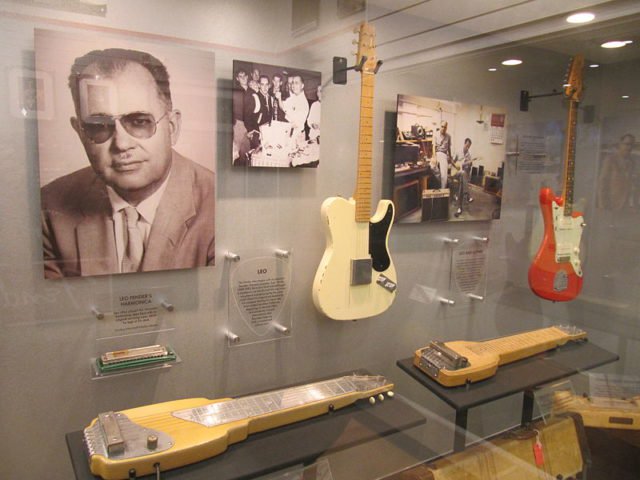
(Fender Guitar Factory museum. Leo and early models)
After graduating from Fullerton Union High School in 1928, he began his education at Fullerton Junior College, where he studied to become an accountant. Although he majored in economics, Fender continued to learn about electronics and work with electric parts. His first major job was the construction of six public address sound systems, which he built for a local band, to be used for their performances in Hollywood. At this time, Fender was employed as a delivery man and later a bookkeeper at the Consolidated Ice and Cold Storage Company in Anaheim.
In the following years, Fender changed jobs several times, working as an accountant for the California Highway Department and a tire company. Around the same time, he met the love of his life, Esther Klosky, whom he married in 1934. The Great Depression left the young man unemployed, so in 1938, the couple moved back to Fullerton, where Fender started his own radio repair shop. Fender Radio Services was founded with $600 that Fender borrowed. Very soon his reputation grew and Fender became popular among local bands. He was constructing and selling public address systems for their performances, and amplifiers for the upcoming amplified acoustic guitars.
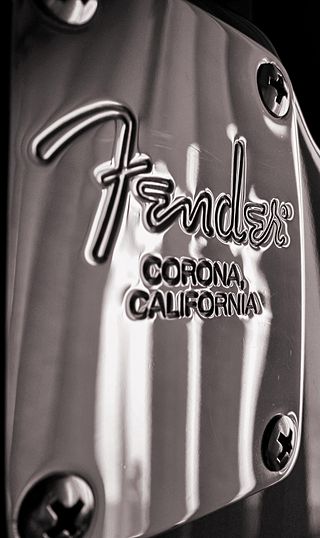
(Fender plate of a Fender Jazz Bass)
Fender teamed up with Doc Kauffman for the first guitar he built. Kauffman was another inventor who worked at Rickenbacker, a guitar manufacturer. Kauffman played and produced lap steel guitars for a decade before meeting with Fender. The two established the K & F Manufacturing Corporation, which produced amplified Hawaiian guitars and amps. In 1944, the two inventors designed a lap steel guitar with an electric pickup which was already patented by Fender. A year later, the company started selling the guitar, which came together with a Fender amp. As World War II was coming to an end, the music scene in the United States changed. With big bands becoming less popular, and new smaller bands playing rhythm and blues, boogie-woogie and western swing emerged. Most of these new bands preferred the electric guitar, so at the end of the 1940s, demand increased significantly. At the time, the most readily available models were the Rickenbacker Spanish Electro and Les Paul’s Log model.
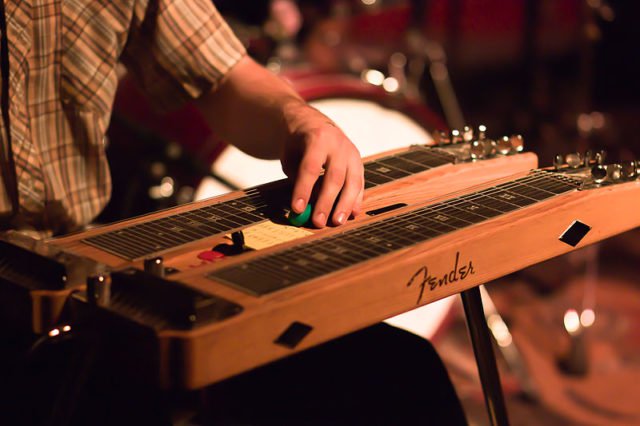
(Lap steel guitar Fender)
In 1946 Leo Fender founded the Fender Musical Instruments Corporation. The inventor realized the need for a simpler guitar, which was easier to play, hold, and tune, so he began working on a new prototype. In 1949 the model was finished, and one year later, it was released as the Fender Esquire. Very soon the model was renamed the Broadcaster, and in 1951 it was dubbed the Telecaster, which would become one of the most popular guitars ever made.
Even though he had learned to play the piano as a child, Leo Fender never learned how to play guitar, the instrument which he spent his entire life developing. Nonetheless, he held one in his arms each and every day until he died.
The name of his groundbreaking guitar was changed due to legal problems, as there was already a line of drums called Broadkaster produced by a company called Gretsch. The competing music company contacted Fender by telegram, complaining about the name of his guitar.
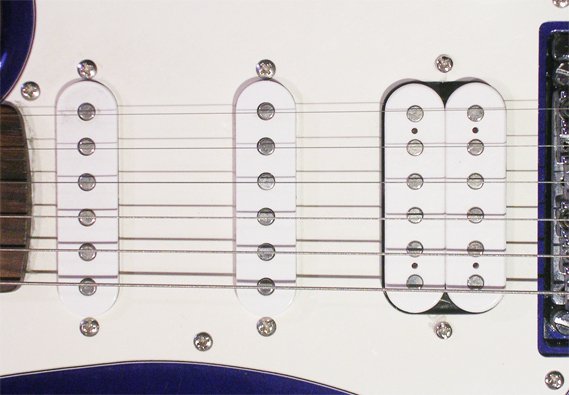
(Three pickups mounted in the body of an electric guitar)
In 1953, Fender began working on a new project, the Stratocaster model, which became one of the world’s best-selling guitars since its release. In the following years, several more models were introduced, including the Precision Bass and its De Luxe version, the Jazz Bass, and the Fender Bassman amplifier.
When the 1960s came, Leo was still working hard on both the business side of his company and the R&D sector, responsible for the development of new products. Troubled by a streptococcal sinus infection that he caught in the 1950s, in 1965 Fender was forced to sell his company to Columbia Broadcasting System. CBS paid $13 million for his company, and he remained a consultant at Fender for a short time. As part of the contract, he agreed not to participate in the musical-instruments industry over the next 10 years. In the meantime, his sickness was cured, so in 1971 Fender established a new company called Tri-sonic, together with his partners, Forrest White and Tom Walker.
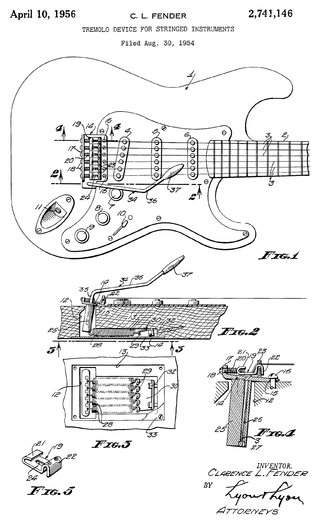
(Diagram showing the lever mechanism for patented by Leo Fender vibrato, requested in 1954)
The two had approached Fender for financial aid, and after he agreed, the new company was formed. Walker and Fender were designing amplifiers, while White was working on guitar design. They worked very carefully so their designs would be different from the CBS Fender guitars. By 1974, they changed the name of the company to Musicman. In the following year, Fender was elected president of the company, in which he had not previously played an active role. Musicman’s beginnings were excellent, and the company was successful for a while. By the end of the 1970s, though, business slowed down, and in 1985 Fender left the company, which was later sold to Ernie and Sterling Ball.
Meanwhile, Fender and his old friend George Fullerton formed another company. G&L Guitars was established in 1979, and it produced guitars that were similar to Fender’s originals but enhanced with modern electronics and tremolo systems. In the same year, Fender’s wife, Esther, died of cancer. Fender, a known workaholic, worked tirelessly at G&L every day and created several patents in the following year.
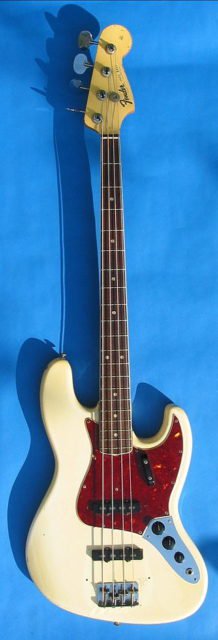
(Fender Jazz Bass 1966)
The last day he spent working was March 20, 1991. His health was weak, due to several strokes and Parkinson’s disease. On March 21, Fender passed away. He was buried at Fairhaven Memorial Park in Santa Ana, California.
In 2009, Fender was posthumously awarded the Technical Grammy Award, for his contributions of outstanding technical significance to the recording field. Fender reshaped the music industry, and his accomplishments will never be surpassed by anyone else.
Ask me anything
Explore related questions




