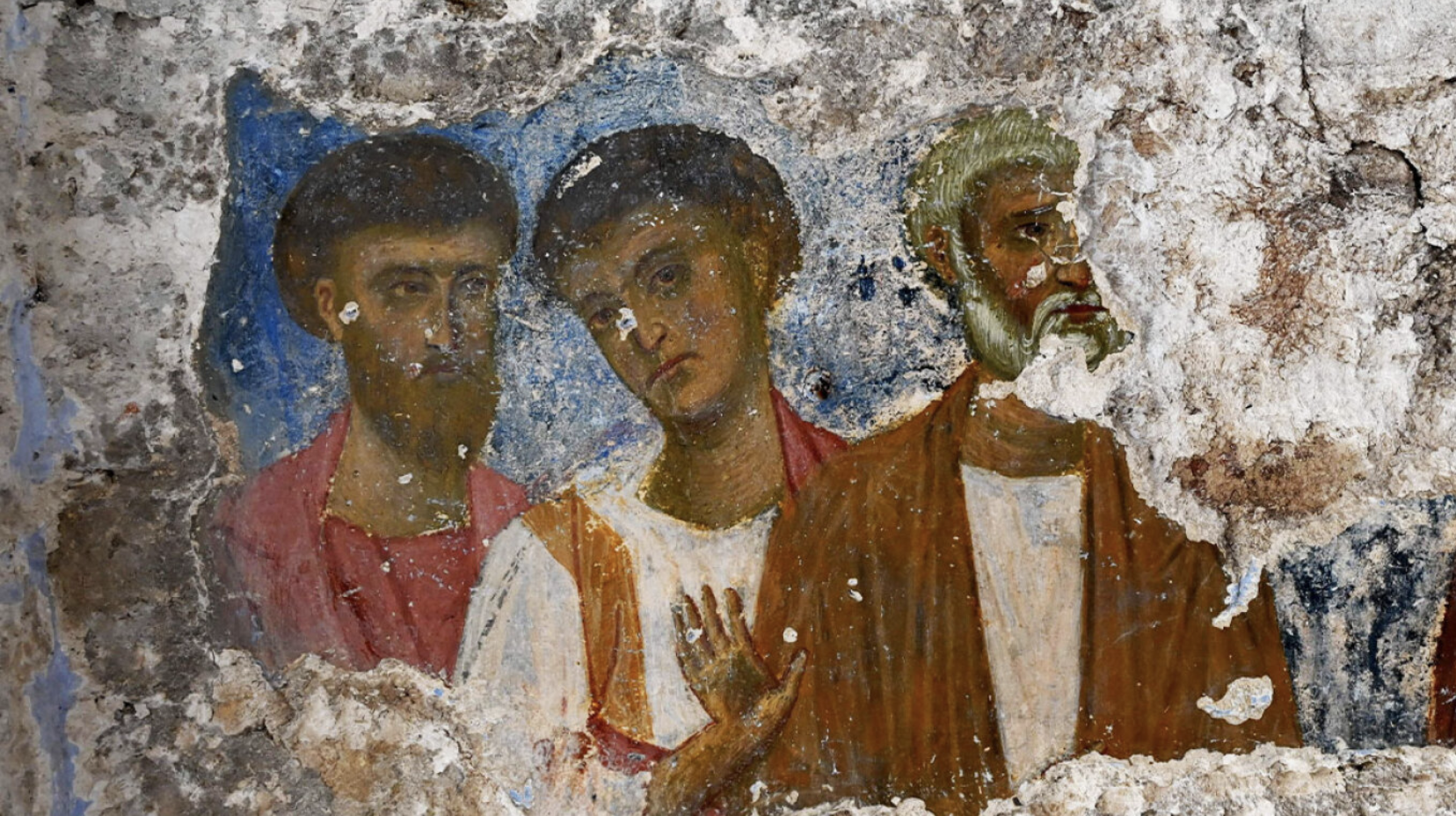
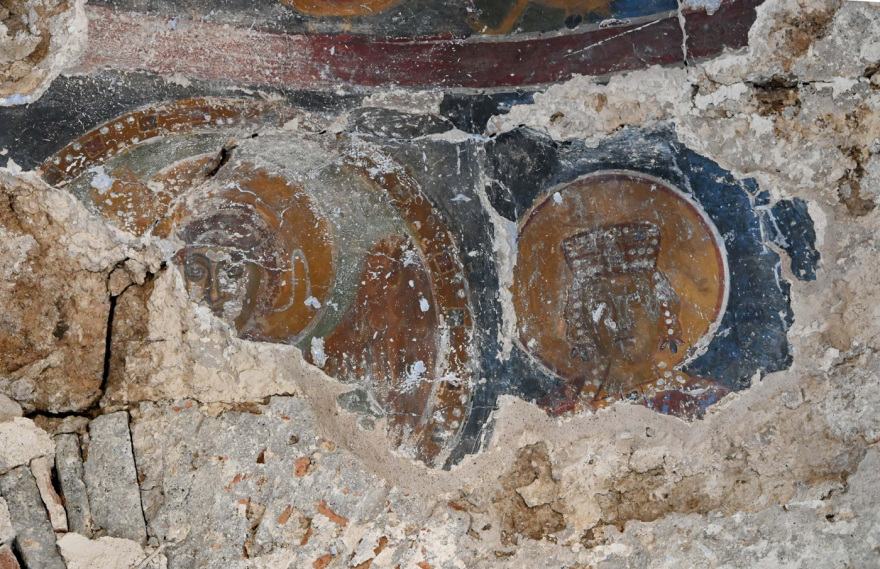
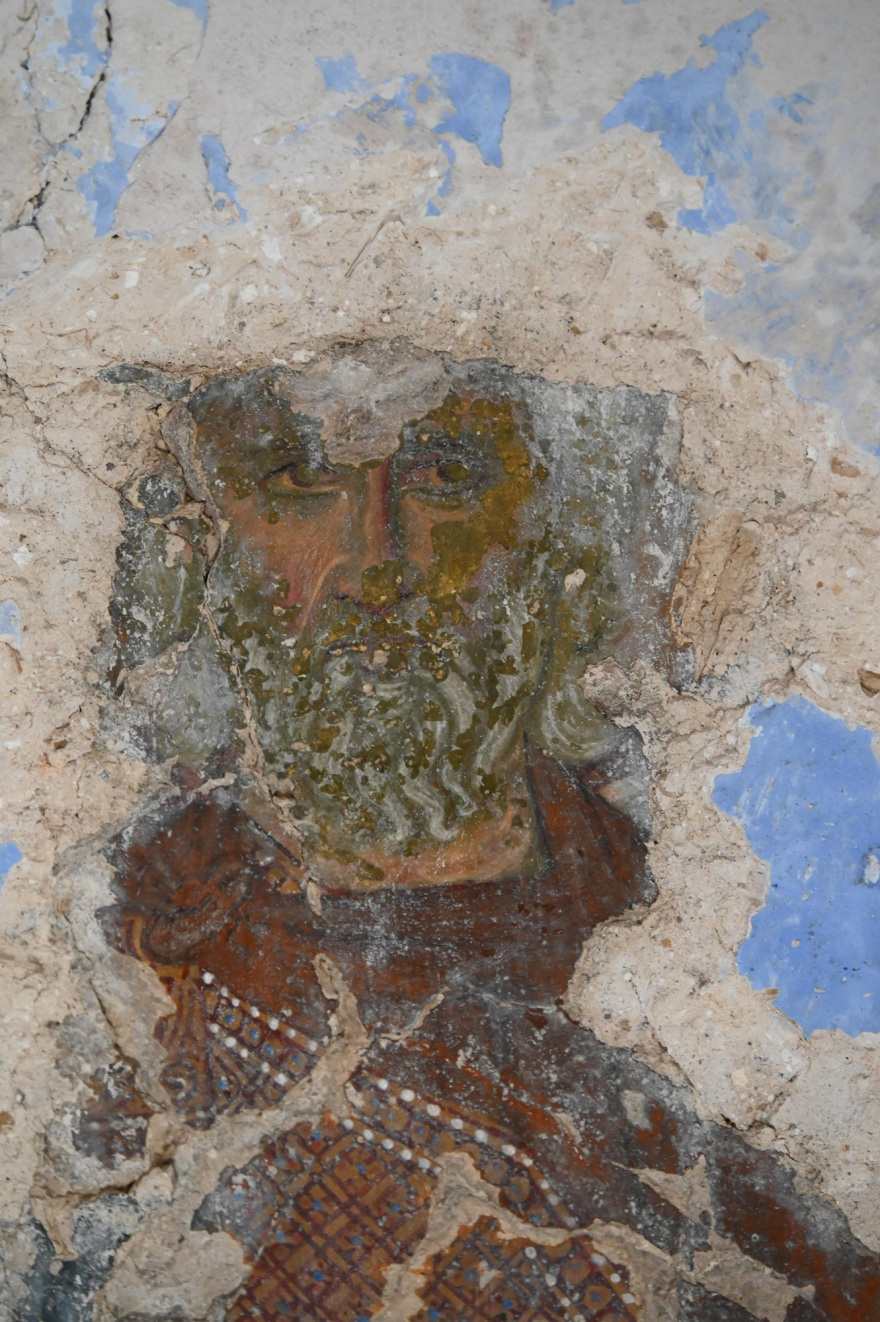
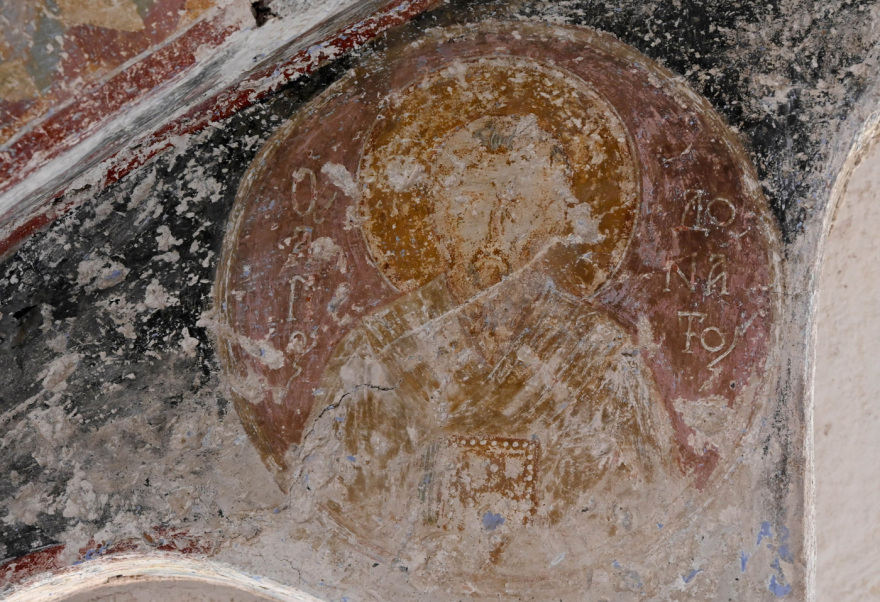
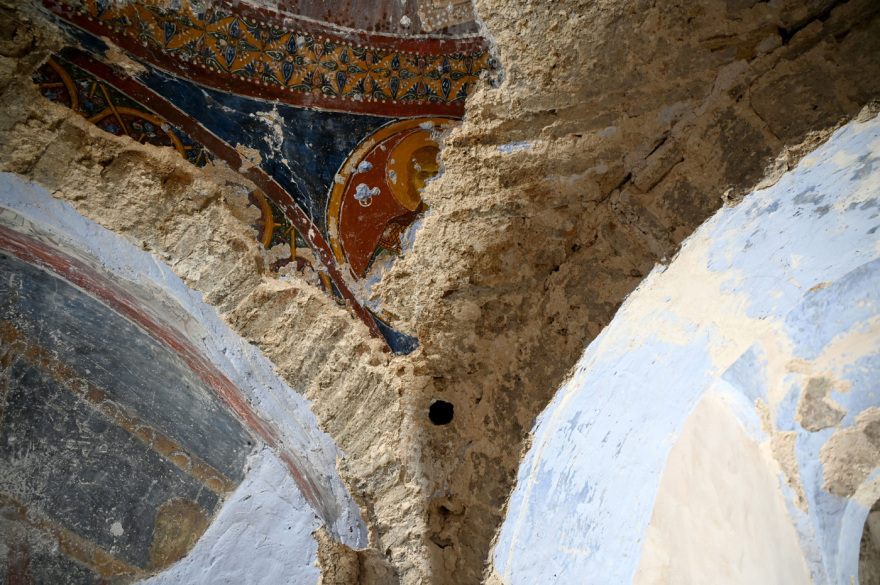
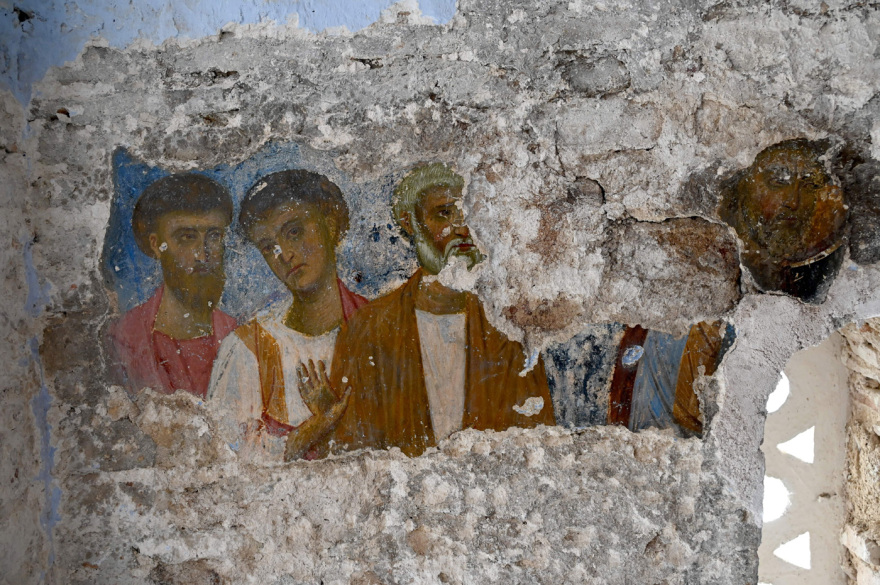
Recently, archaeologists and conservators from the European Center for Byzantine and Post-Byzantine Monuments (EKBMM) made an astonishing discovery beneath the whitewashed walls of the Church of Saint Nicholas in Mesopotamos, in North Epirus, Albania. Hidden for centuries, vibrant frescoes depicting saints appeared at a height of eight meters—preserved thanks to their elevation and vivid colors.
Their excitement was immense, as these frescoes were previously unknown to researchers. As the Center’s director, Flora Karagianni, stated:
“This doesn’t happen often. Usually, we already know about the frescoes and we restore them. To see white walls suddenly reveal figures and faces is a moment of great joy and revelation. This did not happen elsewhere. In other monuments we’ve preserved outside Greece, the frescoes were known and we simply did cleaning and stabilization. The joy of such a discovery, we truly experienced at the Church of Saint Nicholas.”
A Historic Monument in Northern Epirus
According to civil engineer Leonidas Pappas—who holds a postgraduate degree in monument restoration and formerly served as president of “Omonoia,” representing Greeks in Albania—the Monastery of Saint Nicholas in Mesopotamos (a village in Northern Epirus, within the Municipality of Finiq) was built during the reign of Byzantine Emperor Constantine IX Monomachos (around 1050 AD).
During the 40-year rule of Albanian communist dictator Enver Hoxha, all monastery buildings were destroyed—except the church itself, which survived as a protected cultural monument. It was one of 350 churches spared from demolition when religion was outlawed in Albania; most were turned into granaries or warehouses.
A Dual-Use Church? A Rare Theory
Pappas recounts a theory that at one point the church may have functioned with two sanctuaries—serving both the local Orthodox population and the Catholic military forces during the Despotate of Epirus, when the region was under the rule of the Angevin (Anjou) family.
“This is very unusual. It doesn’t generally happen. This theory was proposed by Alexander Meksi, the first Prime Minister of post-communist Albania, in his doctoral thesis on the Monastery of Saint Nicholas,” Pappas says.
However, he notes that this theory is considered highly unlikely and may have gained popularity mainly for tourism purposes.
A Family Story of Protection and Redemption
Pappas also shares a personal story passed down through his family: About 150 years ago, a young woman who became pregnant out of wedlock—facing threats of death and social stigma—fled to the Church of Saint Nicholas to seek refuge.
“Her parents wanted to kill her because it was a disgrace to the family. The monastery protected her. She gave birth to a girl there and years later married a relative of ours, a widower whose wife had died in childbirth. That child was our ancestor.”
The Conservation Work on the Church
Regarding the restoration efforts, Pappas explains that some time ago, the structure was stabilized by Albania’s Institute of Monuments under the Ministry of Culture. The second phase, led by the European Centre for Byzantine Monuments based in Thessaloniki, involved conserving the frescoes and some interior sculptures.
The pigments used were plant-based, since synthetic dyes were either unavailable or extremely expensive at the time—implying that a wealthy patron may have sponsored the church’s decoration.
This second phase is part of a Cooperation Memorandum signed in 2021 between the Centre’s president, Professor Emerita of Byzantine Archaeology Natalia Poulou, and then Albanian Culture Minister Elva Margariti. Funding came from the Greek Ministry of Culture. The fresco conservation is scheduled to continue through 2026, with support from the Municipality of Finiq, the Greek Embassy in Tirana, and the Consulate General in Gjirokastër.
The Mission of the European Center for Byzantine and Post-Byzantine Monuments
Speaking about the Center’s work abroad, Karagianni says:
“For about 28 years, the Center has been restoring Byzantine monuments outside Greece. We’ve preserved countless sites across the Balkans, the Middle East, Turkey, and the Black Sea region.”
These projects are executed under cooperation agreements with local ministries or churches and funded by the Greek Ministry of Culture. Notable efforts include the mosaic floors of the impressive early Christian basilica of Prophet Elias in Jordan, frescoes in North Macedonia, and wooden iconostases and lecterns of the Ecumenical Patriarchate.