





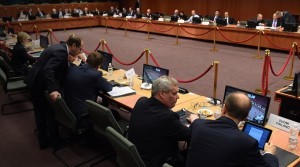
Eurozone officials have expressed displeasure as the Greek government has yet to present an adequate list of itemized measures with full cost calculations.
It had been hoped that the government would have already presented workable and succinct reforms one and a half months following the Radical Left Coalition (SYRIZA) victory at the January 25 elections and two weeks following the Eurogroup meeting of February 20. It is believed that there will be little to work on at the Eurogroup meeting that kicks off at 6 p.m. (Greek time) on Monday, March 9. Finance Minister Yanis Varoufakis’ so-called “creative vagueness” according to his own description (or “utopia” according to his opponents) has led to the exasperation by Greece’s EU partners.
The reforms list that Varoufakis sent to Eurogroup Chief Jeroen Dijsselbloem in Brussels on Thursday morning lacks measures that could bring “immediate results.” In this framework, Athens should not expect a deal that would lead to the release of part of the 7.2-bln-euro tranche benchmarked for Greece.
The greatest reason as to why EU officials are reluctant to help Greece cover its funding gap is that there are concerns regarding the gaping fiscal gap that European economists fear won’t be covered as Greece is seen to not be taking adequate steps to work in this direction. Proto Thema revealed that Brussels is pushing for the return of the troika of international creditors from the European Commission, European Central Bank and International monetary Fund to return to Greece ASAP as the review of data for the Greek economy by correspondence is impossible.
Greek government sources maintain that Varoufakis – in Brussels since Sunday – has arguments that could sway EU partners and succeed in striking a deal. Unconfirmed sources suggest that Varoufakis may open the door to at least one privatization (the debt-laden parimutuel state-run horse racing organization ODIE or regional airports) and there may be a proposal for limited changes to VAT or for fund mergers. The government, however, will not negotiate its plan for debt settlements in 100 installments.
Government sources said Varoufakis’ letter was not supposed to be a detailed cost account but to provide a “basis for discussion” that they believe will be supplemented with proposals on the part of the international creditors, and within the framework of frank discussion concerning the liquidity problems faced by Greece.
Even so, Prime Minister Alexis Tsipras’ verbal attacks against the ECB and EU partners, which he accused of playing “political games”, as well as Varoufakis’ references to a “referendum” have caused a climate of negativity even though the latter explained that the comment had been misinterpreted. It appears that the “battle cries” have been sounded even before the Eurogroup meeting has started, as Maximos Mansion points to conspiracy theories and an insidious campaign to oust Varoufakis through mockery and press leaks.
Ask me anything
Explore related questions




