





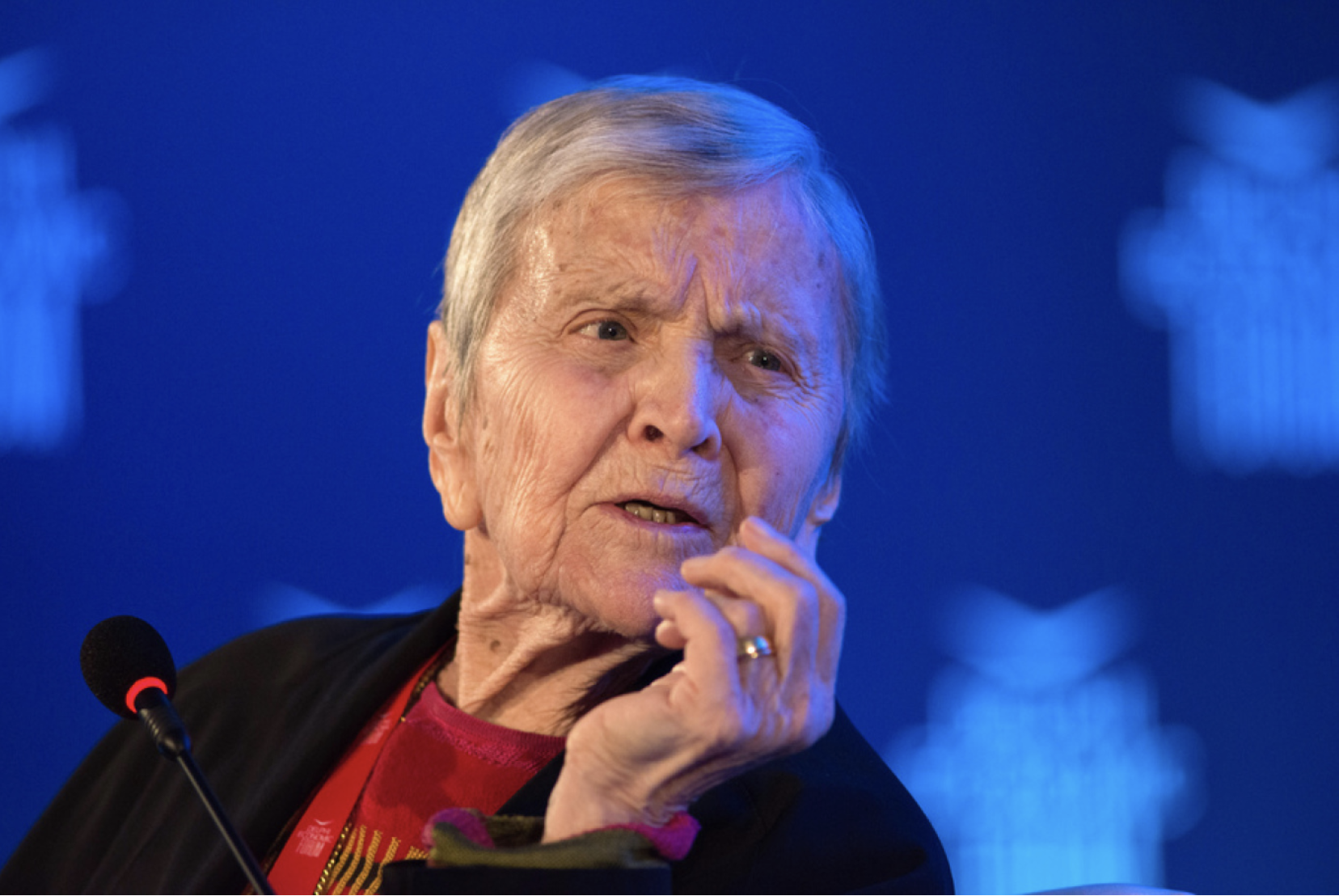
Eleni Glykatzi-Arveler (1926–2026) passed away with all the honors she deserved: her scholarly work was widely celebrated, her participation in the resistance against Nazism was duly highlighted, her academic career in France and on the international historiographical stage was presented in all its dimensions, and those who knew her or had worked with her spoke with exceptional praise about her personality.
What, however, was the element on which Arveler began to build her recognition, identity, and reputation? To say that she was one of the most important figures in modern Byzantine studies—with broad acceptance and decisive influence on the study of Byzantine history—and that her contribution is not limited to academia but extends to public history and the shaping of European historical consciousness, is not enough.
Let us first recall her most important works: Research on the Administration of the Byzantine Empire in the 9th and 10th Centuries (1960), Byzantium and the Sea (1966), Studies on the Administrative and Social Structure of Byzantium (1971), Byzantium: The Land and the Territories (1976), The Political Ideology of the Byzantine Empire (L’idéologie politique de l’Empire byzantin, 1976 — Greek translation by T. Drakopoulou, Psychogios), and Byzantine Geography: Historical Geography of the Mediterranean World.
Her books also include Smyrna Between Two Turkish Occupations (1975), The Diaspora in Byzantium (1995), The Making of Europe (2000), Why Byzantium (2010), I Speak to You About Byzantium (2014), How Greek Is Byzantium? How Byzantine Are the Modern Greeks? (2016), and Asia Minor, the Heart of Hellenism (2021).
With works such as these, Arveler moved away from the older, Western-centric perception that viewed Byzantium as a “decadent” or “orientalizing” state, instead presenting it as a multiethnic, cohesive, and resilient empire with a strong administrative structure and cultural dynamism.
Through her approach, she emphasized the continuity of the Roman state, the administrative and ideological cohesion of the empire, and the role of Byzantine political thought in shaping European identity—thus influencing international scholarship and contributing to the integration of Byzantium into the European historical narrative.
Arveler’s methodology is characterized by interdisciplinarity, combining history, philology, geography, and political theory; critical analysis of sources with an emphasis on their rhetorical and ideological dimensions; and the connection of Byzantine history with contemporary European reality. By studying Byzantine state ideology, she demonstrated how the empire legitimized power and managed its multiethnic composition.
By exploring the political ideology of Byzantium, the geopolitics of the Greek world, the relationship between Byzantium and Europe, and the historical continuity of Hellenism, Arveler became a kind of “beacon” of Byzantine historiography—not only for her scholarly analyses but also for the way she recorded Byzantium as an integral part of modern Europe, far from any marginal or “eastern” construct.
Through her work and her teaching, Eleni Glykatzi-Arveler created a school of thought that became a breeding ground for generations of historians. With her scholarly, institutional, and public discourse, she radically reoriented the image of Byzantium, continuing to influence both research and public debate to this day.
Ask me anything
Explore related questions




