





Every time a war breaks out near Greece, the debate about how we can protect ourselves consistently returns.
As with the war in Ukraine, the war bunkers built during World War II are at the center of the conversation today. That is, how much we can count on them if the conflict gets away from the people directly involved and we need to use them.
According to the official record, about 2,000 shelters are considered active in Attica to date and thus suitable to be used in a condition of extensive bombing. From theory to practice, however, the distance remains long.
The picture of shelters today
Konstantinos Kyrimis, author and researcher, speaking to Orange Press Agency, presents a range of evidence that shelters cannot be the easy solution. Especially since most, if not all, of them have been abandoned.
But even if they were maintained, the total number of people they can accommodate is far less than the number of people living in Athens and even more in the county.
It is indicative that the largest shelter, the one located in Lof Ardittos, has a capacity of about 1,300 people.
Mr. Kyrimis took us on a tour of two shelters in the greater Piraeus area. The one located at the intersection of Vass. Papanastasiou, after Mikrolimano, is closed. An old rusty door separates its interior from the outside world, as it did in another era.
An opening, however, allows one to see the state it has fallen into. Dozens of bottles, soda cans and other objects have formed a dense pile that covers the beginning of the entrance from one end to the other.
This particular image is impossible to capture what the shelter offered in its day. “There are two levels which are warded and on the third level there are sanitary rooms, toilets, showers. Normally it also has two escape exits at two different points on the hill, but with modern building they have now been sealed off and it is not possible to access it from any other point.”
The historical paradox
The shelter was built between 1943 and 1944 by the Germans.
“Obviously not for our protection but for theirs”. On their withdrawal in ’44 the Germans attempted to blow it up, “but it was so well constructed that it was not possible and in the early 1950s it was inspected by our own Passive Air Defence and what was operational was incorporated into our Passive Air Defence System”. The fact that these bunkers were not destroyed leaves open the possibility of a strange historical paradox, Kyrimis stresses. That “in a future war some of us will be accommodated in bunkers built by the Germans in the 1940s.”
The second shelter
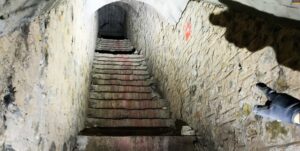
The second shelter we visited was accessible, but equally abandoned.
A crudely covered hole in a small woodland leading to a winding underground path, which is hard to imagine exists.
Of course, as Mr. Kyrimis reveals, in the past, the neighborhood’s teenagers knew about the existence of the site and saw the descent to the shelter as a challenge to prove their mettle. “I remember my friends saying that they would go down the steps without a flashlight to see who was the bravest and who would get as low as possible.”
In itself “this shelter is very well constructed. It’s about 12 to 15 feet underground. It’s also strategic, so it provides too much security. However, because the building in the area has changed too much, while this shelter normally has four entrances and exits, three have now been closed and there is only one entrance and exit, which makes this area unsafe. All shelters, by specification, should have had at least one more fire exit so that if the main entrance collapses, people can safely escape somewhere else.”
However, even if by magic the government decided to undertake a massive restoration of the shelters, Kirimis believes that this alone would not be enough to feel armored against an attack.
First of all because the nature of war is very different from that period.
“Certainly, if one is in the middle of the road, one is totally exposed. If he goes into an apartment building, he’s less exposed. If he goes to the basement, even less, and if he goes to a regular shelter, much less. Old shelters can’t cope and hold up against modern weapons. But that’s not the philosophy either. The philosophy in the ’40s was that bombing was done in a so-called carpet bombing fashion.
There were too many planes flying around, dropping hundreds of bombs, without much accuracy, and the target was a small percentage falling on the target, so the rest of the bombs were falling left and right, with too many collateral damage. Nowadays, weapons of war have become much more sophisticated. Consider that a missile can have a range of 250 kilometers and at 250 kilometers it has a so-called error circle of 10 meters. So, it means that I am aiming at a building, I will hit only that building and ideally I can hit a certain floor of the building. That doesn’t mean that there won’t be casualties, but it certainly means there will be much less collateral damage.”
Therefore the utility value of the shelters is not the same as it was at that time, and in any case no country, “even Switzerland, a model country in the shelter part, quantitatively and qualitatively”, can house more than 5 to 10% of the population.
The philosophy in the event of war “is not so much that we all stay in the city and go to the shelters, but that other plans should be activated, such as leaving the central places and the cities and leaving behind only those who are needed for its operation.”
Can metro stations serve as shelters?
Similarly, the underground metro network cannot be a panacea.
“If you go to the Constitution metro at 9 o’clock in the morning, in peacetime, you will understand why you can’t think about this in war. We still do not as a people have the mentality when the train arrives that those who are in it should get out first and then we should get in, let alone have the psychology in the midst of war and panic to be able to move 5,000 people through the station. I think statistically there are far more likely to be fatalities if they are trampled in the subway than if a Turkish missile or a drone from Iran escapes.”
Therefore, as with many other issues, beyond taking care of infrastructure, a necessary aspect for society to be able to cope with such an extraordinary circumstance is education. “As a society we now expect only shelters to save us, and education plays a very important role.”
“To give you an example, in 1939 there was a very large exercise in Athens in September, in which 7,000 people participated. There was a mock bombing of Athens by three waves of planes in succession. And to make the scenario more realistic, while they were doing the mock bombing, the air force planes were going around, people who were participating in the exercise were lighting flares, smoke bombs on the buildings, so people were getting a chill, an idea of what it would be like to see the city on fire.
Even the newspapers were in on the education part, because the next day they ran announcements saying ”we had so many dead, so many buildings collapsed,” events that hadn’t actually happened, but to create a mithridism in people and to get them used to the image that when there are attacks, there are dead, it becomes something to be expected. So as long as there is no education, we cannot praise the building part and the construction part only.”
In this direction, Konstantinos Kyrimis, who has written a series of books on the subject entitled “The shelters of Attica”, is organizing experiential activities in specific shelters, seeking to acquaint the public with the history of these places, as another modern “education”.
Ask me anything
Explore related questions




