





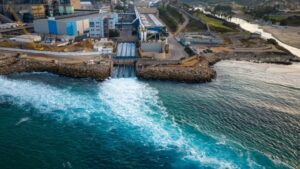
The damage caused on Sunday to a desalination plant in Bahrain by an Iranian drone attack, according to a statement issued by the country’s Interior Ministry that same day, marks a development signaling a dangerous escalation of the war in the Middle East, as critical water supply infrastructure now appears to be coming under attack.
Tehran has not officially commented on the incident. However, a day earlier Iran’s Foreign Minister, Abbas Araghchi, claimed that the United States had struck a desalination plant in Tehran located on the Iranian island of Qeshm in the Persian Gulf.
In a post on social media, the Iranian minister stated that “the United States set this precedent, not Iran.” A spokesperson for the U.S. Central Command, which is responsible for military operations in the Middle East, denied that the American military struck a desalination plant in Iran.
Concern due to limited freshwater sources
Targeting desalination facilities marks a significant expansion in the types of infrastructure being hit in the war that began last Saturday, raising concern in a region where many countries have limited natural freshwater sources.
The Middle East’s desalination plants, which convert seawater from the Persian Gulf into drinking water, constitute a key source of water supply for millions of residents in this arid region.
“This is an attack on the most sensitive point, and on a large scale,” said Hussein Ibish, a senior fellow at the Arab Gulf States Institute, a Washington-based think tank. “Desalination plants, even more than the Gulf monarchies’ energy infrastructure, are their Achilles’ heel.”
The Middle East accounts for more than 40% of global desalination capacity, with about 5,000 plants feeding the region’s water supply systems.
Bahrain fully dependent, Israel needs 80% desalination and Kuwait 90%
Bahrain, where the drone attack occurred, depends almost entirely on desalination plants to meet the drinking water needs of its population of about 1.6 million people. Israel covers about 80% of its drinking water needs through desalination, while in Kuwait the figure reaches 90%.
Although several Gulf countries maintain strategic water reserves, smaller states such as Bahrain could exhaust their reserves within a few days if their production capacity is affected. Saudi Arabia, the largest country in the region, has a greater ability to withstand attacks on water infrastructure compared to its neighboring allies, according to Ibish.
More strikes on civilian and economic infrastructure
As the war in the Middle East continues, more and more attacks are being directed against civilian and economic infrastructure.
On Saturday, a drone exploded near Dubai Airport, causing a temporary suspension of flights. The government of the United Arab Emirates announced that fragments from another projectile struck an apartment building in the tourist area of Dubai Marina.
On the same day, the Berri oil field of Saudi Aramco was targeted by a drone attack that likely originated from Iran, according to Saudi officials familiar with the matter. The same sources said Saudi forces shot down two ballistic missiles heading toward a military base and intercepted multiple waves of drones targeting the Shaybah oil field.
In Kuwait, two fuel tanks at the country’s main airport were hit by drones in a direct attack on critical infrastructure, the country’s Ministry of Defense announced early Sunday.
Earlier in the week, Bahrain reported that a fire broke out at a unit of the state refinery Bapco Energies following an Iranian missile strike. At the same time, an Iranian drone attack caused a fire in an oil tank in the city of Fujairah in the United Arab Emirates on Tuesday.
Iran has also targeted Saudi Arabia’s main oil complex at Ras Tanura at least twice over the past week, while Qatar suspended liquefied natural gas exports after Iranian drones targeted critical energy facilities.
The escalation of attacks has shocked residents of Gulf countries, many of which had never previously faced such intense strikes and have limited shelters or early-warning systems.
At the same time, the Israeli military announced late Saturday night that it struck several fuel storage facilities in Tehran belonging to the Islamic Revolutionary Guard Corps, which “choked” large parts of the Iranian capital with smoke and toxic gases.
These Israeli attacks mark the first time since the start of the war that Israel has targeted energy infrastructure in Iran, following a long public debate about the possible consequences of such an action.
After the Israeli strikes on the fuel tanks, Tehran authorities limited the amount of fuel drivers can obtain, according to the governor of the Iranian capital.
Ask me anything
Explore related questions




