





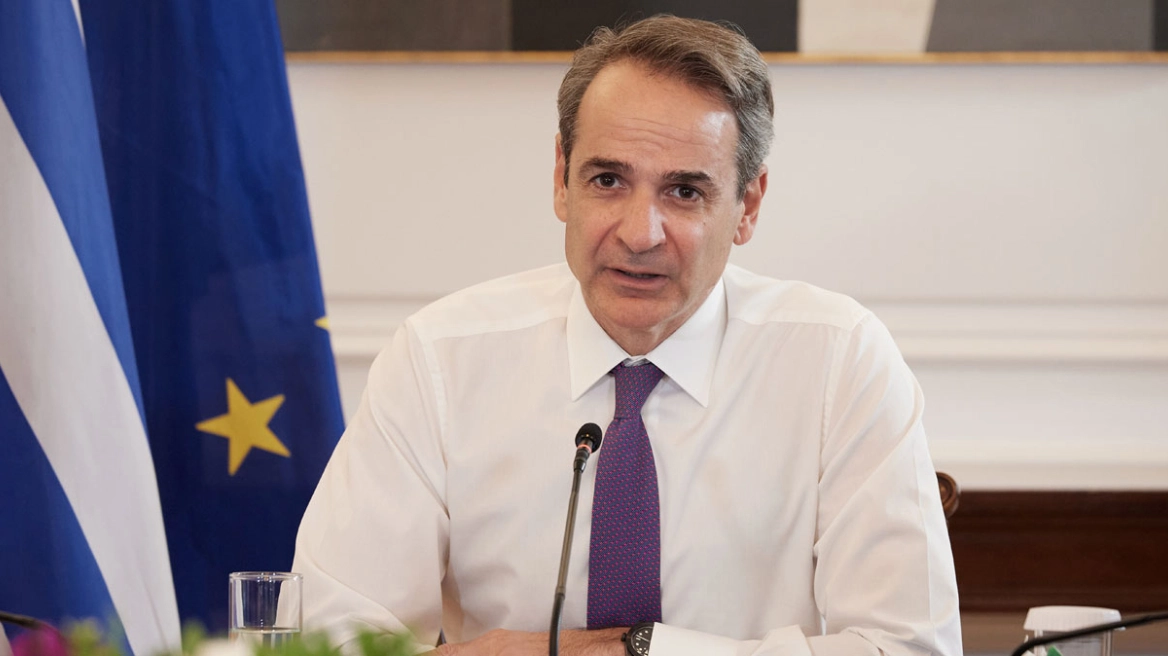
In his weekly review, Prime Minister Kyriakos Mitsotakis focuses on international developments, and especially on the war crisis in the Middle East. After stressing that Greece would stand by Cyprus even if no European partner did, he goes on to outline the government’s interventions, including the imposition of price caps already introduced to address the immediate consequences of the war, and emphasizes that the fiscal discipline of recent years allows for interventions depending on how the crisis evolves.
Read the prime minister’s post:
Good morning! We have already reached the middle of March, with developments around us remaining intense.
At the beginning of the week, together with French President Emmanuel Macron, we visited Cyprus and met with the President of the Republic of Cyprus, Nikos Christodoulides. Our presence there was a self-evident act of support for our Cypriot brothers in a difficult moment. It was a clear message that Cyprus is not alone. I said it then and I repeat it now: Greece would stand by Cyprus even if no European partner did. Fortunately, however, European solidarity and common defense support in practice showed that Europe can respond in critical moments with unity and determination.
International developments, however, never remain only at the level of geopolitics. They almost always affect the economy as well, passing pressure on to prices and ultimately to citizens’ daily lives. In a period of international turmoil in markets and prices, it goes without saying that the state must monitor developments and intervene, ensuring that circumstances do not lead to profiteering. We are therefore moving ahead with imposing a cap on profit margins both on fuel — with special arrangements for the islands — and on 61 supermarket products. The measures will be implemented immediately, supervised by the new Consumer Protection Authority in cooperation with the Ministries of Development and Energy, and will remain in force until the end of June, with heavy fines reaching up to €5 million. Obviously, no country can deal with an international price crisis on its own. It can, however, set rules in the market so that the pressure that already exists is not turned into an unjustified burden on citizens.
As for the broader effects on the economy — beyond prices, that is — we are of course monitoring developments, together with all other European governments. We will act accordingly when there is a clearer picture of how the crisis is evolving and, naturally, based on the resilience of the economy. The fiscal discipline of recent years gives us room to intervene today, with the hope that we will soon be led to de-escalation.
Such periods also remind us of the importance of the energy policy we have pursued in recent years. This is because the increased share of Renewable Energy Sources in the national energy mix that we have achieved significantly strengthens the country’s resilience against the international turbulence in energy prices caused by tensions in the Middle East. Today, the renewables our country has cover more than 50% of electricity generation and contribute decisively to Greece’s lower energy costs, both wholesale and retail, compared with neighboring countries. At the same time, we are investing in energy storage and in natural gas as a transitional fuel, so that the energy system remains reliable and stable. An important step in strengthening the country’s energy security is also represented by the agreements ratified by Parliament with the Chevron and HELLENiQ Energy consortium, which pave the way for new investments with significant economic and geopolitical implications.
However, in an era of major geopolitical upheaval, all options must be on the table. As I mentioned at the recent summit convened in Paris by President Macron, Europe cannot achieve its core goals — such as strategic autonomy, economic competitiveness, and decarbonization — without also discussing the role of nuclear energy. One only has to look at the low energy prices in the French wholesale market, which are due to a large extent to the stable base of nuclear power that shields the French economy from external energy shocks. That is why Greece must seriously examine whether small modular reactors can have a role in its energy mix. Some people refer to an earlier statement of mine rejecting traditional nuclear reactors, and I stand by that. Small modular reactors are a different technology, both in terms of safety requirements and investment size, and I believe this option must be examined. We will establish a high-level ministerial committee, which will submit specific proposals to the government on this issue.
Now, changing the subject, and since the weather is already spring-like — and for the more impatient, summer is approaching too — let me say a few words about our preparations for this year’s wildfire season. As I have already mentioned, we are moving forward with the modernization and upgrading of seven Canadair CL-415 aircraft. The relevant contract signed a few days ago provides for the installation of modern avionics equipment — the so-called “glass cockpit” — as well as an overall operational upgrade of the aircraft, so that our fleet can continue to operate with high standards of safety and reliability for many more years. Let me also remind you that the delivery of seven new Canadair CL-515 aircraft is forthcoming and, together with the other seven upgraded aircraft that we will begin receiving from March 2027, we will be the country with the largest fleet of this type in the world. This contract completes all procurement for the aerial assets included in the AEGIS program and implemented by PPF, the project preparation facility for strategically important projects of the HCAP.
After two years of preparation, the system of cross-check inspections for vehicles circulating without insurance or without having paid road taxes is now entering full implementation. Around 300,000 owners received notices regarding their debts and fines, after repeated prior warnings to comply had gone unanswered. In total, 297,561 notices are being sent: 125,051 for uninsured vehicles and 172,510 for non-payment of 2025 road taxes. The total amount of debts and fines comes to approximately €109.5 million. Those who believe there has been an error can file an objection electronically through the “Cross-Check Inspections” application at oximata.gov.gr. In such matters, however, there can be no tolerance. Compliance with the rules is a matter of fairness for everyone and, above all, a matter of road safety.
The government is proceeding with the implementation of a new, more modern way of supporting the most vulnerable households. The old system of food distribution through multiple intermediaries is being replaced by a digital card given directly to beneficiaries, so that they can meet their needs more directly. At the same time, retroactive payments are also provided for so that no beneficiary loses the support they are entitled to during the transition period. The system is linked to the Guaranteed Minimum Income and makes use of digital procedures, allowing more direct and automated inclusion of beneficiaries. The vouchers will be used exclusively for the purchase of food and basic goods in retail stores, ensuring that the support reaches where it is truly needed. The program, with a budget of approximately €400 million through 2029, will substantially strengthen the social protection net, increasing financial support for beneficiaries by around €55 per month on average. Yet another targeted initiative to support our most vulnerable fellow citizens.
Let me also mention two important cases solved by the Financial Crime Unit of the Organized Crime Directorate. One concerns the dismantling of a criminal organization that is alleged to have set up illegal casinos in dozens of internet cafés in Athens, Thessaloniki, Patras, and Agrinio, with profits estimated at €16 million. Seventeen arrests have been made, though investigations are continuing. The second success of the so-called Greek FBI was the identification of a powerful Roma family involved in a fraud case concerning gold sovereigns. Hellenic Police officers tracked them down through systematic analysis of individual complaints from victims who had been deceived using the same methodology.
But there was also a major success by the Independent Authority for Public Revenue, which managed to uncover a large fuel-smuggling ring that, through three front companies, was systematically channeling illicit fuel into the market, earning profits of at least €9 million. The investigation lasted a year and led to the arrest of 14 people allegedly involved in the fraud, through which the state suffered damages of €2.7 million in lost duties.
This week the government focused its efforts on two regions of our country that have been hit by major natural disasters in recent years: Thrace and Thessaly.
I was very pleased to see the latest employment figures for the Eastern Macedonia and Thrace region, which for many years faced high unemployment. Unemployment there has fallen significantly, from around 17% in 2019 to 9.4% today, while there are 14,300 more people in work than then. It is a development that shows that regional growth can translate into real opportunities for citizens. At the same time, the Ministry of Labour announced new targeted measures to boost employment in the region: a subsidized employment program for 2,000 new jobs is being activated, while a special work-experience program for 250 unemployed people in the livestock sector is also beginning. A commitment I announced two years ago is also being implemented: the establishment of a Music School in Orestiada, through the use of a DYPA property granted to the municipality. A new educational and cultural reference point for the area. Support for Thrace and for the Greek regions is not a slogan. These are projects advancing step by step.
In addition, during my visit yesterday to Thessaly, I had the opportunity to discuss with local stakeholders an issue that has remained pending for decades: the partial transfer of water from the Acheloos River to Thessaly. This is a project that began back in the 1960s, with significant parts of the infrastructure having been built but remaining inactive to this day. The government has decided to restart the project in an organized manner, under the coordination of the Vice President of the Government, so that there can finally be a unified plan. Thessaly is facing a significant water deficit and, according to experts, a measured transfer of water, also making use of the large hydroelectric project at Mesochora, can make a substantial contribution to addressing it. In an era of intense climate pressure and water scarcity, ensuring adequate water resources is a prerequisite for the future of agricultural production and the development of Thessaly.
A historic building in Thessaloniki that survived even the great fire of 1917 is returning to the life of the city. The fully restored building of the State Conservatory of Thessaloniki on Frangon Street was inaugurated this week after extensive restoration work. The building now has modern infrastructure and returns to its role as a center of music education and creativity for Thessaloniki. At the same time, a new state-of-the-art Recording Center and Augmented Reality Studio was inaugurated at the Thessaloniki Concert Hall, enabling the live recording of concerts and the creation of modern audiovisual productions using cutting-edge technologies. These two interventions are part of our strategy to invest simultaneously in the protection of cultural heritage and in the development of new cultural and technological infrastructure, strengthening Thessaloniki’s role as an important hub of artistic creation in the country and the wider region.
But just as we invest in developing new cultural and technological infrastructure, we are also investing in the protection of our cultural heritage. Greece is one of the few countries that has a National Strategy for protecting its cultural heritage from the effects of climate change. Since 2019, the Ministry of Culture has been implementing a comprehensive program for identifying and assessing climate risks, prevention, and strengthening resilience, aligned with international standards and harmonized with the broader National Strategy for Adaptation to Climate Change. Now, however, we are acquiring a long-term action plan through 2050, with five-year interventions for recording risks, prevention, and strengthening the resilience of emblematic archaeological sites and monuments against extreme climate phenomena. From Dion to Mystras and from Delos to Malia, dozens of interventions are being implemented to protect against fires, floods, and landslides. Our homeland, as a country with a unique cultural imprint in the history of humanity, has the responsibility to protect its monuments not only for the present, but also for future generations.
I close with the unanimous selection of Giannis Antetokounmpo, following a government proposal, as one of the 20 personalities awarded the European Order of Merit by the European Parliament. It is an entirely deserved recognition for an athlete who, beyond his great achievements, embodies our shared values: human dignity, equality, and social inclusion.
Ask me anything
Explore related questions




