





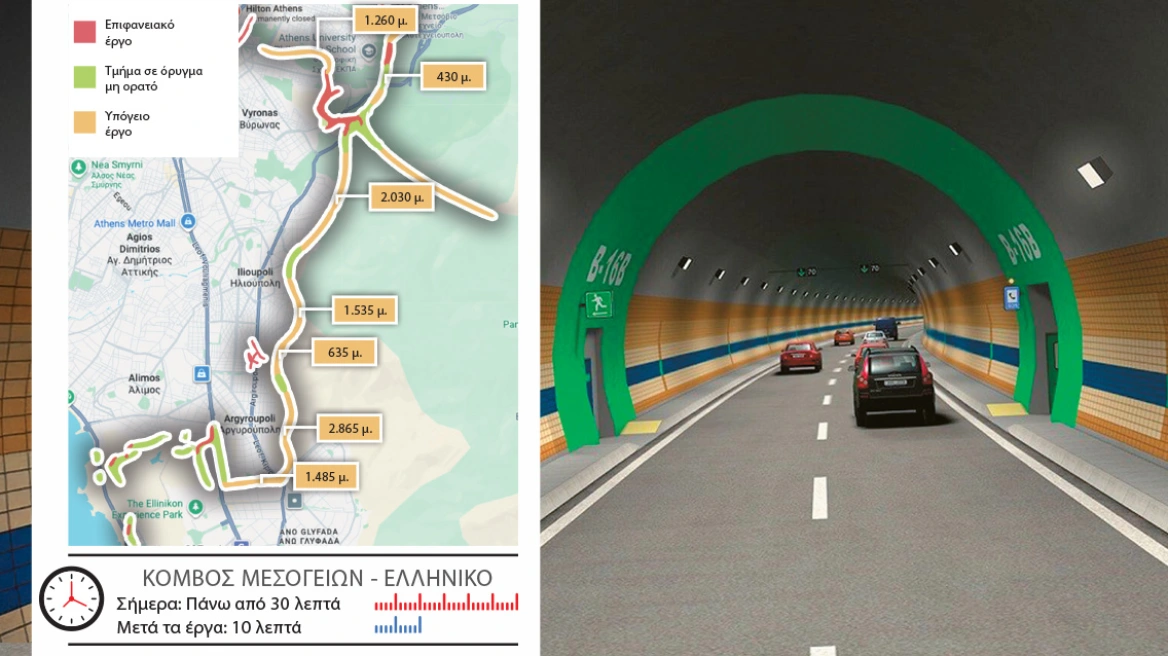
If there is one project in Attica that resembles the legendary “Bridge of Arta”—a Greek expression used for something endlessly delayed—it would be the construction of the Ilioupoli Tunnel or Hymettus Tunnel. This ambitious project was first announced in 1979 by Konstantinos Karamanlis. In retrospect, the plan appears remarkably forward-looking, since today it is presented as one of the potential solutions to Athens’ traffic congestion.
The project was announced, halted, restarted, partially excavated—leaving holes in the mountain that remained just holes—then frozen again, and now it is being revived once more. Even if delayed and facing some opposition, the “haunted” tunnel promises to cut about 20 minutes from the capital’s traffic congestion and reduce the Mesogeion–Elliniko trip to just 10 minutes.
Will the project finally be completed? Some observers call it the most important road project in Attica. Yet skepticism is understandable: nearly half a century for just 4 kilometers is hardly a short time.
Nevertheless, the municipalities of Ilioupoli, Vyronas, and Elliniko–Argyroupoli have recognized its importance. They have collected thousands of signatures from citizens demanding the project’s completion and threaten mobilizations if it is postponed again indefinitely.
Three Lanes in Each Direction
A project that has long returned to public discussion as a promise to ease Attica’s traffic congestion now appears to be entering a more mature stage.
The Ilioupoli Tunnel, an underground road passage planned to connect the Western Hymettus Ring Road with Vouliagmenis Avenue, has once again come to the forefront. Greece’s Deputy Minister of Infrastructure and Transport, Konstantinos Kyranakis, stated clearly in Parliament that “the completion of the Ilioupoli tunnel is progressing.”
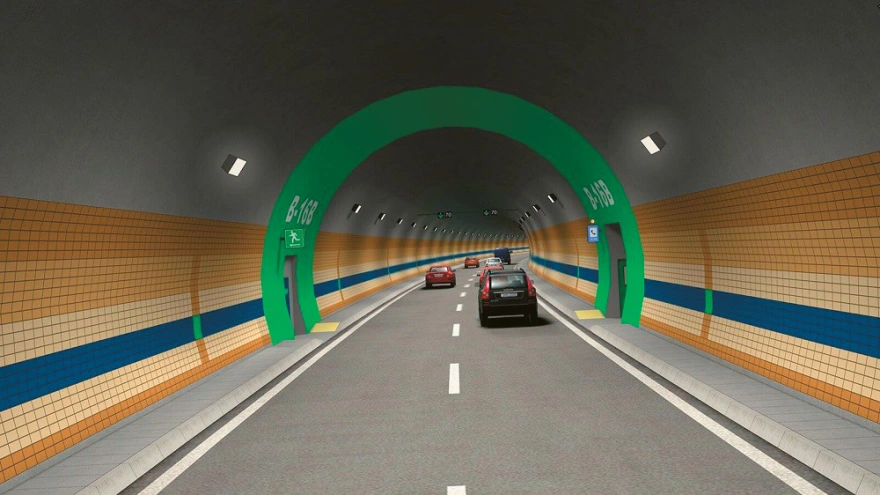
The project involves constructing a tunnel about 3 km long, with three traffic lanes in each direction. There will be no intermediate exits. The tunnel will begin descending underground near Katehaki Avenue and emerge at an interchange on Vouliagmenis Avenue.
Essentially, this is an extension of the Attiki Odos highway, specifically the Western Hymettus Ring Road, toward the Elliniko area. As part of the broader redesign, grade-separated interchanges will also be built along Vouliagmenis Avenue, reducing the need for traffic lights that currently cause frequent delays.
Travel Time Savings
In practice, this will function as a new road artery allowing drivers to bypass much of Athens’ urban congestion via a shorter and more predictable route.
For thousands of daily drivers, this means significant time savings—especially during peak hours when traffic on major roads in southern Athens becomes extremely heavy.
Today, the trip from Katehaki to Elliniko can take 25–30 minutes, depending on traffic. With the new tunnel, the goal is to reduce that trip to less than 10 minutes, a reduction of around 70%.
This explains why the Ilioupoli Tunnel is considered one of the most critical infrastructure projects for the Athens metropolitan area. Beyond driver convenience, it aims to improve the city’s overall functionality, connect different regions more efficiently, and relieve heavily burdened roads.
The project is also directly linked to the broader extension of Attiki Odos toward Elliniko and the coastal zone. This connection is particularly important because of the massive redevelopment project at The Ellinikon, which is transforming the southern waterfront and is expected to significantly increase traffic from residents, workers, and visitors.
Thus, the tunnel is seen not only as a solution to today’s traffic problems but also as a tool to adapt Athens to the growing transportation demands of the future.
The Airport Connection (Original Concept)
Interestingly, the project—now considered highly important—was first announced in 1979 by Konstantinos Karamanlis with a different purpose: connecting Athens more quickly to the old airport located at Elliniko.
The first ideas for the tunnel date back to the 1970s, when the need for a faster connection between the coastal zone and eastern Attica became increasingly important. At that time, the plan was also tied to the old Elliniko airport, facilitating movement from the Mesogeia region to the southern suburbs.
Later, when the airport moved to Spata, the tunnel’s role changed but remained important: it could provide southern suburb residents with faster access to the new airport.
Early Test Excavations
Initial test excavations were carried out in 1979 in the Stavros pass, following the path of the ancient Sphittian Road, a historical route that crossed Mount Hymettus at its lowest pass.
During the early works:
- Two test tunnels (~60 m each) were excavated near Terpsithea above the Glyfada cemetery.
- Another 130 m tunnel was dug from the Dukes stream area near Sesi.
These exploratory tunnels were meant to serve as the basis for the main underground connection. However, the project never progressed beyond the research stage, leaving the excavations as silent remnants of an ambitious plan that was abandoned before construction began.
Local Opposition and Abandonment
The exact reasons why the project was never implemented remain unclear. Some argued the route was not the best possible alignment. At the same time, local opposition emerged because the project would have required new access roads passing through private property.
These social and planning pressures appear to have contributed to the abandonment of the plan.
Even today, the traces remain on Mount Hymettus. The test tunnels were never sealed and still exist as relics of an earlier vision for Attica’s infrastructure. During the excavation of the main test tunnel, workers even discovered a small cave connected to one of the internal corridors.
A Symbol of Unfinished Plans
The story of the Glyfada–Koropi tunnel illustrates Attica’s long-standing difficulty in turning ambitious ideas into completed infrastructure.
On one hand, there was a clear need for better connections between the southern suburbs and the Mesogeia region. On the other, technical challenges, local opposition, and perhaps a lack of consistent political commitment left the project unfinished.
Today, the “abandoned Hymettus tunnel” serves more as a reminder of a road that was never built than as the beginning of one that will be completed.
Yet that sense of unrealized potential keeps the idea alive. In a region still searching for solutions to its transportation challenges, every old plan that might have changed the landscape gains renewed value. The abandoned Hymettus tunnel is not just a forgotten construction—it is part of Athens’ infrastructure history, a subterranean reminder that some projects remain longer in collective imagination than on the map.
Ask me anything
Explore related questions




