





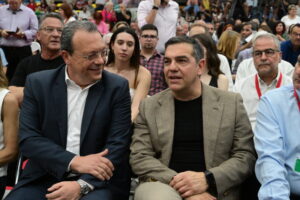
Executives of the Syriza Progressive Alliance have been closely watching developments in PASOK over the past twenty-four hours, and they are far from indifferent. The high levels of participation and the moves by the leadership team at Charilaou Trikoupis have raised significant concern within the former opposition party.
Today at noon, the Co-Party and Enlargement Committee is meeting in a formal session in the presence of PASOK President Nikos Androulakis, with participation from former SYRIZA Deputy Ministers, including Theodosis Pelegrinis. This has further heightened nervousness both inside and outside Koumoundourou. Executives are anxious not only because of low poll ratings but also due to former Prime Minister Alexis Tsipras’s reluctance to activate part of Koumoundourou’s potential—a situation they had counted on remaining static in Charilaou Trikoupis’s efforts to attract executives from the broader political field.
For these reasons, many within SYRIZA PS now feel that the “hourglass of waiting” has run out. They are preparing to launch dynamic initiatives, with the faction led by Pavlos Polakis taking the lead. Starting tomorrow at noon, when the party’s Political Secretariat meets, and with the Central Committee meeting scheduled for next weekend, the two dominant internal factions aim to gauge support and definitively resolve the question of cooperation with other progressive forces.
The Two Lines
The faction aligned with MP Pavlos Polakis advocates for SYRIZA PS to maintain autonomy, pushing for a clear roadmap toward the elections to solidify the party’s strategy in public opinion. “SYRIZA will participate in the elections either as part of a broader coalition or, if others decline, it will run independently. We will not shut down a party that represents the historical current of the Left,” said Tryfonas Alexiadis on Parapolitika FM, echoing the views of Polakis’s group.
Meanwhile, the party’s press spokesman, Kostas Zachariadis, reiterated his support for collaboration on ERTnews. “It is not our preference for SYRIZA-PS to stand alone; we are working toward a broad Progressive Alliance,” he said. He described a coordinated effort aimed at unifying progressive forces, addressing both smaller movements—such as Nikos Kotzias, Louka Katseli, and Pavlos Kokkalis—and larger ones, including New Left, PASOK, and of course Alexis Tsipras.
Zachariadis added that if PASOK decides at its congress to run independently—which he considers the most likely scenario—then the question arises for SYRIZA PS: what course of action will they take if PASOK seeks to “defeat Mitsotakis by a single vote,” as Androulakis has suggested?
“I don’t agree with withdrawing, just as I don’t agree with simply surveying SYRIZA’s current forces,” Zachariadis continued. “The role of SYRIZA-PS, as mandated by the decisions of the Political Secretariat and Central Committee, is to reconstruct the broader progressive space, promoting unity and overcoming dividing lines. We must actively participate in this debate. We are not talking about shutting down SYRIZA-PS, nor do we want to. But statements like ‘if it doesn’t work, I’ll go it alone’ risk becoming self-fulfilling prophecies,” he concluded, subtly addressing Polakis.
Famellos in a Bind
Amid this climate, both factions are calling on party President Socrates Famellos to take a clear position, clarifying the party’s stance as the election period intensifies. Famellos responded that cooperation with Alexis Tsipras would require a “common program and a common ballot paper.” However, this statement has yet to satisfy either faction, both of which are pressing for a more definitive articulation of SYRIZA PS’s electoral approach.
Ask me anything
Explore related questions




