





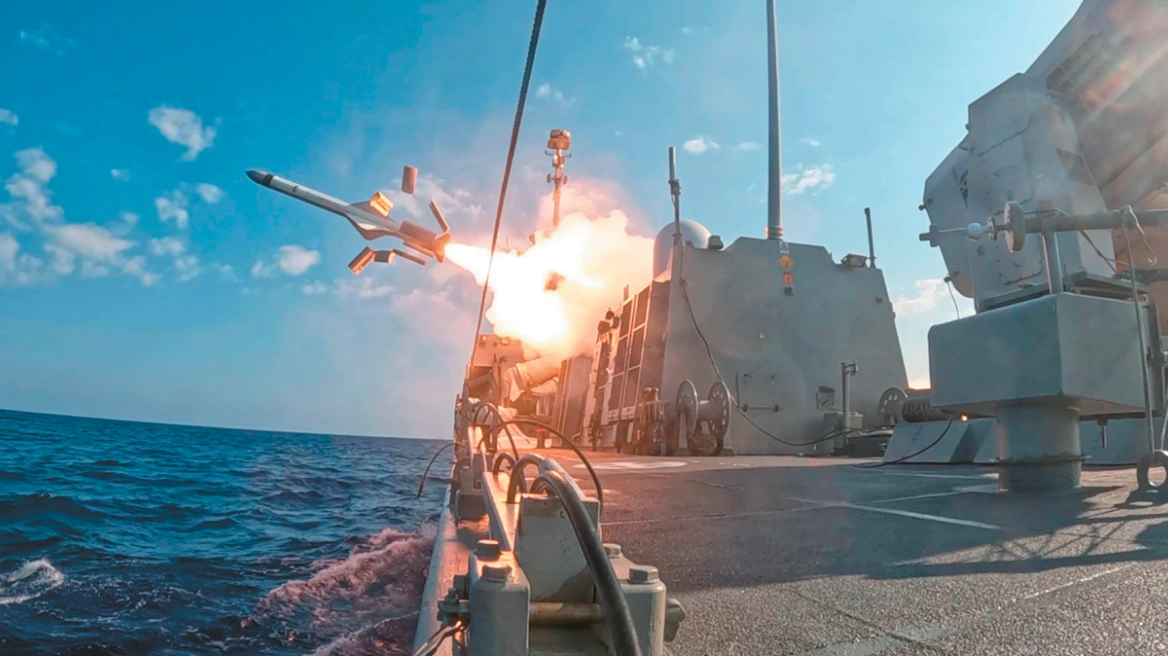
The display came just hours after a key meeting of the Government Council for Foreign Affairs and Defense (KYSEA), chaired by Prime Minister Kyriakos Mitsotakis, who gave the green light to a comprehensive air defense and aerial coverage system. Estimated to cost around €4 billion, the initiative aims to significantly enhance Greece’s deterrence capabilities.
A Five-Layer Defense Shield
Many components of the new system—dubbed the “Achilles’ Shield”—were presented during the March 25 military parade in Athens. The Ministry of Defense effectively staged a show of strength in front of Syntagma Square, unveiling parts of a five-tier defensive architecture that Greece is adopting for the first time in its history.
This integrated system will create a protective umbrella over Greek territory and extend into the wider Mediterranean. It is structured across five levels:
- Anti-aircraft defense
- Anti-ballistic protection
- Anti-drone systems
- Anti-ship capabilities
- Anti-submarine warfare
The last two layers focus primarily on safeguarding maritime borders.
For the first time, core military units and advanced defense technologies will be combined with artificial intelligence applications and modern command centers, many of which will be developed domestically. The system draws on global best practices, including models implemented in countries such as Israel.
Anti-Drone Systems and Electronic Warfare
A central component of the anti-drone layer is the Greek-designed “Centaur” system, capable of detecting and neutralizing hostile drones through electronic jamming. Developed through collaboration between the Hellenic Center for Defense Innovation (ELKAK) and the Hellenic Aerospace Industry, the system is already deployed on Greek Navy frigates operating in the Red Sea as part of Operation “ASPIDES.”
Interest in acquiring the system has reportedly emerged from countries such as Cyprus and Bulgaria, reflecting its effectiveness in real-world conditions.
Drone integration is expected to play a key role in the new defense structure. Mobile drone production units—also presented at the parade—will support this effort. Based at the 306th Technical Base Factory in Xanthi, these units are equipped with advanced tools and 3D printers, enabling the production of spare parts and up to 1,000 FPV (First Person View) drones annually in field conditions.
At the second level of protection, V-BAT unmanned aerial systems have already been introduced into the Armed Forces, following a donation from the Athanasios K. Laskaridis Foundation. These vertical take-off and landing (VTOL) drones are designed for surveillance, reconnaissance, targeting, and search-and-rescue operations, particularly in Thrace and across the Aegean.
Command, Control, and AI Integration
Command-and-control systems will play a pivotal role in the “Achilles’ Shield.” Among them is the Tactical Command and Control Station, an autonomous operations center equipped with advanced communications and digital tools.
The broader architecture also incorporates electronic warfare capabilities, including jammers and sensors designed to detect and disable unmanned aircraft. Advanced AESA radar systems will enable the tracking of hundreds of targets simultaneously.
Artificial intelligence applications will further enhance operational efficiency, with software capable of prioritizing threats in real time and recommending the most appropriate response systems.
Unmanned aerial vehicles will also support major units. For example, the S-100 drone—integrated into the new FDI Belharra frigates—can detect, identify, and target threats at distances of up to 100 kilometers without operator intervention.
Advanced Missile Defense Systems
Beyond domestically developed technologies, Greece’s missile and ballistic defense will rely on proven, state-of-the-art systems.
These include the Israeli-made PULS (Precise & Universal Launching System) multiple rocket launchers, recently approved by Parliament. In addition to Patriot systems, military sources suggest that the following may also be integrated:
- SPYDER (short- and medium-range air defense)
- Barak MX (multi-layer missile defense system)
- David’s Sling (medium- to long-range missile interception system)
Key Milestones Toward 2030
The implementation of the new defense structure is progressing rapidly under the “Agenda 2030” framework, championed by Defense Minister Nikos Dendias.
A major milestone will be the arrival of the first F-35 fighter jets at Andravida by 2028. This will be followed by the completion of the Hellenic Navy’s FDI Belharra frigate program. After the commissioning of the frigate “Kimon,” the second vessel, “Nearchos,” is expected in 2026, followed by “Formion” and “Themistocles.”
Another critical step is the creation of a unified information network linking all branches of the Armed Forces. This network will connect fighter aircraft—such as Rafale jets—with ground forces and special operations units, ensuring full interoperability across the military.
The ultimate goal is for Greece to field a fleet of 200 advanced fighter jets by 2030, including fourth- and fifth-generation aircraft such as F-35s, Rafales, and upgraded F-16 Vipers.
Strategic Investment and Regional Context
The broader 12-year defense procurement program is expected to reach up to €25 billion, marking the largest defense investment in Greece’s modern history. Prime Minister Mitsotakis has described the initiative as a cornerstone of national security.
At the same time, regional dynamics remain fluid, with Turkey pursuing defense agreements with the United Kingdom for Eurofighter support.
Against this backdrop, the “Achilles’ Shield” is positioned as a modern “Greek Dome”—a comprehensive defensive barrier that draws symbolic inspiration from Homeric heroes while addressing the challenges of contemporary warfare.
Ask me anything
Explore related questions




