





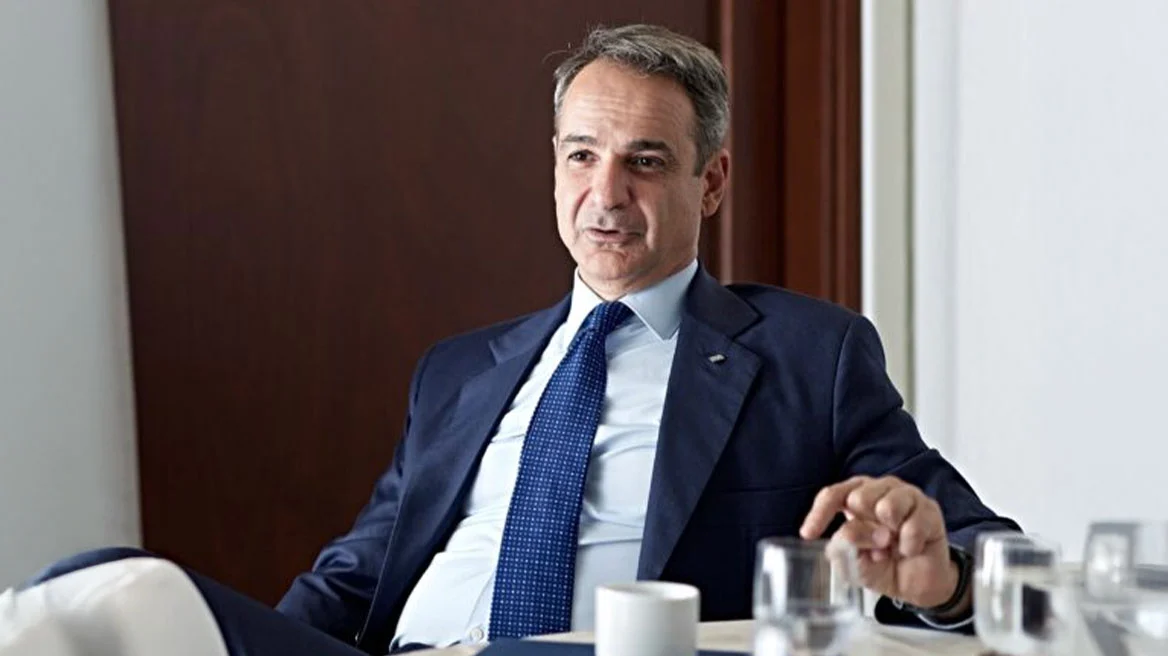
Prime Minister Kyriakos Mitsotakis, in an interview with Breitbart News on the sidelines of the Delphi Economic Forum, emphasizes the need to reach an agreement between the United States and Iran in order to end the war in the Middle East and restore stability in energy markets.
In his interview, Mr. Mitsotakis expresses hope that the President of the United States will succeed in reaching an agreement with Iran, which would also include the reopening of the Strait of Hormuz. At the same time, he refers to an upcoming visit by Donald Trump to Greece, stressing that the American president “will have a very good time.”
Matthew Boyle, the journalist who interviewed the Greek Prime Minister, notes that this position comes roughly a year after Mr. Mitsotakis had stated, following the imposition of global tariffs by Donald Trump, that the US and the EU would soon reach a “win-win” agreement—an assessment that was confirmed a few months later with the signing of a relevant agreement by the American president and Ursula von der Leyen.
In his new intervention, Mr. Mitsotakis reiterates his hope for a similar development in US–Iran relations, noting that after the achievement of military success by the United States, the focus now shifts to economic consequences and diplomacy.
“Let’s hope that we will also have some sort of agreement regarding the situation in the Middle East because of course we’re all quite concerned about the economic fallout,” Mitsotakis told Breitbart News. “Of course, we, from the very beginning, said that Iran cannot have a nuclear weapon, and as a country in the region we’re always very concerned with the destabilizing effect that Iran had but I think we’ve reached a point where we need to be quite concerned about the economic fallout of this situation.”
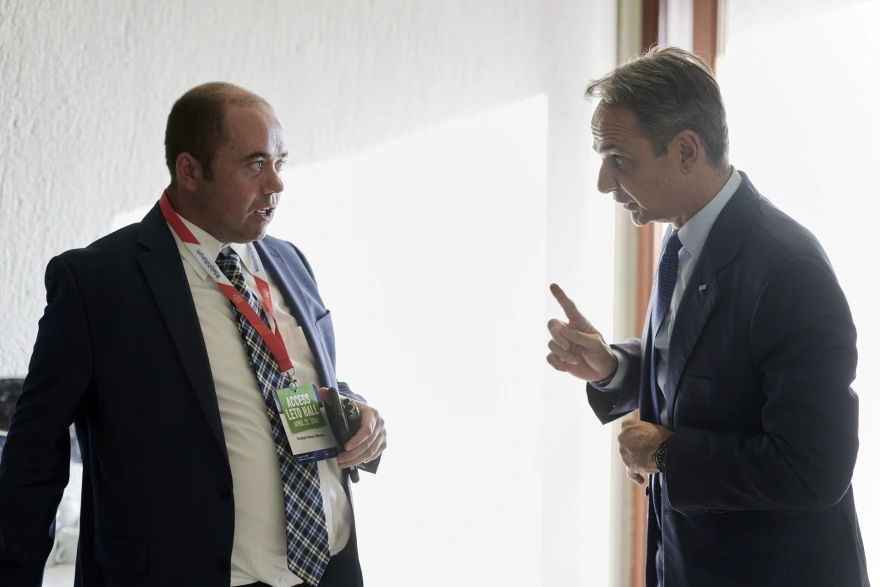
“A wake-up call”: Hormuz and Europe’s energy autonomy
The Prime Minister also emphasized that developments in Iran and the Strait of Hormuz highlight the need for Europe to become more energy autonomous. In this context, he stressed that Greece is, for the first time in decades, moving forward with natural gas exploration through partnerships with American companies such as ExxonMobil and Chevron.
“This is a wake-up call for Europe to become more realistic and more practical regarding the energy transition,” he said. “We have supported both renewable energy sources and natural gas, demonstrating that they can coexist. We are moving forward with exploration, with the first expected from Exxon after 40 years, and more to follow from Chevron. We want to maintain close cooperation with American energy companies and rely on the US as a reliable supplier of natural gas at competitive prices.”
Referring to transatlantic relations, Kyriakos Mitsotakis rejected the view that the Iran crisis is pushing Europe and the United States apart, arguing instead that it will bring them closer.
“I believe this crisis will ultimately bring the US and Europe closer,” he said. “Despite the difficulties, the transatlantic alliance still has much to offer. If this means Europe must increase its defense spending, then that is the right step. We have already done so in Greece, and the same is happening in other European countries.”
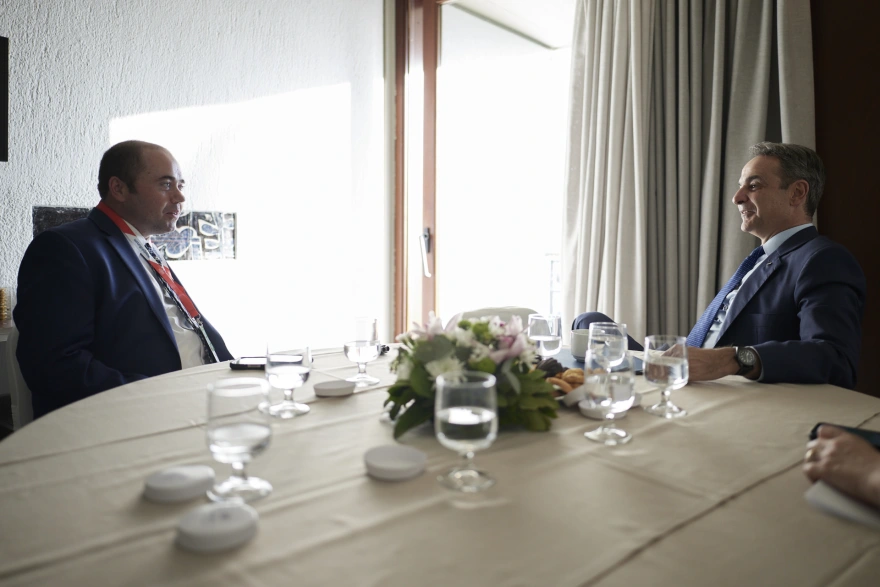
“We are proud of our hospitality; Trump will have a very good time”
He also made special reference to Greece–US bilateral relations, describing them as stronger than ever, noting that Donald Trump is expected to visit Greece soon (according to the US ambassador to Greece, Kimberly Guilfoyle, this is expected “very soon” within the year).
“I can guarantee that he will have a very good time,” he said, adding that “Greeks are proud of their hospitality.”
The Prime Minister highlighted the historical ties between the two countries, noting that the founders of the United States were inspired by ancient Greek democracy, while the Greek War of Independence was influenced by the American struggle for independence. He also emphasized Greece’s geopolitical role in the Eastern Mediterranean, its strategic relations with Israel and the Arab world, and the importance of the IMEC corridor connecting India–Middle East–Europe.
Regarding energy, he stated that agreements with ExxonMobil and Chevron have already been signed and that the first exploratory activities are expected to begin in the first quarter of 2027. “If successful, this would be a decisive development for Greece and Europe,” he said, while also underlining Greece’s role as a liquefied natural gas (LNG) import hub and an energy supply corridor for neighboring countries and Ukraine.
Finally, he referred to Greece’s role as a mediator in regional crises, noting that it maintains relationships of trust with Israel, Arab countries, and the Palestinians. He supported the two-state solution for the Middle East and stressed the need for progress on Gaza, in order to create conditions for broader regional stability.
Ask me anything
Explore related questions




