





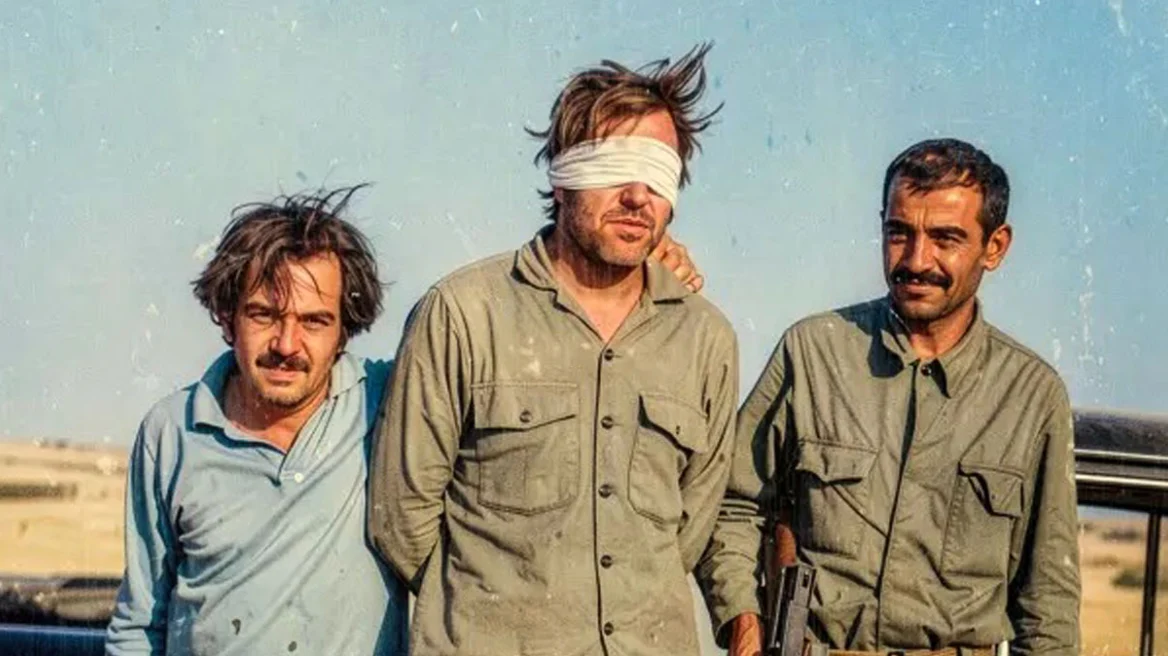
A photograph that is being made public for the first time on the Greek Cypriot side opens a new round of investigation into the fate of a prisoner from the 1974 Turkish invasion. The man is depicted blindfolded and with his hands bound, standing among Turkish military personnel and in front of a black Mercedes that is linked to testimonies about missing persons in the Agios Dimitrios area, near Mia Milia, outside Nicosia.
The photograph was released by researcher Odysseas Christou, who is appealing to anyone with information to help identify the man. He describes him as a “giant prisoner,” both because of his physical build and his posture within the scene of captivity.
According to the analysis presented, he is most likely a Greek Cypriot reserve National Guardsman, without equipment, wearing an olive-green uniform, with his eyes covered by white cloth and his hands tied behind his back.
The photograph and the three figures
Three men can be seen in the photographic evidence. The prisoner stands in the center. To his right appears a Turkish soldier, likely an officer, fully equipped, carrying a Thompson submachine gun and a pistol holster on his belt. To the left stands a man in civilian clothing who, according to the researcher’s assessment, either accompanied the military unit or was connected to a television crew from Turkey’s state broadcaster TRT.
Behind them, a black Mercedes-Benz 230, known as the “Fintail,” a model from the 1960s, is visible. The presence of the car is particularly significant, as the researcher is examining whether it is the same “black Mercedes” mentioned in testimonies about missing persons in the Agios Dimitrios area.
In such cases, even a car ceases to be a minor detail. It becomes part of the path of people who disappeared and of families who, half a century later, are still searching for answers.
The possible location and time the photo was taken
According to Odysseas Christou, the photograph is linked to the area around the chapel of Agios Dimitrios in Mandres Kaimakliou, just south of Mia Milia. The area lay along the axis of the Turkish advance during the second phase of the invasion, after the collapse of the Geneva talks and the launch of “Attila 2” on August 14, 1974.
The analysis accompanying the publication of the document estimates that the photograph was taken between August 14 and 17, 1974, with August 15 being the most likely date. Based on shadows and the position of the sun, an afternoon time frame is considered more probable, around 18:30 to 19:30, although a morning shot cannot be entirely ruled out.
The role of TRT
According to the same research, the photograph appears to have been taken by a member of a TRT television crew led by Turkish journalist Selim Esen.
Esen had arrived in Cyprus on August 11, 1974, and followed Turkish military movements across various areas. On August 14, with the start of the second phase of the invasion, he is believed to have followed Turkish tanks toward Famagusta, passing through Mia Milia, Tymbou airport, and likely the Agios Dimitrios area.
This is particularly important, as it increases the likelihood that additional footage or photographs from the same area and period may exist. If found, they could help not only identify the man in the photograph but also reconstruct the final movements of prisoners and missing persons.
The Agios Dimitrios area
According to testimonies cited by the researcher, the Agios Dimitrios area had been turned into a gathering place for civilians and prisoners. Many residents of Mia Milia, along with refugees from the first phase of the invasion, had taken refuge in the chapel and nearby houses. The men were taken separately, blindfolded and with their hands bound, while women and children were held in enclosures in the area.
Of the 14 missing persons reportedly last seen in the Agios Dimitrios and Mandres Kaimakliou area, only three sets of remains have been found. About 60 men were taken the following day to Pavlidis Garage as prisoners and later transferred to prisons in Adana, while the women and children were released.
The “black Mercedes” and the missing persons
The “black Mercedes” is also central to the investigation, as testimonies state that three missing individuals were seen boarding such a car on the afternoon of August 15. They were 28-year-old reserve commando Makis Sergidis of the 211 Infantry Battalion, 23-year-old reservist Evangelos Portis of the 241 Infantry Battalion, and 42-year-old civilian Nikos Kolokasis from Mia Milia.
The same testimony notes that also inside the Mercedes were the then 21-year-old deacon of Archbishop Makarios, Father Theoklitos, and 17-year-old Kostas Giannakas, who disembarked at the last moment following the intervention of a Turkish corporal and a Turkish officer. The fate of the remaining passengers remains unknown.
Call for testimonies
The publication of the photograph does not close a case. It reopens it, with the hope that someone may recognize the prisoner or provide information about the route of the black Mercedes. Odysseas Christou is calling on anyone with knowledge to assist in the investigation, as the identity of the blindfolded man remains unknown.
Fifty-two years after the invasion, such evidence serves as a reminder that the issue of missing persons does not belong to the past in the way public discourse often finds convenient. For families, every photograph, every name, every testimony, and every forgotten frame can be the beginning of an answer that has been inhumanly long delayed.
Ask me anything
Explore related questions




