





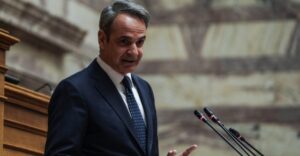
The nearly six-hour meeting of the parliamentary group of New Democracy concluded with messages of unity, pointed remarks, and internal party criticism. The prime minister tried to maintain balance, allowing room for MPs’ concerns while setting clear boundaries.
In his address, Prime Minister Kyriakos Mitsotakis presented a package of proposals for the forthcoming Constitutional Revision. He also urged MPs to avoid “gloomy introversion” and to “sweat for the jersey,” while attacking PASOK and sending a message to the European Public Prosecutor’s Office regarding the OPEKEPE case, clarifying that all MPs would remain on the party ballots.
During the marathon discussion, sharp comments were unavoidable. Adonis Georgiadis took aim at Nikos Dendias over his absence, Makis Voridis called European Chief Prosecutor Laura Kövesi an “activist,” and Thanos Plevris demanded an end to the “protected environment” surrounding ministers. At the same time, MPs criticized the behavior of non-elected ministers toward them and the lack of consultation on key decisions.
Mitsotakis: “We need to sweat for the jersey”
In his speech, the prime minister called on MPs to “speak the language of citizens,” reminding them that high prices remain the number one issue. At the same time, he urged them to avoid “gloomy introversion,” making clear that internal reflection is welcome as long as it comes with alternative proposals and does not turn into public infighting. “To win a third consecutive election, we need to sweat for the jersey. And we will do it together,” was his message to MPs.
Mitsotakis also referred to the OPEKEPE case. “We will not allow Parliament to turn into a permanent courtroom, and everyday governance will not be subordinated to self-appointed judges,” he stressed, calling for a “swift, clear, unobstructed” path toward vindication for the MPs involved. Calling on the European Public Prosecutor’s Office “to dispel the impression that it is involved in political conflict,” he announced that all ND MPs would remain on the electoral ballots if they wished, emphasizing that “without final court rulings, the presumption of innocence applies.”
Attack on PASOK and the opposition
The prime minister was particularly sharp toward PASOK, commenting on its stance during the recent attempt to appoint heads of Independent Authorities. Accusing the main opposition party of “backtracking from a political agreement while simultaneously speaking with the smaller opposition and deceiving both sides,” he said such tactics “may suit university lecture halls, but not Parliament.”
He also criticized the opposition as a whole, accusing it of “awkward silence” and being solely focused on damaging “the moral standing of the party.”
Referring to the “toxic rhetoric” about a “mafia” and “criminal organization,” Mitsotakis mentioned Giorgos Mylonakis, saying that “who the ruthless culprit really is can be seen in the life-and-death battle he is fighting.”
Proposals for Constitutional Revision
Mitsotakis extensively discussed the proposals for Constitutional Revision, which he described as a spearhead of the government’s agenda.
The package includes, among other things:
- the possibility of establishing non-state universities,
- revising permanent tenure in the public sector through universal evaluation,
- changing the law on ministerial responsibility by abolishing preliminary investigative committees,
- a six-year non-renewable term for the President of the Republic,
- expanding postal voting within Greece,
- constitutional protection of fiscal balance,
- and provisions concerning Artificial Intelligence and Climate Change.
The government’s proposals also include changes in the selection process for the leadership of the Supreme Courts, aimed at limiting the government’s role.
Messages to ministers “to treat MPs with courtesy and respect”
During the meeting, Mitsotakis intervened on at least two occasions.
The first intervention concerned a recent clash between Thesprotia MP Vasilis Giogiakas and Deputy Minister of Infrastructure Nikos Tachiaos during a parliamentary question session.
Mitsotakis expressed his “personal annoyance,” asking members of the cabinet “to treat MPs with courtesy and respect. Even refusals should happen without misunderstandings.” At the same time, he asked MPs to look at “the bigger picture,” acknowledging that “requests will always exceed what can be satisfied.”
The second intervention came when Evia MP Thanasis Zempilis referred to the possibility of reducing the number of MPs. The prime minister reacted by saying: “That is off the table for Constitutional Revision,” clarifying that “this is not the time for it.”
Internal party complaints
During the session, government MPs voiced complaints about the “executive state,” the behavior of non-parliamentary ministers, and their own role.
Andreas Katsaniotis said that although he voted in favor of transferring OPEKEPE to the Independent Authority for Public Revenue “so as not to create a problem for the party,” the parliamentary group was informed of an already finalized decision without being consulted. The Achaia MP, one of the five signatories of the letter criticizing the executive state model, stressed that while the government answers to the prime minister, it is politically accountable to Parliament and supported by MPs. He added that the party does not govern “through studies” and that no technocratic text — such as the Pissarides plan or studies by the Bank of Greece, the OECD, or IOBE — can replace political mandate.
Christos Boukoros hinted at criticism of non-parliamentary ministers who later run for Parliament, indirectly referring to Christos Triantopoulos, his internal rival in Magnesia.
Miltos Chrysomallis pointed out that MPs “often do not know whom to approach,” while the problem worsens with non-parliamentary ministers who “operate with an eye on their personal political careers.” Dionysis Stamenitis called the government’s seven-year record “impressive,” but asked for institutional strengthening of MPs’ participation in drafting legislation, saying many feel their role is limited.
Yiannis Pappas, another of the five MPs who signed the critical letter about the “executive state,” called for upgrading the parliamentary role, while clarifying that his criticism “aims not at abolishing but at improving” the model. Thanasis Zempilis added that “it is not only Kövesi who undermines us as MPs, but also pro-government media.”
Dimitris Markopoulos targeted ministers who “only talk about their portfolios” and hide during difficult times, while Thanos Plevris supported incompatibility between being an MP and a minister and proposed preventing non-parliamentary ministers from later running for office. He also demanded “an end to the pointless protection of ministers” and a stop to the “protected environment.”
Criticism of Kövesi, barbs aimed at “absentees”
On the other hand, Makis Voridis defended the executive state as an “achievement that will remain even after us” and launched fierce criticism at Laura Kövesi, describing her as an “activist judge,” while calling for “a definitive end to the criminalization of political life.”
Deputy Prime Minister Kostis Hatzidakis stressed the need for “unity without silence, self-criticism without self-sabotage,” adding that “the opponent is not inside this room.” Development Minister Takis Theodorikakos warned that “those absent will bear responsibility for their absence.” Vasilis Spanakis adopted a more combative tone, saying “we are angry but not defeated” and urging the party to move “from defense to attack.”
Adonis Georgiadis also took a swipe at Nikos Dendias. “Some ministers find time to go where they insult us but not to attend the parliamentary group,” he said. Elsewhere, jokingly, he added: “Since I won’t be on the ballot because I had a hair transplant, I can speak more freely — not everyone sweats for the jersey. Some would even go to the moon to avoid speaking.”
ND parliamentary representative Dimitris Kairidis criticized those who “differentiate themselves without proposals,” emphasizing that under Kyriakos Mitsotakis, New Democracy remains the “dominant political force setting the agenda.”
Among the more unusual proposals, MP Tasos Dimoschakis suggested that parliamentary candidates should undergo a “psychosocial test before election.”
“The executive state had its moment”
Leaving the meeting, Mitsotakis described the atmosphere as “useful.”
When asked whether there had been complaints, he replied to reporters: “Very little. What do you mean by complaints? You’re the ones looking for complaints,” adding that “the executive state definitely had its moment.”
Ask me anything
Explore related questions




