





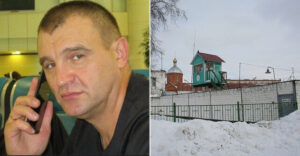
Three summers ago, in 2023, a severe outbreak of scabies swept through Penal Colony No. 7, deep in the Russian interior. The infestation, caused by the microscopic mite Sarcoptes scabiei, which brings intense itching and rashes, became a particularly severe ordeal for Ihor Shyshko, a Ukrainian prisoner of war.
“It had spread all the way to my eyes,” he recounted, explaining why he decided to seek medical help. “I thought about asking whether they could give me some brilliant green antiseptic dye to rub on myself, in the hope it might somehow stop the infection.”
But instead of offering treatment, he says, the doctor who saw him used the dye as a means of sexual humiliation, drawing on the prisoner’s body and then calling others in to look.
“Here he drew a penis,” said Shyshko, pointing to his face. “Here he drew breasts. And here,” he added, pointing to his back, “he wrote ‘f*** here’, with an arrow towards my buttocks. Then he called someone else in to see what was going on.”
The 43-year-old Ukrainian special services officer had been arrested in the first weeks of Russia’s full-scale invasion in 2022, and spent about a year in Colony No. 7 before being released in a prisoner exchange.
He is one of nearly 50 former Ukrainian prisoners of war who spoke to journalists from Schemes, the investigative programme of the Ukrainian service of Radio Free Europe/Radio Liberty (RFE/RL), about their time in the prison, which lies about 230 kilometres north-east of Moscow, in a small village called Pakino. In three lengthy interviews and dozens of exchanges, the Ukrainians described a long catalogue of abuses, including beatings, denial of medical care, sexual humiliation and other forms of mistreatment.
Made to crawl, bark and eat mouldy bread
Several of the former detainees said they spent entire days on their feet, weak with hunger, their daily ration at times reduced to a few pieces of soggy, mouldy bread. Many recalled that, instead of being taken out for exercise, they were led to the areas where the guard dogs were kept; some said guards forced prisoners to crawl on all fours, bark, and even drink water from the dogs’ bowls.
Two former detainees described how they were made to crawl across the floor using only their hands, injuring their feet until they bled, in a form of torture they called the “seal crawl”. They also reported being subjected to a method known chiefly in Asia and the Middle East as bastinado: repeated blows to the soles of the feet with a baton, leaving them unable to walk.
In their testimony, about half of the former prisoners who spoke to journalists also described the violent conduct of the man responsible for their medical care, a prison doctor they had nicknamed “the vet” and “Dr Death”. One after another, they recounted how he mistreated sick inmates and appeared to take a perverse pleasure in forcing them to act out homosexual scenes.
“Do you know what the most terrifying part was?” said Shyshko. “You realised that everyone else depended on you. If you didn’t do what they asked at that moment, they would leave the whole cell without food. It was collective punishment. The young, the old, the sick, everyone depended on you.”
Putting a name to the doctor
None of the prisoners knew the doctor’s surname. But by cross-referencing fragments of information gathered from many former detainees, together with publicly available data, leaked databases and law-enforcement sources, Schemes journalists concluded that he is a man named Vyacheslav Cherdantsev.
Cherdantsev did not respond to repeated telephone calls and messages seeking his comment on the allegations. Neither the warden of Colony No. 7, Yuri Fomin, nor the Russian Federal Penitentiary Service replied to related requests.
The practices described in this investigation form part of a broader, well-documented pattern of abuse. According to independent bodies including United Nations monitoring missions, the Office for Democratic Institutions and Human Rights (ODIHR) of the Organization for Security and Co-operation in Europe (OSCE), and the European Court of Human Rights, Ukrainian prisoners of war held in Russia are subjected to widespread and systematic abuses, among them torture, sexual violence and the denial of medical care. In an earlier investigation, Schemes journalists identified another Russian prison doctor, in the Republic of Mordovia, who subjected prisoners to electric shocks and forced them to take part in humiliating “rituals” for his own amusement.
The case against the colony
When the first prisoners from Colony No. 7 returned to Ukraine through prisoner exchanges, Ukrainian prosecutors opened an investigation as part of the country’s wider effort to prosecute alleged Russian war crimes.
So far, two prison officials, the deputy head of security and operations, Alexei Khavetskyi, and the operations officer Grigory Shvetsov, have been formally notified that they are suspected of war crimes.
In response to a request for comment, the Office of the Prosecutor General of Ukraine confirmed that Colony No. 7 remains under investigation as a site where war crimes were systematically committed against Ukrainian detainees, including torture, inhuman treatment, humiliation, rape and other forms of sexual violence.
As of 20 May 2026, prosecutors had documented the cases of 259 prisoners of war and three civilians who returned from the prison, along with two Ukrainian detainees who died there.
‘Woe to you if anyone complains’
Most of the Ukrainians held at Colony No. 7 were members of the armed forces, as Shyshko was. But not all were military personnel. Civilians were held there too, among them Volodymyr Mykolayenko, the former mayor of Kherson, who had refused to co-operate with the occupying authorities, and Stephen James Hubbard, the last American the U.S. government regards as wrongfully detained in Russia.
Another of the detainees was Dmytro Khyliuk, a 51-year-old Ukrainian journalist arrested by Russian soldiers in his village near Kyiv at the start of the war. He spent more than two years in Colony No. 7 before finally being released in a prisoner exchange last August.
Khyliuk, who shared a cell with Shyshko, described the psychological toll of the monotony and isolation. He recalled the moment a stray cat wandered into the cell during a search. The inmates caught it and, he said, were overcome with joy simply to hold a living creature. On another occasion they found a single sunflower seed in the yard and passed it from hand to hand to smell it.
Khyliuk called the Red Cross visit of May 2023 a “disgrace” and a “farce”. The organisation’s representatives, he said, asked the detainees whether they were being fed properly while Russian guards wearing body cameras stood right beside them. “They had warned us,” he said. “‘You’ll have visitors tomorrow, and woe to you if anyone complains.'”
Questioned by the investigators, the International Committee of the Red Cross said its staff are bound by strict rules of impartiality, that it seeks to improve conditions of detention through confidential dialogue with the relevant authorities, and that it could not comment further, since it regards that process as the most effective way to pursue its humanitarian goals.
Khyliuk reserved some of his harshest words for the prison doctor, whom he called “the ultimate scoundrel”.
‘Dr Death’
He and other former inmates accused the doctor of extreme medical negligence, saying he refused to hand out medication, made inmates reuse dirty bandages, and threatened them if they took the bandages off without his permission. By their accounts, even the scabies outbreak, an illness easily treated with a cream or oral medication, became another opportunity for abuse.
“They would often put someone with scabies in a cell where there were no other cases,” said Khyliuk. “There was no logic to preventing an outbreak. On the contrary, the logic was to let it spread. I caught it twice myself.”
Shyshko said the “treatment” for scabies involved keeping prisoners naked for long stretches. “I was completely naked for a month,” he said. “There were 15 of us in the same situation, in the same cell.”
“I asked the doctor what the point of the nudity was,” he recalled. “He replied: ‘Why do you think you’re in this cell? It’s a cold cell, so the mites will die. Preferably along with you.'”
At least one former detainee named the doctor as his main torturer. “He was without doubt the person chiefly responsible,” he said. “He beat us because we are Ukrainians.”
Another recalled: “I had problems with my legs, but he never gave me any medicine. His prescription was to eat less and walk more.”
The detainees had given the doctor a range of nicknames, among them “Dr Death”, “Dr Pus” and “Sandals”, the last because he wore sandals in winter as well as summer. His most common nickname, though, was “konoval”, a derogatory Russian word for a clumsy, incompetent vet.
The toll on the youngest
David Pradchenko, a 25-year-old marine captured while defending Mariupol, was held in the same camp as Shyshko and Khyliuk. He too described scenes he called horrific. On one occasion, he said, other members of the medical staff removed one of his toenails without anaesthesia, in the doctor’s presence.
When detainees were not being mistreated, their health problems were simply ignored. Pradchenko recalled that the doctor answered their complaints with a little rhyme used to soothe small children: “The kitten’s in pain, the puppy’s in pain, and it will pass for you too.” At other times, rather than offering treatment, he would make the sign of the cross and tell prisoners to “go with God”, or advise them to recite the Lord’s Prayer as medicine.
Pradchenko also said his cellmate, 23-year-old marine Pavlo Polovyi, developed a severe rash brought on by acute stress and never received proper medical care. He believes this treatment contributed to the young soldier’s mental collapse, which in May 2023 led him to take his own life. His remains were returned to Ukraine the following year.
Sexual humiliation as a weapon
Many former detainees, independently of one another, described the doctor’s use of sexual violence and homophobic humiliation as a tool of abuse.
They accused him of routinely inspecting and commenting on inmates’ genitals and buttocks with no medical justification. He also, they said, forced naked detainees to file past him, to embrace one another, dance in pairs and simulate sexual acts, turning the whole thing into a spectacle for himself and the guards.
“From a medical point of view, I’m working out which angle gives the best view,” one former prisoner recalled the doctor saying. Another said he heard him demand that the prisoners prepare “scenes” to perform by nightfall, even naming which of them would take part.
By the same accounts, this psychological abuse went hand in hand with physical assault. The doctor, the former detainees said, would stroke their buttocks with a pencil, and had turned coercing them into needless rectal examinations into a “hobby”. Pradchenko and several others said he even threatened detainees with rape.
‘I remember his hands’
To identify the doctor, journalists tried to reach about 90 former detainees from Colony No. 7. Nearly 50 provided information and consistent descriptions of a man named Vyacheslav: heavily built, roughly 1.75 to 1.90 metres tall, and between 45 and 55 years old.
Through the Ukrainian journalism project KibOrg, the reporters obtained a list of about 1,150 current and former staff of Medical Unit No. 33 of the Russian Federal Penitentiary Service, which covers the Vladimir region, where Colony No. 7 is located. The list included four men named Vyacheslav. Cross-referencing details such as age and other characteristics, the journalists settled on Vyacheslav Cherdantsev.
Because his personal social-media accounts were private or dormant, the journalists found photographs of him from about 10 years ago on relatives’ pages. Shown these images, several former detainees said the man closely resembled the doctor they remembered.
To confirm the identification, the reporters obtained a more recent photograph of Cherdantsev from the Russian messaging platform Max. Shown that picture, more than 30 former detainees said it was the doctor who had abused them, and about a dozen were absolutely certain. “That’s 100% the doctor,” said Shyshko. “The eyes, the gaze, the hands. I remember his hands very, very well.”
Leaks and an open investigation
According to material from leaked Russian databases and information drawn from open sources, Vyacheslav Cherdantsev went on drawing a salary from Medical Unit No. 33 until at least 2025. On the Russian social network VK, he also appears as a friend of several other serving members of the colony’s medical staff.
The same leaks indicate that Cherdantsev, 48, was born in a village in Kyrgyzstan and worked as a healthcare worker at a juvenile correctional facility there, where he was involved in HIV prevention and the treatment of drug addiction. Around 2013 he moved to Russia, settled in the village of Pervomaisky, near Pakino, bought a flat and worked at an orphanage. The following year, in 2014, he obtained a Russian passport.
Ukrainian journalists from Schemes passed their findings to Ukrainian law-enforcement authorities, who confirmed that they had already taken statements from several former inmates of Colony No. 7 alleging abuse by a prison doctor. They are continuing to take statements from recently released prisoners.
According to the Ukrainian government, around 7,000 Ukrainians remain imprisoned in Russia.
Ask me anything
Explore related questions




