





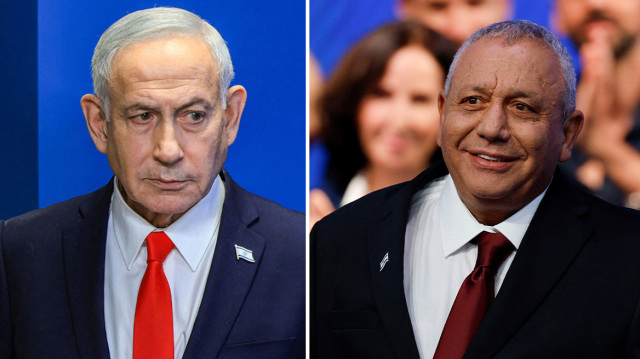
Israel’s parliamentary elections have produced a winner who cannot govern alone and an opposition that, despite its combined numerical advantage, is struggling to agree on who should lead the country and which parties should form the next government.
Israeli Prime Minister Benjamin Netanyahu has kept Likud in first place, but his governing alliance appears to have lost the 61-seat majority required to control the Knesset. Gadi Eisenkot has emerged as his principal challenger for the premiership, although he lacks a viable coalition agreement.
A sharp increase in turnout among Israel’s Arab citizens has reshaped the parliamentary balance, creating new political uncertainties in a country facing another period of instability.
The election on 27 October failed to provide a clear answer to the central question that dominated the campaign: whether Netanyahu would remain in power or whether former Israeli military chief Eisenkot could replace him.
With 84.5% of polling stations counted as of 12.34pm on Wednesday, Netanyahu’s coalition was projected to secure 54 seats, while the bloc led by Eisenkot, leader of the Yashar party, was on course to win 49. The two Arab parties, the Joint List and Ra’am, were projected to hold a combined 17 seats.
The figures represent a significant setback for Netanyahu’s outgoing coalition, whose constituent parties previously controlled 68 seats. Nevertheless, Likud remains the largest individual party, allowing Netanyahu to claim a leading role in negotiations over the next government.
Parties opposed to Netanyahu’s continued premiership are projected to control approximately 65 seats, according to estimates released during the count. However, their numerical advantage does not automatically translate into the ability to form a government.
Deep political divisions among opposition parties make agreeing on a common governing programme particularly difficult.
The result carries additional significance because the election followed a prolonged period of war, deep social divisions and fierce criticism of the government’s handling of national security.
Much of the campaign centred on Netanyahu himself, with his opponents demanding political change while the prime minister presented his experience as a guarantee of stability.
Netanyahu and Eisenkot offer competing interpretations of the result
The first public statements from the two main rivals illustrated the struggle already under way to define the political meaning of the election.
Addressing Likud supporters in Jerusalem, Netanyahu emphasised that his party remained Israel’s strongest political force.
He also argued that the political Right continued to command a clear majority among Jewish voters and called on right-wing parties to unite behind a strong national government.
The prime minister stopped short of declaring victory, instead portraying the outcome as a renewed expression of confidence in Likud.
A central theme of his remarks was the possibility that Arab parties could participate in or support a future government led by Eisenkot.
Netanyahu warned that such an arrangement would, in his view, endanger Israel’s security, accusing Arab political parties of holding anti-Zionist positions.
Speaking in Tel Aviv, Eisenkot offered a sharply different interpretation.
He argued that Israelis had voted for change and against Netanyahu’s continued leadership, describing the result as historic and accusing the outgoing government of losing public confidence.
Eisenkot sought to portray himself as the politician capable of bringing together diverse parties united by the objective of removing Netanyahu from office.
The former chief of staff of the Israel Defence Forces has a strong military profile. The death of his son during military operations in Gaza has also been a personal tragedy that has profoundly influenced his public image.
His Yashar party is projected to win approximately 21 seats, making it the largest opposition party.
However, Likud’s lead and the fragmentation of the remaining opposition parties significantly limit Eisenkot’s ability to secure a mandate to form a government.
Record turnout and the decisive impact of the Arab vote
One of the most striking features of the election has been exceptionally high voter turnout.
According to Israel’s Central Elections Committee, 77.7% of eligible voters cast their ballots, compared with 70.6% in 2022.
This represents the highest turnout since 1999, reflecting the intensity of the political contest and the mobilisation of voters across Israeli society.
Particularly significant was participation among Israel’s Arab citizens, who account for approximately 20% of the population.
According to Arab political representatives, turnout in their communities exceeded 75%. Early projections had suggested that Arab parties could win 16 seats, a potentially historic performance, although subsequent figures increased their combined total to 17.
This mobilisation was driven in large part by opposition to Netanyahu’s government, particularly its two most prominent far-right figures, Itamar Ben-Gvir and Bezalel Smotrich.
Rising crime in Arab communities, complaints about inadequate policing and dissatisfaction with government policies towards the Arab population all contributed to the increased turnout.
For many Arab voters, participation was a direct political attempt to weaken the outgoing coalition.
Yousef Jabareen, leader of the Joint List, described the result as a historic day for the Arab community, arguing that it had become a political force that could no longer be ignored.
Similarly, Ra’am leader Mansour Abbas attributed the increased support for Arab parties to the policies pursued by Ben-Gvir and Smotrich.
However, the rise in Arab participation has created a political paradox.
Arab voters may have deprived Netanyahu of the parliamentary majority he needs without necessarily giving Eisenkot the means to establish an alternative government.
Why Eisenkot faces major obstacles to forming a government
Eisenkot’s main challenge lies in the profound political differences between his potential coalition partners.
The anti-Netanyahu camp includes parties from the Right, Centre and Left, alongside Arab political groups that hold fundamentally different views about Israel’s future.
Former prime minister Naftali Bennett and Avigdor Lieberman have ruled out forming a government that includes or relies upon Arab parties.
Their position severely restricts Eisenkot’s options because, without the Arab parties’ seats, the anti-Netanyahu bloc does not have the parliamentary majority required to govern.
Eisenkot himself has also established conditions for parties seeking to participate in a future coalition.
These include recognising Israel as a Jewish state and acknowledging Hamas as a terrorist organisation that must be dismantled.
Such conditions would be extremely difficult for all Arab political parties to accept.
Moreover, significant differences between the Arab parties themselves mean they cannot be treated as a single political bloc.
One theoretical option would be a minority government operating with external parliamentary support or tolerance.
However, this arrangement would require political compromises likely to provoke strong opposition both within the anti-Netanyahu camp and across Israeli society.
The previous coalition formed by Bennett and Yair Lapid in 2021 offers an important precedent.
That government included Ra’am, demonstrating that cooperation between Jewish and Arab parties is politically possible.
Its collapse in 2022, however, also illustrated how internal disagreements can threaten the survival of such a diverse coalition.
President Herzog’s role in determining the next government
Once the counting process has been completed and the results certified, attention will turn to the presidential residence in Jerusalem.
Israeli President Isaac Herzog will hold consultations with the parties represented in the new Knesset, asking each to recommend the politician they believe should receive the mandate to form a government.
Under Israel’s political system, that mandate does not automatically go to the leader of the largest party.
Instead, the president must select the candidate considered most likely to assemble a parliamentary majority.
Likud’s first-place finish therefore does not guarantee that Netanyahu will receive the initial mandate.
Equally, the fact that parties opposed to Netanyahu collectively control more seats does not mean they will all endorse Eisenkot.
The politician given the mandate initially has 28 days to form a government, with the possibility of an extension of up to 14 days.
If that attempt fails, the president can ask another member of the Knesset to try to form a government.
Should the second candidate also fail, further parliamentary procedures are available. If these do not produce a viable government, Israel could face another election.
Such an outcome would be far from unprecedented.
Between 2019 and 2022, Israel held five general elections as political parties repeatedly failed to establish stable parliamentary majorities.
The highly personalised political confrontation surrounding Netanyahu, combined with deep divisions among parties, contributed to years of political deadlock.
Could a national unity government break the impasse?
One potential solution would be a national unity government bringing together Israel’s two largest parties, Likud and Yashar.
Such an arrangement could command a strong parliamentary majority and reduce the influence of smaller parties with uncompromising ideological demands.
Nevertheless, the political obstacles are substantial.
Eisenkot has explicitly ruled out serving in a government led by Netanyahu, while the prime minister’s relationships with several former political partners remain marked by deep mistrust.
Even if Herzog attempts to mediate between the competing camps, the disagreements extend well beyond the allocation of ministerial posts.
They concern Netanyahu’s continued leadership, the direction of Israel’s national security policy and the relationship between the country’s governing institutions.
The prospect of another election therefore remains a genuine possibility.
Netanyahu may attempt to exploit Likud’s first-place finish and the opposition’s inability to reach an agreement, presenting himself as the only available candidate capable of providing stable government.
Eisenkot, meanwhile, will seek to convert the combined parliamentary strength of Netanyahu’s opponents into a political agreement, even if only for a limited period, with the principal objective of removing the prime minister from office.
The success of that effort will depend on whether opposition parties can set aside their ideological differences in pursuit of their shared desire for political change.
The opposition has an opportunity, but it has yet to demonstrate that it possesses the political cohesion necessary to seize it.
Netanyahu may have lost his parliamentary majority, but he has not lost the possibility of remaining in power.
Eisenkot may have attracted the support of parties seeking a change of government, but he must first demonstrate that those forces can work together.
Israel’s election has therefore ended without a clear governing majority.
The country’s next government will be determined not simply by the ballot box, but by the negotiations, political compromises and coalition agreements that follow.
And unless the competing parties can overcome the divisions exposed by the election, Israelis may once again find themselves heading back to the polls.
Ask me anything
Explore related questions




