





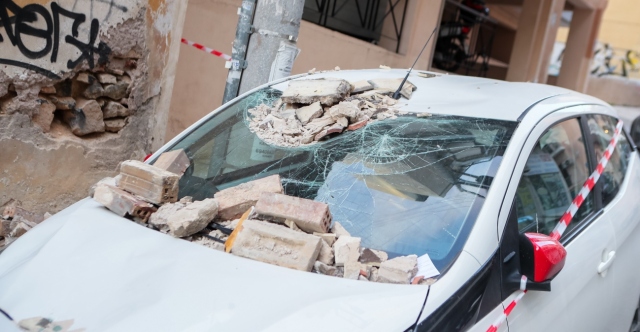
The deterioration of ageing apartment buildings across Greece is raising serious safety concerns, with experts warning that cracks, rust and falling concrete may indicate structural problems that should never be ignored.
A series of balcony collapses in recent years has highlighted the dangers posed by poorly maintained buildings. Incidents in Neos Kosmos in Athens in January 2026, Lavrio in October 2025, and earlier cases in Crete and Thessaloniki have renewed calls for systematic inspections before further accidents occur.
Behind scaffolding, the façades of abandoned neoclassical properties and apartment blocks built decades ago, deterioration is not always immediately visible. Cracks, rust stains and pieces of concrete breaking away can indicate corrosion of the steel reinforcement, potentially putting residents and pedestrians at risk.
Christos Zeris, professor at the School of Civil Engineering of the National Technical University of Athens (NTUA) and president of the Greek Section of the American Society of Civil Engineers (ASCE), explained to protothema.gr which generations of buildings are particularly vulnerable, how corrosion develops and why inspections should become routine rather than being carried out only after an accident.
Why older buildings are more vulnerable
“In older buildings, protection of steel reinforcement against corrosion was not as effective. Concrete was more porous, and the concrete cover protecting the reinforcing steel was thinner than what we use today. As a result, corrosion can begin more quickly, particularly in coastal environments or industrial areas,” Zeris explained.
However, the age of a building alone does not determine its structural condition. The quality of construction materials, workmanship and supervision during construction are equally important.
“Statistically, buildings from the 1960s and 1970s are more vulnerable, because we know how concrete and construction materials evolved from decade to decade. But that does not mean every old building is dangerous or that a newer building is necessarily safe,” he said.
“I have seen buildings from the 1970s withstand corrosion very well, but also buildings only 20 years old with problems. Construction quality, supervision and whether the work was carried out properly and construction requirements were followed all matter.”
The professor cited an older building in the Exarchia district of Athens, constructed under legislation dating back to 1936, where a basement air-raid shelter that had remained flooded for years was nevertheless found to be in good condition.
He attributed its durability to the higher concrete specifications required for that particular structure, demonstrating how material quality can significantly influence the lifespan of a building.
The warning signs property owners should look out for
According to Zeris, visible cracks in concrete are among the most important warning signs, especially when accompanied by rust stains or moisture.
“Corrosion causes the steel to expand. Iron oxide occupies a much larger volume than the original metal, creating internal pressure on the surrounding concrete and causing surface cracks, which accelerate the process,” he explained.
“At the same time, over the years, part of the reinforcement’s cross-section is lost and its bond with the concrete deteriorates. Therefore, when we see cracks running along reinforcing bars, especially where there are signs of oxidation, the affected area needs to be inspected and repaired.”
Such cracks can occur in reinforced concrete structural elements, including columns, structural walls and beams, as well as balconies.
Moisture is another factor that should not be underestimated.
Water infiltration does not necessarily originate from a leaking roof. Water entering through joints, including those damaged by earthquakes, or through deteriorated surfaces can reach structural elements that would normally be considered protected from exposure.
This means that even lower floors and structural elements adjoining neighbouring properties may be affected.
At ground level, rising damp from the soil can also damage structural components, even where a ground-bearing floor slab is present.
Zeris stressed that any assessment of structural damage must be carried out by a qualified engineer, since not every crack is caused by corrosion.
Its location, shape and whether it is accompanied by rust, moisture or concrete detachment are all important factors in determining its significance.
Why balconies require particular attention
Balconies are especially vulnerable because corrosion can develop in areas that are difficult to inspect.
Damage to steel reinforcement may progress beneath marble finishes, tiles and other floor coverings without being visible from above.
“Quite often, due to construction errors, the upper reinforcement has not been positioned correctly, while progressive cracking contributes to its corrosion,” Zeris said.
He emphasised that floor finishes can conceal damage, allowing corrosion to gradually weaken the structure.
“Inspection should not be limited to the surface we walk on, but should also include the exposed underside and the points where the balcony is supported.”
Concrete breaking away from the underside of a balcony is another warning sign.
Even a relatively small fragment falling from a considerable height can cause serious injury.
Such damage should therefore never be dismissed as a cosmetic issue. It should prompt an engineering assessment and, where necessary, immediate safety measures and repairs.
The professor also warned that deterioration does not reverse itself over time.
“Once corrosion has begun and the reinforcement starts losing mass, that loss cannot recover on its own. We can now slow down or stop the process through appropriate interventions, but accurate and timely diagnosis is essential,” he said.
Depending on the extent of the damage, repairs may involve additional corrosion protection, concrete restoration, replacing sections with newer, less porous concrete containing corrosion inhibitors, replacing reinforcement or strengthening structural elements.
“There is no single solution that applies to every building,” he stressed.
Modern technologies have significantly improved both the materials available for structural repair and strengthening and the methods used to identify and assess corrosion.
Living away from the coast does not guarantee protection
Environmental exposure is another major factor influencing the deterioration of reinforced concrete buildings.
Airborne chlorides, including ordinary salt carried by sea spray, can accelerate corrosion, while industrial pollution and atmospheric carbon dioxide can weaken the protective properties of concrete.
Zeris also highlighted the impact of excessive use of de-icing salt, which can contribute to the deterioration of exposed infrastructure.
Although a distance of 1.5 kilometres from the sea is used as a criterion when assessing exposure to marine chlorides, he said this does not necessarily reflect actual environmental conditions.
“The 1.5-kilometre limit has been established, but we should not focus exclusively on it. Local topography and winds can carry and trap salt over greater distances,” he explained.
“The microclimate plays a significant role. That is why annual measurements are needed to establish which areas are genuinely more exposed, rather than relying solely on a general distance rule.”
Mapping environmental risks and prioritising building inspections
Zeris believes a systematic national approach should begin with mapping environmental conditions before identifying which buildings require inspection most urgently.
“We should start by mapping environmental conditions, measuring concentrations of chlorides and carbon dioxide in the air across different areas throughout the year, in order to record the degree to which structures are exposed to corrosive factors,” he said.
The assessment should also consider soil conditions, rising damp and the presence of aggressive salts from other sources.
In agricultural areas, for example, fertilisers can contribute to the deterioration of infrastructure such as irrigation systems.
“Based on these findings, we could identify the most heavily affected areas and determine which should be prioritised for inspections,” he explained.
The next stage would involve assessing buildings according to their age, structural type and environmental exposure.
Crucially, inspections should not be restricted to visual observations.
“Assessment does not have to be limited to visual inspection, although initial visual monitoring of external signs certainly helps,” Zeris noted.
He explained that engineers can also carry out on-site non-destructive tests on concrete, at relatively low cost and without significantly affecting the structure.
These tests can help establish whether corrosion is present and determine how extensively the building has been affected.
The central message, he stressed, is that structural deterioration must be identified and addressed before it results in an accident, rather than waiting for another balcony collapse to expose the dangers posed by neglected buildings.
Ask me anything
Explore related questions




