





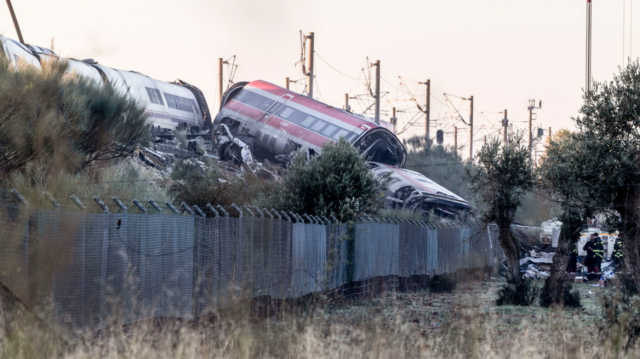
The train in Spain that collided on Wednesday with another service stopped on the tracks, killing at least 69 people, was travelling at 160 kilometres per hour, according to the preliminary accident report.
Meanwhile, Spain’s Civil Guard has announced that it has received reports of 64 people missing, following the country’s deadliest railway disaster since 2013.
Authorities have carried out 49 post-mortem examinations so far and identified five victims — three women and two men — Esther Padilla, a spokeswoman for the regional government of Castilla-La Mancha, told Spanish public broadcaster TVE.
🚩 Así ha sido el accidente de tren de Urda, en Toledo. https://t.co/qdRtPn73wB
— MEDITERRÁNEO DIGITAL (@MediterraneoDGT) October 28, 2026
It remains unclear how many of those reported missing are among the dead who have yet to be identified. Another accident involving trains operated by the same companies occurred in January on the same railway line.
Wednesday’s tragedy has brought renewed attention to the safety and maintenance of Spain’s rail network, the largest in Europe. The collision occurred after six trains automatically stopped because of a fault in the automatic signalling system. The control centre in Madrid then took over management of rail traffic.
A few minutes later, a train operated by state-owned Renfe was instructed to resume its journey, even though a train belonging to private operator Iryo remained stationary on the same line, Spanish Transport Minister Óscar Puente explained.
How the train disaster in Spain unfolded
An audio recording of communications between the control centre and train drivers, obtained by the newspaper El País, reveals that a controller authorised the Renfe train to continue at its normal speed.
According to Puente, the instruction contravened the protocol, which stipulates that trains must not travel faster than 40 kilometres per hour in such circumstances.
The controller also authorised the Renfe train, carrying 379 passengers and seven crew members, to resume its journey. Under the protocol, however, the Iryo train, carrying 147 passengers and five crew members, should have been allowed to move first.
“The sequence of malfunctions, instructions and actions ultimately led to the collision, as there were no safety safeguards in place,” according to the preliminary report by the Independent Administrative Authority for the Technical Investigation of Accidents and Incidents (AITAT).
AITAT estimated that the Renfe train was travelling at between 160 and 200 kilometres per hour when the collision occurred. However, it added that it would not be able to confirm the train’s exact speed until it had retrieved information from its black box.
“The scene was shocking. You could see carriages that were completely burned out, as if they had exploded. People were coming out of them in a very bad condition, while others began bringing out bodies and laying them down right there, next to where we were standing,” said Sebastián Herrero, who was travelling on the Iryo train.
Ask me anything
Explore related questions




