

×
GreekEnglish

×
  • Politics
  • Diaspora
  • World
  • Lifestyle
  • Travel
  • Culture
  • Sports
  • Cooking
Saturday
29
Aug 2026
weather symbol
Athens 31°C
  • Home
  • Politics
  • Economy
  • World
  • Diaspora
  • Lifestyle
  • Travel
  • Culture
  • Sports
  • Mediterranean Cooking
  • Weather
Contact follow Protothema:
Powered by Cloudevo
> Politics

Kyriakos Mitsotakis: Letter to Ursula von der Leyen regarding inflation – Multinational corporations have asymmetric power eroding citizens’ incomes

Multinational corporations earn over €14 billion annually from price differentials across EU countries - The government's proposals to the Commission

Newsroom May 20 11:40

Δείτε περισσότερα άρθρα μας στα αποτελέσματα αναζήτησης

Add Protothema.gr on Google

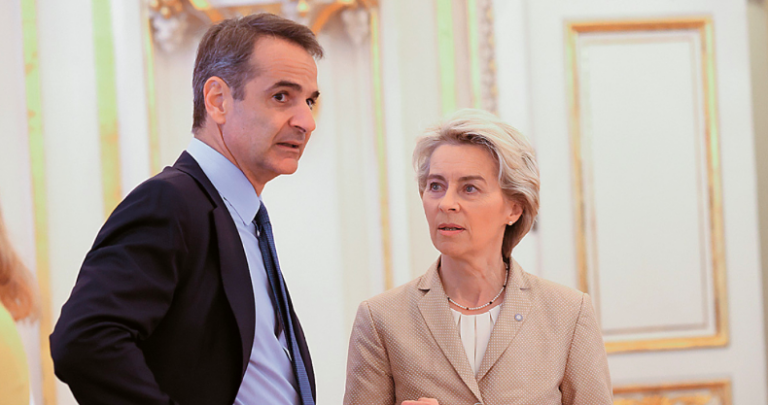
Prime Minister Kyriakos Mitsotakis, in a letter to European Commission President Ursula von der Leyen, requested  interventions in EU Law to ensure equal treatment and consumer protection from the price markup imposed by multinational corporations. He highlighted that these corporations, especially in oligopolistic markets, remove at least 14 billion euros annually from European households’ disposable income. Mitsotakis emphasized the need for bolder steps for more competition and transparency in the Single Market. Also proposed was for EU-level legislation to effectively address Territorial Supply Constraints, where these restrictions are not justified by factors that promote societal welfare. Minister of State Akis Skertsos coordinated the initiative and the development of the arguments presented in the letter.In addition, multinational corporations impose price markups amounting to at least 14 billion euros annually on European consumers through geographical supply restrictions. This issue has been discussed for years, with a 2020 European Commission study highlighting significant consumer losses due to these restrictions. The problem has intensified with rising inflation and increased corporate profits.

See Also 

Kyriakos Mitsotakis: I’ll reach out to President of the European Commission to request EU intervention on multinational corporations’ pricing

Significantly, a 2023 study conducted by Leiden University found that these supply constraints are a hidden factor driving inflation, particularly affecting smaller countries. Recently, seven EU countries called for the abolition of these restrictions. In Greece, for instance, the price of baby formula remains disproportionately high despite government-imposed profit margin caps. The Greek Competition Commission previously identified a 32% price discrepancy compared to the lowest prices in Europe.

Multinational companies exploit geographical restrictions (TSCs) to prevent parallel trade and protect their profits. These restrictions include:
1. Refusing to supply wholesalers/retailers who sell outside designated areas.
2. Differentiating product content or branding across regions.
3. Limiting product quantities to hinder wider distribution.
4. Using single-language packaging to prevent cross-border sales.
In Greece
In Greece, among the few substantiated cases was that of Colgate-Palmolive. In 2017, the Competition Commission fined the parent company and its Greek subsidiaries 9.4 million euros for prohibiting parallel imports in its commercial agreements with major supermarket chains.

>Related articles

Kyriakos Mitsotakis speaks at Wonderplant’s investment in Ptolemaida

Turkish drone flies between Samothraki and Limnos as Greek F-16s scramble to intercept

Thessaloniki Metro extension to Kalamaria opens to the public — See video and photos

The penalty for any retailer violating the rule was the withdrawal of discount privileges. Later, the parent company managed to be acquitted by arguing it was unaware and not responsible for the practices of its subsidiaries.

The Competition Commission’s checks revealed, among other things, that between 2001-2008, 85%-95% of comparable products were more expensive in Greece than in Italy, and 40%-65% of these products were at least 20% more expensive. Additionally, 73%-85% of products were more expensive compared to Spain, France, and Portugal.


Ask me anything

Explore related questions

#inflation#Kyriakos Mitsotakis#Ursula von der Leyen
> More Politics

Follow en.protothema.gr on Google News and be the first to know all the news

See all the latest News from Greece and the World, the moment they happen, at en.protothema.gr

> Latest Stories

Greece once again under the scrutiny of rating agencies, with the surplus and rapid debt reduction as its “weapons”

August 29, 2026

Tram services to become more frequent, with shorter waiting times on Syntagma–Pikrodafni and Voula–SEF

August 29, 2026

Pirates return to the Gulf of Aden, with more than 90 seafarers held hostage

August 29, 2026

Historic Deal: US takes control of Venezuela’s oil, gaining control of 65 billion barrels

August 29, 2026

Rent refund: Key dates for payments and who will receive two months’ rent

August 29, 2026

“It was worth it”: Mother killed her 11-month-old son so the father would not get custody

August 29, 2026

The Kremlin refuses to comment on reports of new talks with Ukraine in September

August 28, 2026

Power Game: Putin sees U.S. as weakened, “defies” Trump’s message and prepares to meet Xi Jinping and Pezeshkian

August 28, 2026
All News

> Greece

In reverence, the emotional deposition in Jerusalem, see photos & video

The Holy Temple of the Resurrection opened after many days due to the war between Israel and Iran

April 10, 2026

In the final stretch for the accreditation of joint master’s degrees: Aiming for their launch in the coming academic year

April 10, 2026

Schedule for Epitaph Procession today (10/4)

April 10, 2026

Perfect weather for Easter excursions, according to Tsatrafyllia’s forecast

April 10, 2026

Easter in Greece: The customs that continue in Greek tradition – From Nafpaktos to Corfu

April 10, 2026
Homepage
PERSONAL DATA PROTECTION POLICY COOKIES POLICY TERM OF USE
Powered by Cloudevo
Copyright © 2026 Πρώτο Θέμα



