





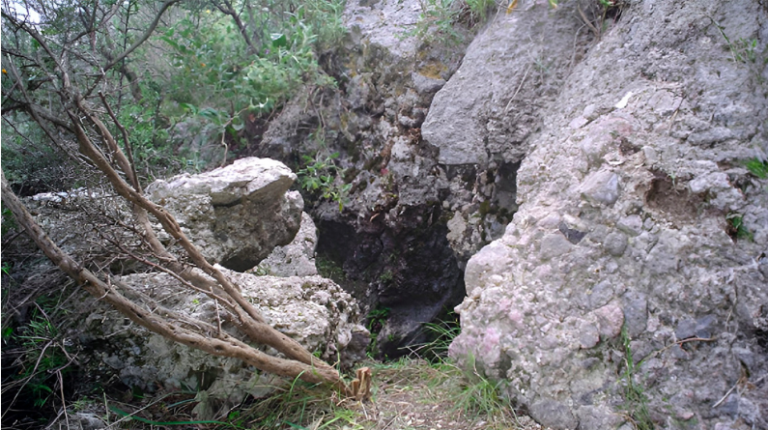
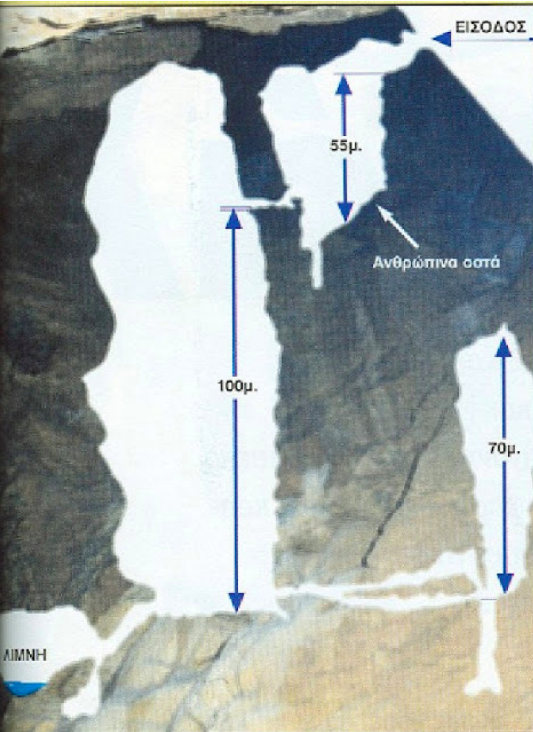
One of the most heinous and gruesome actions carried out by ELAS and OPLA during the Occupation was the massacre of thousands of civilians from Argolis and Corinthia near the Holy Monastery of Agios Georgios Feneos. Their bodies were thrown into the abyss of Feneos, also known as the “Windmill Hole” on a commemorative plaque for the victims. The exact number of people thrown into the chasm, dead or alive, remains uncertain, with some estimates exceeding 3,000. In recent years, searches in the Feneos chasm have led speleologists to recover the bones of many victims. However, the configuration of the cave makes it impossible to retrieve all the remains, many of which will forever rest in the chasm.
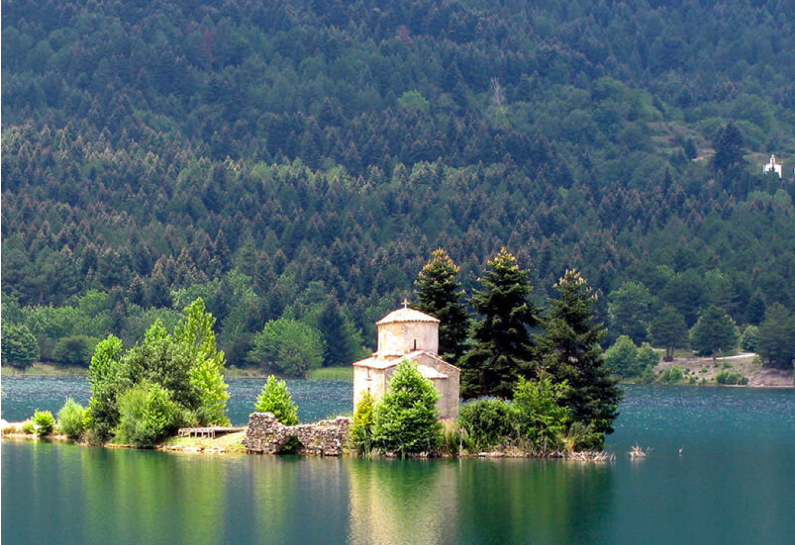
The Old Monastery of Agios Georgios in Lake Doxa
In the picturesque mountainous area of Feneos in Corinth, near the village of Goura on the border with Achaia, lies the Holy Monastery of Agios Georgios Feneos (or Fonia). This name comes from the nearby village of Fonias (now Panorama) and is derived from the ancient word Feneos. The “new” Holy Monastery of Agios Georgios is located 1.7 km north of the “old” monastery. From the “old” monastery, only the church of Agios Fanourios remains, overlooking the artificial Lake Doxa in a beautiful landscape. The old monastery was founded by a Kalavrytine monk in the 14th century. Frequent flooding of Lake Feneo caused problems for the monastery, and a major flood at the end of the 17th century forced the monks to relocate to a safer location. In 1693, the monastery was rebuilt in its current location. It was stauropegial, meaning it was directly under the (Ecumenical) Patriarch. The Holy Monastery of Agios Georgios played a central role in the 1821 Revolution in Corinth. It is believed that Kolokotronis famously declared, “Fire and axe to the traitors (to Ibrahim),” there. Unfortunately, through no fault of its monks, the Monastery was associated with the terrible massacres of civilians by members of ELAS and OPLA in 1944 (Source: imkorinthou.org).
Did Aris Velouchiotis Order the Feneos Massacres?
Some sources suggest that the horrific Feneos massacres were ordered by Aris Velouchiotis, who arrived in the Peloponnese in May 1944. When he learned of the low participation of local residents in ELAS, he reportedly said, “Catch and slaughter 10 from each village and you will see how they turn out.” According to the book by Lieutenant General e.a. Panagiotis Zara, “GREECE IN THE HOT CENTER OF THE COLD WAR – COMMUNIST ACTIVITIES,” Velouchiotis’s presence in the Peloponnese from May 1944 and his order to eliminate all dangerous “nationalists” is confirmed.
Siantos, concerned about the low participation in ELAS in the Peloponnese, sent Velouchiotis there with orders to “pave the road with bodies.” Accompanied by 60 bodyguards, Velouchiotis arrived in Morea on May 4, 1944. After three days, he reached the headquarters of the III “Division” in Helmos. A meeting followed with Captain “Papuas” (Nikos Dienis), Military Commander “Alexandros” (Dimitrios Kassandras), and other ELAS officials. Velouchiotis expressed his concern about the progress of ELAS in Morea, demanded intensified attacks against the Security Battalions, and accused the leadership of the “Division,” which he deposed. He ordered the merciless pursuit of all enemies of the revolution, the extermination of dangerous “nationalists,” and those resisting the imposition of the popular movement. He established ELAS prison camps and unleashed a wave of violence and terror, leading to the desolation of the countryside and the deaths of thousands. Velouchiotis also ordered avoiding conflict with German forces to prepare for post-liberation warfare. He believed in the creation of mountain guerrillas, while the KKE leadership, particularly Siantos, and Ioannidis, focused on organizing and equipping urban masses, especially in Athens. Thus, Velouchiotis’s role in the Feneos massacres was decisive.
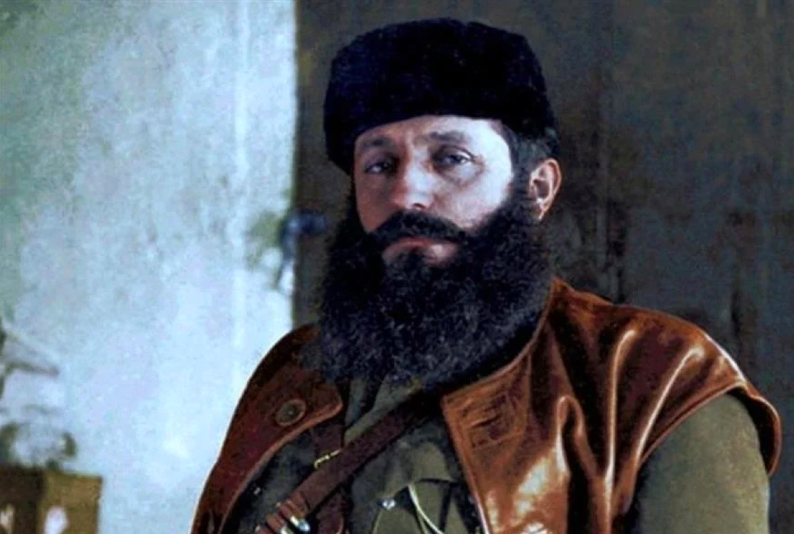
The Horrors of Feneos: Civilian Executions and the Monastery’s Dark History
In one of the most heinous acts committed by ELAS and OPLA during the Occupation, thousands of civilians from Argolis and Corinthia were slaughtered near the Holy Monastery of Agios Georgios Feneos and their bodies were thrown into the abyss of Feneos, known as “Windmill Hole.” The exact number of victims remains uncertain, but estimates suggest over 3,000. Searches in recent years have uncovered many bones, but the cave’s structure makes it impossible to retrieve all the remains.
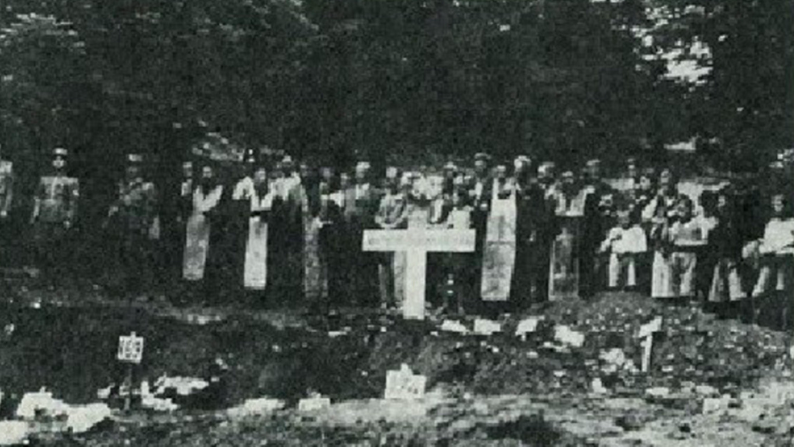
The Monastery of Agios Georgios Feneos
Located in the picturesque mountainous region of Feneos in Corinth, near the village of Goura, the male Holy Monastery of Agios Georgios Feneos (or Fonia) stands as a historical landmark. The “new” monastery, founded in 1693, is situated 1.7 km north of the original site. The old monastery, now a church dedicated to Agios Fanourios, overlooks the artificial lake Doxa. The monastery was central to the 1821 Revolution in Corinth.
The Massacres of Feneos
Some sources claim that Aris Velouchiotis, who arrived in the Peloponnese in May 1944, ordered the massacres after seeing low participation in ELAS. He allegedly commanded the killing of ten people from each village to force compliance. Velouchiotis and his men moved to the area and escalated violence against perceived enemies of the revolution, leading to widespread terror and deaths. His orders included avoiding conflicts with the Germans to preserve ELAS forces for future battles.
The Grim Events of July 1944
In July 1944, as the Germans advanced into mountainous Corinthia, ELAS forces abandoned the Monastery of Agios Georgios, taking 400 prisoners with them. Instead of releasing the prisoners, they executed them at Kakovouni by throwing them into the Feneos chasm. The rebels fled without resistance, and the Germans arrived shortly after, burning villages and looting the area.
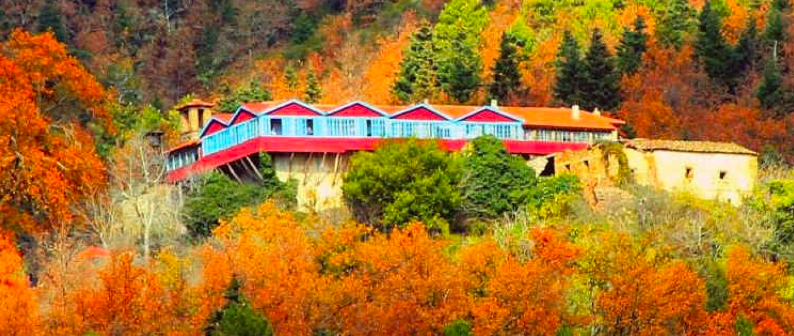
Retrieving the Bodies from Feneos Chasm
In May 1945, a team from the Ministry of Justice recovered 440 bodies from the Feneos chasm, 260 of which were identified. Speleologists Nikos Leloudas and Stathis Pavlidis later retrieved approximately 150 more skeletons in 1991, although many remains were left due to the chasm’s depth and instability. The presence of grenades further complicated recovery efforts.
The Monastery’s Dark Secrets
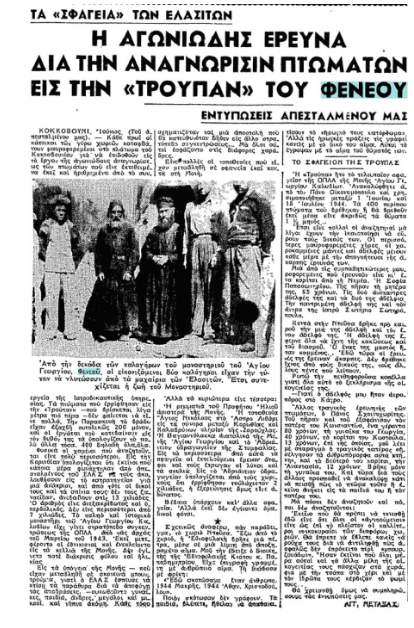
A 1945 report in the “Truth of Tripoli” newspaper detailed shocking atrocities at the Monastery of Agios Georgios. An inscription in blood labeled a cell as “GAMBRION MELATHRON,” indicating it was used for raping women and girls. Abbot Averkios recounted the rape and subsequent torture of three young girls who were forced to watch their family’s execution. Afterward, they were beaten and made to dance around the bodies.
Conclusion
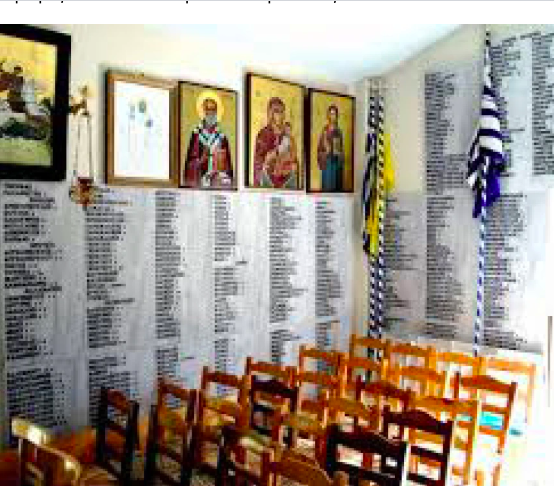
The atrocities committed by ELAS and OPLA at Feneos represent a dark chapter in Greek history. Survivors and eyewitnesses, including monks Averkios and Leontios, provided harrowing testimonies of the events. Despite evidence of participation in rapes, Leontios remained at the monastery post-war without excommunication. The church of All Saints now stands in the area, housing the ossuary with the victims’ bones and plaques bearing their names.
Sources: Ioannis K. Bougas, “INNOCENT BLOOD,” Volume II, Pelasgos Publications.
Ask me anything
Explore related questions




