

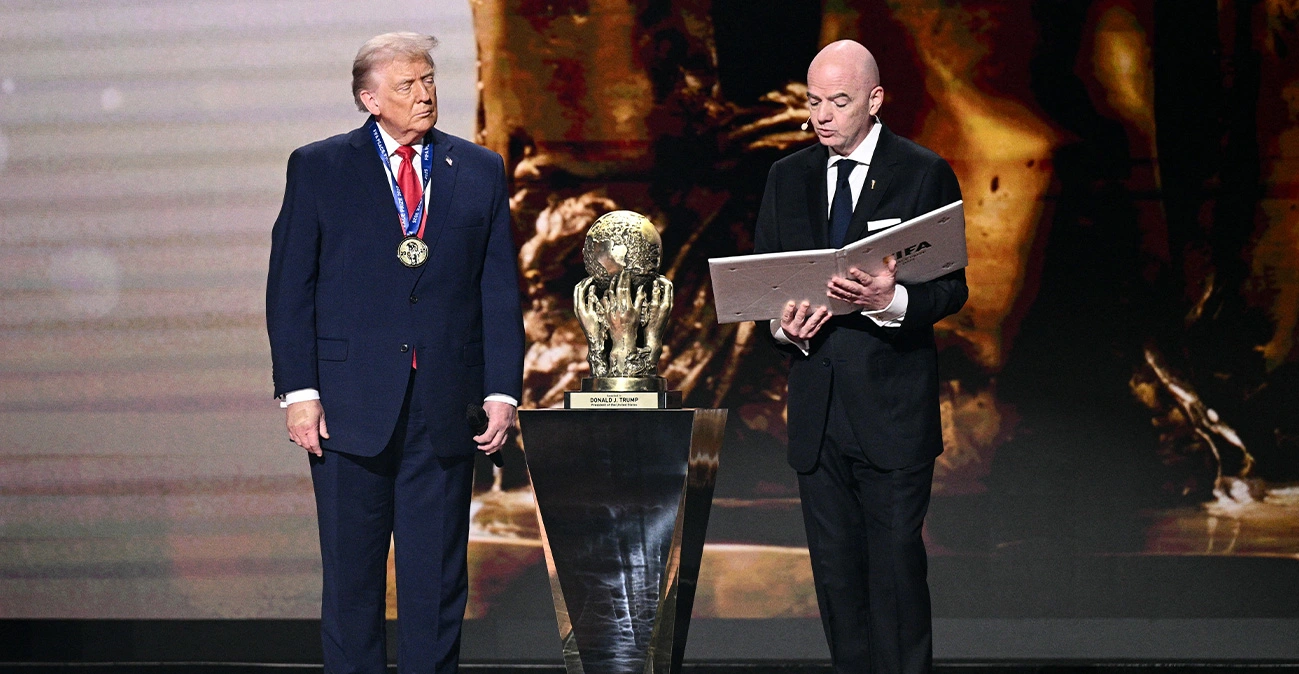
The draw for the 2026 World Cup, scheduled for 19:00 today (December 5), aims to overshadow even the biggest mega-spectacles in American sports. FIFA has planned a lavish event at the Kennedy Center in Washington to determine the groups of the tournament, which will be hosted by the United States, Canada, and Mexico.
The event will not only be athletic, but will also have a strong political and artistic tone. The heads of state of the three host countries are expected to attend the draw: U.S. President Donald Trump, Canadian Prime Minister Mark Carney, and Mexico’s President Claudia Sheinbaum.
The ceremony will be hosted by supermodel Heidi Klum, comedian Kevin Hart, and actor Danny Ramirez. Assisting in the draw will be former England captain Rio Ferdinand and award-winning presenter Samantha Johnson, along with Tom Brady, Wayne Gretzky, Aaron Judge, and Shaquille O’Neal.
Italian tenor Andrea Bocelli, former Pussycat Dolls singer Nicole Scherzinger, British superstar Robbie Williams, and the American disco group Village People will perform on stage, combining sports, entertainment, and spectacle like never before.
48 countries and 3 hosts
For the first time in tournament history, 48 teams will be divided into 12 groups of four, creating a schedule of 104 matches in 16 host cities across the US, Canada, and Mexico. So far, 42 teams are known; the remaining six will come from the European (4 slots) and intercontinental (2 slots) playoffs and will finalize the lineup by March 31, 2026.
The traditional group format of four teams is maintained, though the number of groups has increased. Instead of the eight groups (1–8) of previous World Cups, there will now be twelve (1–12).
The procedure
The national teams of the host countries will be placed in positions A1 (Mexico), B1 (Canada), and D1 (USA).
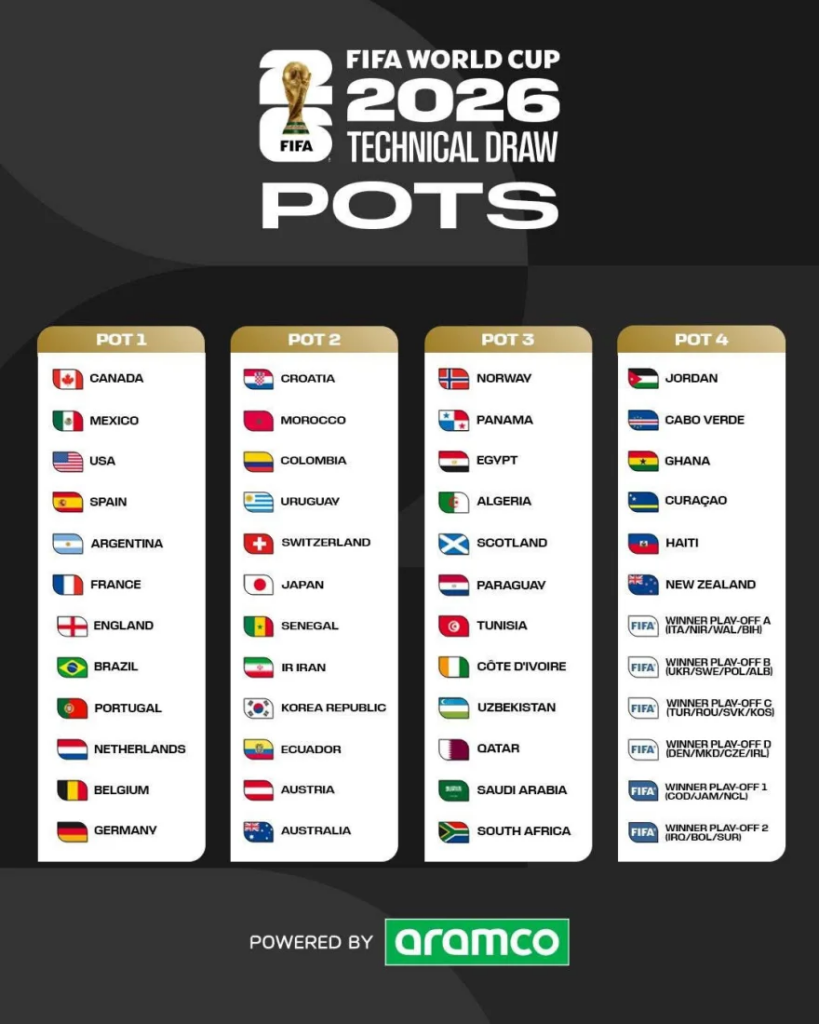
Based on FIFA’s latest rankings, the pots are:
Pot 1: Canada, Mexico, USA, Spain, Argentina, France, England, Brazil, Portugal, Netherlands, Belgium, Germany
Pot 2: Croatia, Morocco, Colombia, Uruguay, Switzerland, Japan, Senegal, Ireland, Iran, South Korea, Ecuador, Austria, Australia
Pot 3: Norway, Panama, Egypt, Algeria, Scotland, Paraguay, Tunisia, Ivory Coast, Uzbekistan, Qatar, Saudi Arabia, South Africa
Pot 4: Jordan, Cape Verde, Ghana, Curaçao, Haiti, New Zealand, UEFA playoffs A/B/C/D, intercontinental playoffs 1 & 2
The draw begins with all teams from Pot 1 being allocated to Groups 1–12, then continues with Pots 2, 3, and 4 in that order.
No group may contain more than one team from the same confederation, except UEFA, which has 16 qualifiers. Thus, four of the twelve groups will contain at least two European teams.
The favorite pairings
A major recent change announced by FIFA: In the knockout rounds there will be “favorite pairings” that avoid each other if they qualify as group winners.
This applies to Spain and Argentina (ranked 1st and 2nd), and to France and England. If each pair wins its group, the teams will be placed on opposite sides of the bracket to avoid meeting before the final.
Qualification
The top two teams from each group will qualify, along with the eight best third-place teams. This will create the Round of 32—another new feature—meaning one more knockout round than before. A team will now need to play eight matches to become world champion (previously seven).
The schedule
Another significant moment will come 24 hours after the draw. On Saturday at 19:00 Greek time, the exact match schedule (venues and kickoff times) will be announced at a separate event.
The World Cup will begin on June 11 at the “Azteca” Stadium in Mexico City and conclude with the final on July 19 at MetLife Stadium in East Rutherford, New Jersey.
The beginning
Qualifying began on September 7, 2023, with three CONMEBOL matches played that day.
The first goal of the qualifiers was scored by Colombian player Rafael Santos Borré against Venezuela.
A total of 2,480 goals have been scored in 883 matches, averaging 2.81 goals per match (as of November 18, 2025).
Qualified teams (42):
Hosts: Canada, Mexico, USA
AFC: Australia, Iran, Uzbekistan, Jordan, South Korea, Japan, Saudi Arabia, Qatar
CAF: Cape Verde, Ghana, Morocco, Tunisia, Egypt, Algeria, Ivory Coast, Senegal, South Africa
CONCACAF: Curaçao, Haiti, Panama
CONMEBOL: Argentina, Brazil, Colombia, Ecuador, Paraguay, Uruguay
OFC: New Zealand
UEFA: Austria, Belgium, Croatia, England, France, Germany, Netherlands, Norway, Portugal, Scotland, Spain, Switzerland
The last six places:
UEFA Playoffs (4 slots)
Semifinal 1: Italy – Northern Ireland
Semifinal 2: Wales – Bosnia & Herzegovina
Final: Winner 2 vs Winner 1
Semifinal 1: Ukraine – Sweden
Semifinal 2: Poland – Albania
Final: Winner 1 vs Winner 2
Semifinal 1: Turkey – Romania
Semifinal 2: Slovakia – Kosovo
Final: Winner 2 vs Winner 1
Semifinal 1: Denmark – North Macedonia
Semifinal 2: Czechia – Ireland
Final: Winner 2 vs Winner 1
Intercontinental Playoffs (2 slots)
Semifinal: New Caledonia – Jamaica
Final: DR Congo – winner of semifinal
Semifinal: Bolivia – Suriname
Final: Iraq – winner of semifinal
Qualification slots:
- AFC: 8 direct + 1 playoff
- CAF: 9 direct + 1 playoff
- CONCACAF: 6 direct (3 + 3 hosts) + 2 playoff
- CONMEBOL: 6 direct + 1 playoff
- OFC: 1 direct + 1 playoff
- UEFA: 16 direct
Excluded teams
- Russia: banned indefinitely on Feb 28, 2022, due to the invasion of Ukraine
- Sri Lanka: excluded in Jan 2023 due to interference in the federation
- Eritrea: withdrew on Nov 10, 2023, over concerns players would seek asylum abroad
- Congo: excluded Feb 6, 2025, due to government interference in its football federation
Debut appearances
Four national teams—Cape Verde, Curaçao, Jordan, and Uzbekistan—have qualified for a World Cup for the first time.
Note: Curaçao, an autonomous country within the Kingdom of the Netherlands, will surpass Iceland (331,000 residents) as the smallest-population country ever to participate in a World Cup. The island has just 155,000 inhabitants.
Ask me anything
Explore related questions