





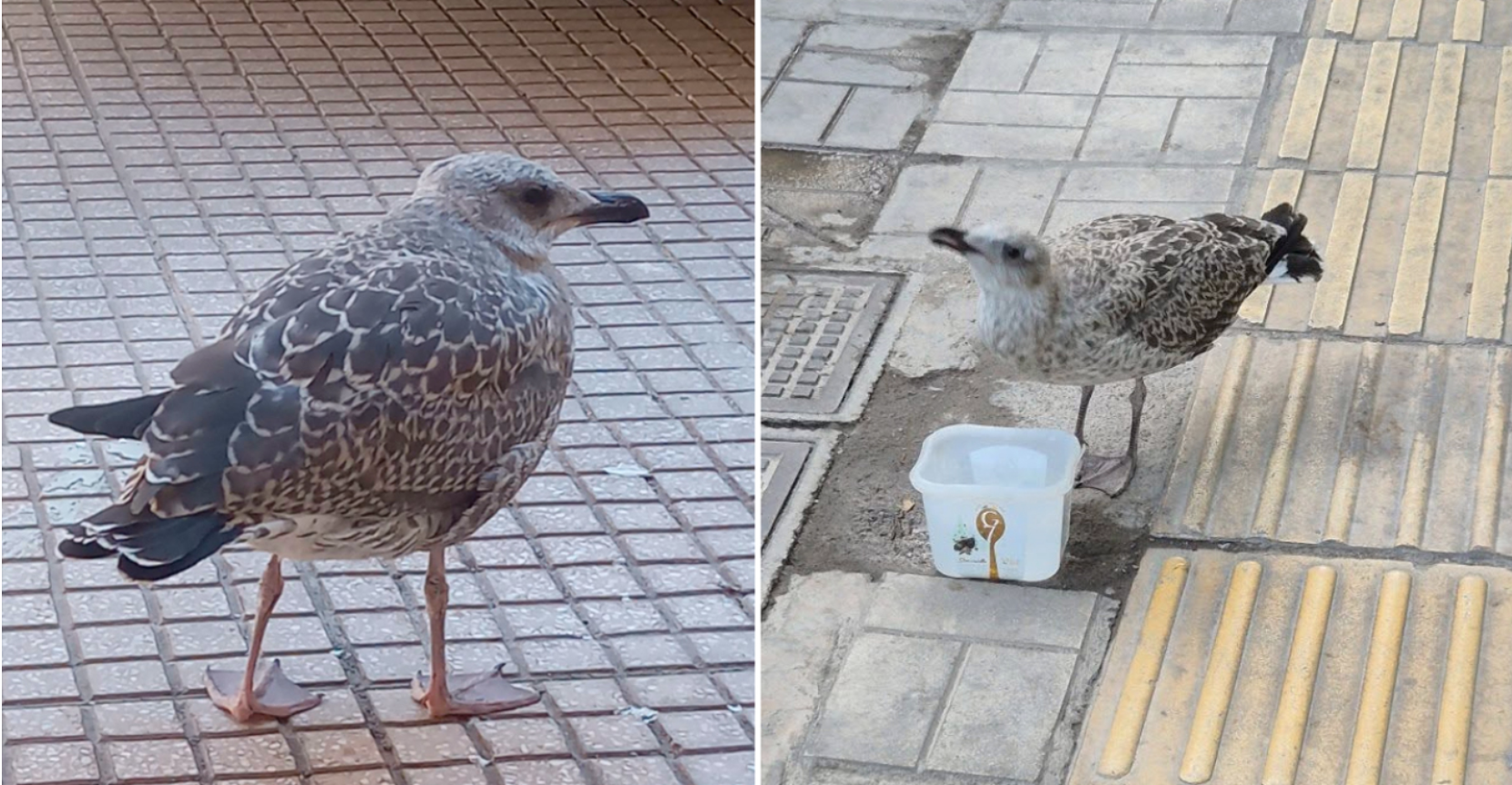
Reports from residents about young seagulls being spotted on roads, sidewalks, and in the courtyards of apartment buildings across various areas of Attica have increased in recent weeks.
In an announcement, the wildlife protection and rehabilitation organization ANIMA explains that this is a seasonal phenomenon observed every year during the summer months, as young birds leave their nests prematurely and begin exploring their surroundings.
According to ANIMA, seagulls have established colonies not only in Athens but also in other major Greek cities, including Thessaloniki, Chalkida, and Volos.
The organization clarifies that if a bird does not appear to have visible injuries or fractures, it does not necessarily need to be rescued. Instead, citizens are advised—if it can be done safely—to move the bird to a rooftop or a nearby coastal area so that its parents can locate it.
If the bird appears injured or in need of care, ANIMA asks citizens to place it in a cardboard box and transport it to the organization’s facilities for treatment. The organization also reminds the public that, due to limited resources and staff, it is unable to collect animals directly from the locations where they are found.
Full Statement
“What is happening with all the young seagulls these days?”
“In every neighborhood of Piraeus, in Nea Smyrni, Kallithea, Moschato, and Faliro—but also on Patision Street, Solonos Street, and in Sepolia—young seagulls can be seen wandering on sidewalks or calling out to their parents from apartment-building courtyards. And if you look up toward the rooftops, you’ll see the worried parents flying overhead and calling back. They may even be thinking, ‘Our impatient child has left the nest too early again.’
Because that is exactly what is happening.
Over the past few years, as seagulls have colonized Athens—as well as Thessaloniki, Chalkida, and Volos—the same phenomenon has repeated every June and July. As a result, we frequently find ourselves in disagreements with citizens who demand that we immediately come and collect these adventurous youngsters.
Our approach is the following:
If the young seagull is healthy, with no fractures or injuries, catch it using a large towel (it may take two people to wrap it securely) and place it on a rooftop so its parents can find it. If it is older and you are close to the sea, you can release it on the beach.
If it needs medical care, place it in a cardboard box and bring it to ANIMA. We are open seven days a week for exactly this reason.
We do everything except field collection because we simply do not have enough personnel to provide that service as well…”
Ask me anything
Explore related questions




