





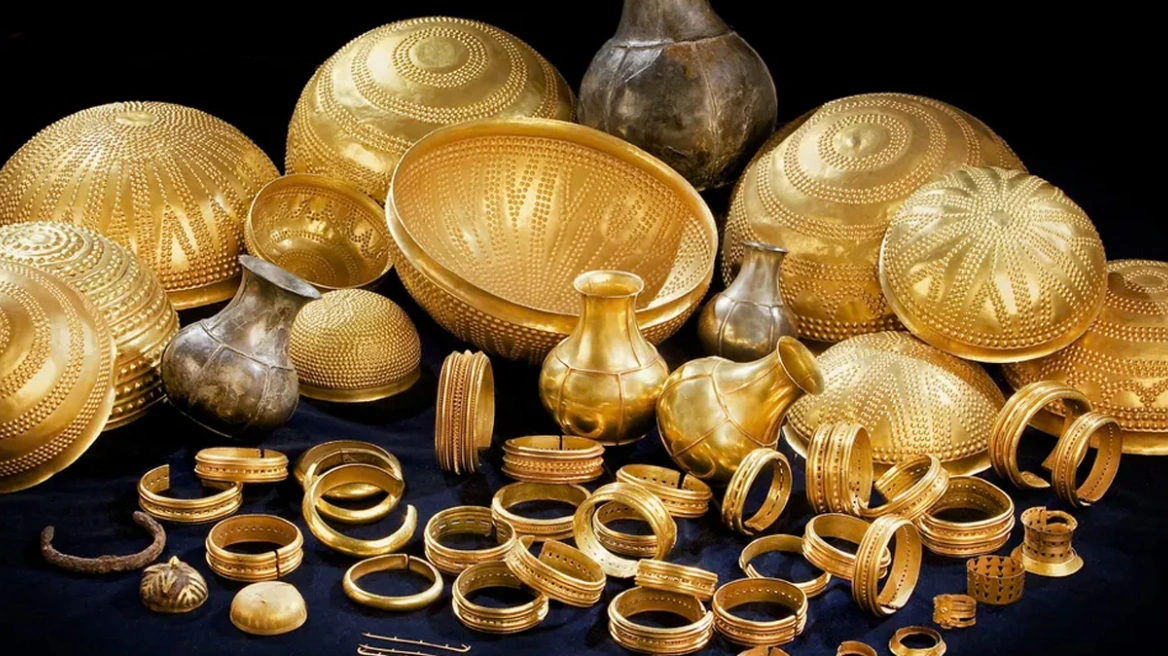
One of Europe’s most important archaeological finds from the Bronze Age, the famous Villena Treasure (Tesoro de Villena), was stolen in the early hours of Thursday from the museum of the town of the same name, in Spain’s Alicante province.
According to municipal sources cited by the Spanish news agency EFE, the case has already been taken up by the Guardia Civil and the Judicial Police, which are conducting an investigation to determine the exact circumstances of the theft.
The museum’s alarm was activated at 5:16 a.m.; however, local authorities are so far unable to determine the true extent of the theft or exactly which objects have been removed.
A priceless treasure approximately 3,000 years old
The Villena Treasure is an exceptionally important collection of metalwork, dating to around 1000 BC and consisting primarily of gold objects.
Among its objects are 11 bowls, 28 bracelets and three vessels. The collection also includes three silver vessels, two objects made of amber and gold, one made of iron and gold, as well as an iron bracelet.
In total, the treasure comprises 59 objects made of gold, silver, iron and amber, with their combined weight approaching 10 kilograms.
The discovery that changed the archaeological history of the region
The story of the treasure’s discovery begins in the autumn of 1963 and has almost cinematic characteristics.
In October 1963, a bracelet was found among soil that had been transported from the Rambla del Panadero, in the Sierra del Morrón of Villena. It was initially thought that it might be a component from a truck engine.
The construction foreman, Ángel Tomás, even left the object in a conspicuous location, expecting someone to come looking for it, as he believed it was some kind of truck bearing.
Fate, however, saw to it that the object eventually came into the hands of local jeweler Carlos Miguel Esquembre. He realized that the find required closer examination and contacted José María Soler, who was then director of the Municipal Archaeological Museum.
Examination of the bracelet led to the beginning of archaeological investigations at the Rambla del Panadero. After several days of excavations, on December 1, 1963, Soler and his colleagues made the major discovery.
Inside a vessel hidden in the bed of the stream, they found the treasure, which would go on to be described as one of the most important—and, according to Spanish media, the most important—archaeological collections from the Bronze Age in Europe.
Ask me anything
Explore related questions




