

×
GreekEnglish

×
  • Politics
  • Diaspora
  • World
  • Lifestyle
  • Travel
  • Culture
  • Sports
  • Cooking
Tuesday
23
Jun 2026
weather symbol
Athens 33°C
  • Home
  • Politics
  • Economy
  • World
  • Diaspora
  • Lifestyle
  • Travel
  • Culture
  • Sports
  • Mediterranean Cooking
  • Weather
Contact follow Protothema:
Powered by Cloudevo
> technology

A giant exoplanet is hiding at the center of the Milky Way galaxy

The exoplanet has been given the clunky label OGLE-2016-BLG-1190Lb

Newsroom November 8 07:22

Δείτε περισσότερα άρθρα μας στα αποτελέσματα αναζήτησης

Add Protothema.gr on Google


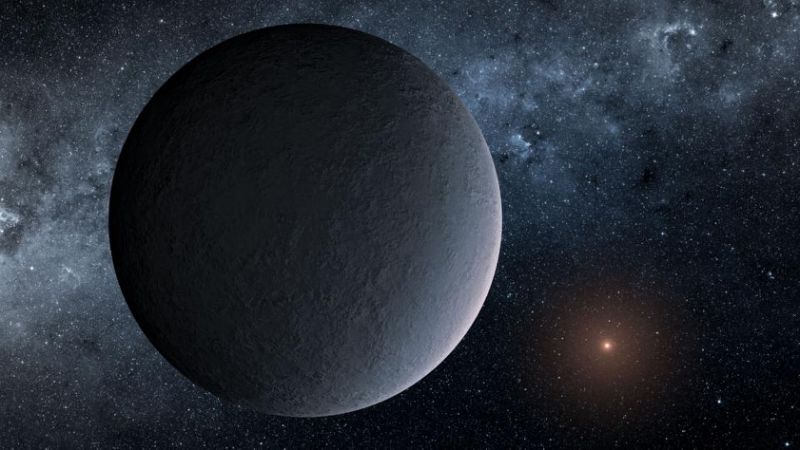
Scientists have spotted a gigantic exoplanet that they believe is hiding deep at the center of the Milky Way, about 22,000 light-years away from Earth, a large team is reporting in a paper recently posted on the physics pre-print server arxiv and submitted to The Astrophysical Journal.

The new planet orbits a star a little smaller than our own sun at about twice the distance that Earth orbits the sun. The exoplanet has been given the clunky label OGLE-2016-BLG-1190Lb, but don’t let the name bore you. It’s a little bigger than 13 Jupiters smooshed together, which means that for a planet, it’s really, really big—in fact, it may actually be large enough to be a tiny little star, what’s called a brown dwarf, instead.

Brown dwarfs are less charitably known as “failed stars” since they don’t actually have a stellar oven at their heart creating energy by fusing together atoms. But they’re still classified as a star because they produce light. The boundary between planet and brown dwarf falls right at 13 Jupiter masses, so given the scientists’ uncertainty about the new object’s precise size, it’s having a bit of an identity crisis.

But the scientists are actually less intrigued by its precise size than by how it formed: Traditionally, the things we call planets formed by lumps of stuff sticking together in a disk around a star, whereas stars are formed by a giant cloud of gas breaking down into stars.

Astronomers are particularly intrigued by the new planet because it is tucked deep in the heart of the Milky Way, in what’s called the galactic bulge. Usually, it’s hard to spot planets in this region since they’re tens of thousands of light-years away and don’t produce light.

>Related articles

Greek prime minister and defence minister to inaugurate new cyber defence centre as Athens strengthens its digital shield

Elon Musk & SpaceX: How the “failed idea” and the Russians’ “NO” led to the launch of a $2 trillion company

Incredible: A single dose of a well-known substance “woke up” the brain of an 80-year-old woman with Alzheimer’s disease

The scientists were able to spot the planet by using a technique called microlensing, the only approach that allows them to spot planets deep in the galaxy’s heart. If a very large cosmic object with a very strong gravity, like a star, lies between Earth and a target, it bends the light of the distant object. That pattern varies when the distant star is accompanied by a planet. So scientists are able to work backward from what they know of the distant star and how its light changes to figure out precisely what’s coming between it and Earth.

NASA’s Spitzer Space Telescope, which has been chasing Earth in orbit around the sun for 14 years, has helped spot exoplanets before using the same microlensing technique.

Source: yahoo.com

Ask me anything

Explore related questions

#astronomy#brown dwarfs#center#discovery#distance#earth#exoplanets#galaxy#giant#hiding#journal#Milky Way#nasa#orbit#planets#science#space#space exploration#star#technology#telescopes
> More technology

Follow en.protothema.gr on Google News and be the first to know all the news

See all the latest News from Greece and the World, the moment they happen, at en.protothema.gr

> Latest Stories

Map for the new school year: 43 kindergartens and 32 primary schools to be abolished – Which schools are merging and where new units are being established

June 23, 2026

Why are so many young seagulls appearing on the streets of Athens?

June 23, 2026

Oman and Iran stated that any arrangement concerning the Straits must fully respect their sovereign rights

June 23, 2026

New academic partnership between Panteion University and Columbia University to study contemporary China

June 23, 2026

Chrysochoidis: In a few days, the 300 cameras for red-light violations will be operational

June 23, 2026

Chardalias on the vandalism outside his home: “A direct insult to institutions, no one will intimidate us”

June 23, 2026

Europe swelters under extreme heat: Dozens drown in France, red alerts in Spain and Italy, record temperatures in Britain

June 23, 2026

France records 40 drownings during heatwave as extreme temperatures, red alerts and wildfire risks spread across Europe

June 23, 2026
All News

> Greece

In reverence, the emotional deposition in Jerusalem, see photos & video

The Holy Temple of the Resurrection opened after many days due to the war between Israel and Iran

April 10, 2026

In the final stretch for the accreditation of joint master’s degrees: Aiming for their launch in the coming academic year

April 10, 2026

Schedule for Epitaph Procession today (10/4)

April 10, 2026

Perfect weather for Easter excursions, according to Tsatrafyllia’s forecast

April 10, 2026

Easter in Greece: The customs that continue in Greek tradition – From Nafpaktos to Corfu

April 10, 2026
Homepage
PERSONAL DATA PROTECTION POLICY COOKIES POLICY TERM OF USE
Powered by Cloudevo
Copyright © 2026 Πρώτο Θέμα



