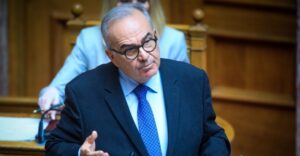
Deputy Minister of National Economy and Finance Nikos Papathanasis announced an initiative for a new housing program that will offer incentives both for home renovation and energy upgrades, aiming to provide more affordable housing. The program is expected to launch after the completion of the current “My Home II” and “Save – Energy Efficiency” initiatives.
If approved, the new program will begin after “Save 2025,” possibly in early 2026, Papathanasis explained in interviews.
“The housing issue — a major pan-European challenge — has officially entered the EU agenda for the first time,” he said. “The Prime Minister has taken the initiative to create a new program that will serve as a pilot for Europe. Negotiations are already underway with our European partners to redirect resources toward this new program, which will include home renovations not limited solely to energy efficiency.”
He also noted that the government’s housing policy encompasses measures totaling €6.5 billion. Within the “My Home II” program alone — thanks to expanded income and age eligibility — 65.45% of the program’s total budget has already been allocated, covering 11,000 loans worth €1.258 billion. The average loan is €119,490, with 58.8% of recipients earning up to €24,000 annually.
Many of these approvals come from regional Greece, especially Central Macedonia, Thessaly, Thrace, and Western Greece.
“There’s no reason to talk about a ‘My Home III’ while ‘My Home II’ still has available funds to support low-income citizens,” Papathanasis said.
Greece Among EU Leaders in Fund Absorption
He reiterated that Greece ranks among the top EU countries in absorbing funds from both the NSRF and the Recovery and Resilience Facility (RRF). According to official EU data, total disbursements from the RRF have reached €23.4 billion — about 65% of the total budget — following the approval of Greece’s 6th payment request, which received a positive preliminary evaluation by the European Commission.
He cited examples of projects funded by EU resources: electric buses, preventive health screenings, interactive boards in public schools, renovations and energy upgrades of public buildings, hospitals, and health centers, as well as digital transformation initiatives. Other examples include low-interest SME loans through the TEPIX II program, export, innovation, women’s entrepreneurship, and rural business support schemes.
Papathanasis also announced that new EU-funded programs will be launched in 2026, following ongoing Europe-wide revisions.
“This outcome is no coincidence — it means we’re doing something right,” he said. “We are ready to submit the 7th payment request from the Recovery Fund by December. EU funds are directed toward infrastructure, entrepreneurship, and improving citizens’ daily lives. We believe that increasing disposable income comes through creating new jobs — and jobs are created only when businesses feel secure, when the country operates in a stable environment. And Greece moves forward confidently only when it has a stable government.”
“Fake News About My Position on the State Ballot”
Papathanasis dismissed as false reports suggesting he would not run again in the Northern Athens Sector, but instead be placed on the state ballot of New Democracy.
“The reports about my placement on the state ballot are fake news. The Northern Sector of Athens is and will remain my electoral district. In the 2027 national elections, I will once again seek the mandate of my fellow citizens. These scenarios must stop — I don’t know where they come from, but they have no basis in truth,” he stressed.
Ask me anything
Explore related questions