





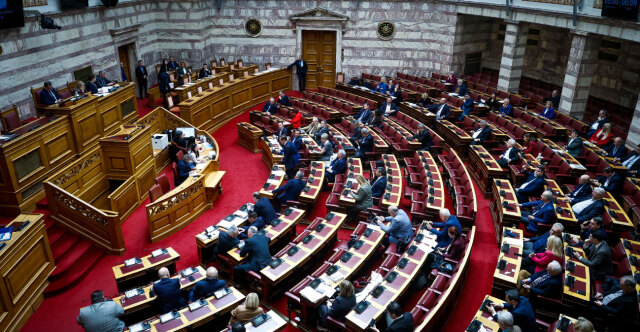
A “bar association” similar to the one in Livadia could theoretically be formed by the 83 lawyers in Parliament, as they constitute the largest professional-scientific group among MPs. Doctors also hold significant parliamentary representation.
Following the controversy over the academic qualifications of former Deputy Minister of Rural Development Makarios Lazaridis—particularly regarding his role at the Ministry of Education as a scientific associate—as well as questions surrounding the studies of ruling party parliamentary representative Dimitris Markopoulos, a closer look at MPs’ biographies reveals a wide range of educational backgrounds.
Among them are individuals with impressive academic credentials and studies in Greece and abroad. At the same time, there are MPs from more traditional professions—such as builders and farmers—who are simply high school graduates.
A diverse professional landscape
The Hellenic Open University, from which Mr. Markopoulos graduated in 2012, along with its Cypriot counterpart, appears particularly popular among MPs seeking academic qualifications.
Parliament also includes two driving instructors—Vassilis Kotidis (Hellenic Solution) and independent MP Konstantinos Floros, who was elected with the Spartans and also describes himself as a computer technician.
The now-defunct Spartans parliamentary group once stood out for its unusual mix of professions, including former Mister Hellas Michalis Gavnotakis and chef-pastry maker George Aspiotis. Haido Asimakopoulou (Hellenic Solution) is a graduate of the Lambelette School of Beauty, while ND MP for Karditsa Asimina Skondra studied at a private school of office administration and accounting.
Journalists who left their studies
At least three MPs who entered journalism abandoned their university studies early in order to pursue their careers.
Deputy Foreign Minister Yiannis Loverdos enrolled in the Law School of the University of Athens after graduating from Athens College, but never completed his degree. SYRIZA MP Elena Akrita left her Philology studies at the National and Kapodistrian University of Athens (EKPA) for journalism.
Christos Giannoulis lists “literary studies” in his parliamentary biography without specifying the institution or whether he graduated. On his personal website, he clarifies that he chose journalism as his “real university,” later completing studies in Greek Culture at the Hellenic Open University.
Similarly, Popi Tsapanidou’s official biography highlights her long journalism career but makes no mention of formal studies; she began working at just 16 years old.
New Democracy (ND)
Among ND MPs:
- 46 are lawyers
- 19 are doctors
- 17 are economists
- 6 are agronomists
- Several are political scientists
Many MPs have strong academic and linguistic backgrounds. Angeliki Delikari speaks six languages, Dimitris Kairidis five, and Tasos Hatzivasileiou four. All ND MPs speak English, except Dimitris Kyriazidis, who states he speaks French.
Notable educational details include:
- Thodoros Roussopoulos, Dimitris Markopoulos, and Yiannis Andrianos hold degrees from the Hellenic Open University.
- Elena Rapti studied Psychology (without specifying where) and holds a degree in Greek Culture from the Open University of Cyprus.
- Simos Kedikoglou reports studies in Moscow and Paris but does not clarify whether he obtained degrees.
- Katerina Monogiou (Cyclades) is a dietitian with a degree from the former TEI of Crete.
PASOK
PASOK has:
- 11 lawyers
- 7 doctors
Other notable members include:
- Rear Admiral Stavros Michaelides
- Rania Thraskia, a clinical psychologist, educator, family counselor, and author
Thraskia holds:
- A Psychology degree and an MSc from the University of East London
- A degree in Education from the University of the Aegean
- A four-year specialization in systemic and family counseling
By contrast, no academic qualifications are listed for Manolis Hnaris, who works in agriculture and livestock farming.
SYRIZA
SYRIZA’s parliamentary group includes:
- 6 lawyers
- 4 doctors
Socrates Famelos studied Chemical Engineering and Environmental Planning at Aristotle University and the Hellenic Open University.
Giorgos Karameros reports studies in journalism in Athens and Sunderland and holds an MBA.
Nina Kasimati’s academic background remains somewhat unclear, as her CV mentions studies in English law in London and at UCL without specifying completion.
A notable case is Marina Kontotoli, who left school at 14 but later entered Panteion University at age 38 and completed her studies while running two hair salons.
Other parties
KKE: Includes lawyers, a doctor (Giorgos Lambroulis), and journalist Giorgos Marinos. No studies are listed for some members, such as builder Nikos Exarchos.
New Left: MPs generally have strong academic backgrounds, with few exceptions.
Hellenic Solution: Led by journalist Kyriakos Velopoulos, whose studies include the Open University of Cyprus. The party includes a mix of professionals, such as journalists, a beautician, and a driving instructor.
NIKI: Leader Dimitris Natsios is a teacher with a theology degree. MP Athanasios Rakovallis combines a background in physics with writing and religious work.
Course of Freedom (Plefsi Eleftherias): Three out of five MPs have law degrees, including party leader Zoe Konstantopoulou.
Independents: Among 27 independent MPs:
- 7 are lawyers
- 5 are doctors
Ivy League graduates
A distinct group includes MPs who studied at elite U.S. universities such as Harvard, Yale, and Princeton.
Notable figures include:
- Prime Minister Kyriakos Mitsotakis
- Kyriakos Pierrakakis
- Niki Kerameos
- Stavros Papastavrou
Former Prime Ministers George Papandreou and Antonis Samaras also studied at top U.S. institutions.
Mitsotakis, for example, graduated from Harvard with honors and later completed postgraduate studies at Stanford and Harvard Business School.
A Parliament of contrasts
Overall, the composition of Parliament reflects a striking mix of backgrounds: from highly educated individuals with international academic careers to professionals with more practical experience and limited formal education.
This diversity highlights both the breadth of representation and the ongoing debate about qualifications, merit, and the role of expertise in political life.
Ask me anything
Explore related questions




