





“The owner of Violanta knew very well about the smell in the factory. Whatever happened in the factory, he learned about it immediately. Even the slightest thing. He didn’t just stay in his office; he would go downstairs as well. He doesn’t admit it to gain mitigating circumstances. Nothing happened without Tziortziotis—he was pulling the strings in his businesses.”
Exactly three months after the deadly explosion at the Violanta biscuit factory, the victims’ relatives—such as Ms. Maria Katsarou, who lost her sister Eleni that dreadful dawn—speak calmly and firmly, having now come to terms with the devastating loss. She is clear about what she wants, as do all relatives of the five women who died while working: “Justice,” she says, adding: “Everyone responsible at the factory knew. We don’t want it to shut down, but accountability must be assigned.”
Last Thursday, Violanta’s owner, Konstantinos Tziortziotis, appeared again before the Trikala investigating magistrate, this time to answer charges of multiple counts of negligent homicide and bodily harm. He remains in pre-trial detention for the felony of explosion with possible intent, which resulted in the deaths of five night-shift workers at the Trikala factory.
His first request for release from pre-trial detention has been rejected, and he has filed an appeal before the competent judicial council. His main defense argument, citing case law, is that he cannot be accused of intent, as this would mean he not only knew about the risk of explosion but also accepted it as a possibility. However, according to legal precedent, when there is self-endangerment, intent cannot be established. Tziortziotis argues that he himself, as well as his children who work at Violanta, were present daily at the factory.
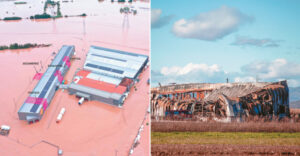
At the same time, attention returns to the flooding of the factory caused by storm “Daniel” in September 2023. At that time, as shown in photographic evidence, the facilities remained flooded for days, with water reaching significant levels, as happened across much of Thessaly.
Tziortziotis’ side now looks to the storm as the starting point of the chain of events that ultimately led to corrosion in the pipelines transporting propane from storage tanks to the factory. Yet precisely because of that disaster, inspections of the pipelines for corrosion risks should have been more frequent and carried out with greater diligence and thoroughness—both by the company itself and by the competent public authorities responsible for oversight.
Operating licenses
Three months after the fatal explosion, relatives are trying to adjust to their loss. Children are learning to live without their mothers, mothers without their daughters, men without their wives. Until recently, a police patrol car stood daily outside the locked main gate of the factory and the shell of the rear building. Investigations by fire brigade experts, as well as a report by the Polytechnic University, have outlined the mechanism and sequence of events leading to the tragedy.
Following the explosion, operating licenses for two other factories under the same ownership were also revoked. The Larissa factory has since resumed operations, while the company awaits a new license for its subsidiary VitaFree plant, hoping to restore a significant portion of production there.
Violanta has continued to supply products to the market, at least within Greece, from its stockpiles. Recently, part of its production has been transferred to another local biscuit manufacturer under an agreement: during the night shift, Violanta employees produce its biscuits there—products that, before the tragedy, were exported to 20 countries.
The day after the explosion, the company announced that its approximately 350 employees would continue to be paid normally until full operations resumed. However, according to information received by the Trikala Labor Center and its president Dimitris Armagos, employees were paid regularly until February and received their Easter bonus, but have not yet been paid for March. Additionally, complaints have reached the Labor Center alleging that the company is requesting contract changes—from full-time to part-time—in view of reopening the VitaFree unit. It is noted that in the initial period after the tragedy, the approximately 350 employees appeared divided, with many supporting their employer. Within this context, Tziortziotis is attempting to build his defense. According to reports, the odor reported in both the dishwashing area and the toilets was not linked to propane, as there were no propane pipelines in those areas; instead, pipelines ran underground over a 30-meter route. Thus, they assumed the issue was related to sewage, filled the toilets with cleaning agents and disinfectants, and the smell would come and go.
Technical report
Tziortziotis is also said to cite a technical report stating that sulfur-based odorants (mercaptans), added to naturally odorless propane to detect leaks, were absorbed and neutralized underground by moisture and soil. The report notes: “The sulfur-containing odorant fraction of the fuel was not detectable in environmental samples, although the main hydrocarbons of liquefied gas were detected. This finding is fully consistent with the internationally recognized phenomenon of odor fade—the reduction or loss of propane odor due to adsorption, absorption, or oxidation of sulfur-based odorants. Technical literature acknowledges that when propane leaks underground and passes through soil, moisture, concrete, rust, or porous materials, mercaptans and other sulfur compounds may be retained or transformed, resulting in gas that reaches the surface with weakened or undetectable odor. Therefore, the absence of sulfur compounds in later environmental samples does not negate a gas leak but is technically consistent with underground gas migration in such conditions.”
However, the question raised forcefully by victims’ relatives is why workers’ complaints about the smell were not thoroughly investigated—especially after the destruction caused by storm “Daniel.” “My sister and the other women are not coming back, but the owner should take responsibility. They kept telling him, and he didn’t fix it. He doesn’t admit it because he wants mitigating circumstances and to be released. He hasn’t even apologized—he lies, because if he apologizes, it means he admits fault. It was his factory,” says Ms. Katsarou.
Ms. Katsarou, who is trying to support her mother Androniki and her late sister’s son, has already testified before the investigating magistrate: “I said what I knew—that the smell had been there for a long time and we hoped something would be done. Nothing was done, and now they pretend the employer didn’t know. I consider it an insult to the victims, to the women who died. We want justice—money and compensation are not everything, nor should the employer try to escape responsibility with crumbs.”
According to available information, inspections were carried out by a plumber at the facilities in December 2025 and again in January, just days before the fatal explosion, but no connection was made between the odor and the propane pipelines.
Failures
Particular weight is given to the report by the Metallurgy Laboratory of the School of Mining and Metallurgical Engineering at the National Technical University of Athens, prepared by Associate Professor Dr. Petros Tsakiridis. The expert report, submitted to the Fire Service in early March and included in the case file, identifies a series of failures and omissions. Specifically:
■ Regarding the type of steel used in the pipelines: The observed failure is not attributed to unsuitable material or metallurgical deficiency, but to external factors related to installation conditions and corrosion protection of the underground section.
■ Regarding aging of the coating on the above-ground section: “Although no active corrosion was observed in the examined above-ground sample, the condition of the coating indicates a significant reduction in its protective capacity, being in a stage of functional degradation.”
■ Regarding the type of underground connections: “The use of threaded connections in the examined underground section constitutes a high-risk construction practice, which, combined with the absence of external anti-corrosion protection and protective backfill, significantly contributed to localized corrosion. Although not the immediate cause of perforation in this case, the threaded connection is identified as a potential failure point and a deviation from best practices and regulatory requirements for underground fuel gas installations.”
■ Regarding the absence of anti-corrosion protection: “The lack of both passive and active protection left the pipeline fully exposed to the natural corrosive action of the soil, leading to extensive pitting and ultimately through-wall failures. Therefore, the absence of anti-corrosion coating and cathodic protection constitutes a major deviation from regulatory requirements and best practices for underground fuel pipelines and is a decisive factor in the corrosion mechanism and premature failure.”
■ Regarding the absence of a protective sand layer: “Sand ensures uniform mechanical support, prevents localized stress, and primarily acts as a neutral and draining medium, reducing moisture retention and direct contact of the metal with aggressive soil components. The absence of such a protective layer in the examined installation constitutes a significant deviation from regulatory requirements and best engineering practices. Combined with the lack of external anti-corrosion coating and cathodic protection, the direct placement of the pipe in natural, conductive, and moist soil significantly contributed to intense localized corrosion and premature failure.”
Before the investigating magistrate
It should be noted that today, before the Trikala investigating magistrate, the factory director and the production manager are testifying as new defendants in the Violanta tragedy. The charges they face include direct complicity in an explosion with intent, multiple counts of negligent homicide, and bodily harm. Meanwhile, the owner’s lawyer, Michalis Dimitrakopoulos, stated after his client’s supplementary testimony that Tziortziotis’ concern is to support the families of the victims for life and to ensure that the approximately 350 employees who depend on the company do not lose their jobs. “They are a family—not strangers. Employees are friends, relatives, fellow villagers—that is why they stand by him. We do not want to speak legally about this case,” he said.
Ask me anything
Explore related questions




