





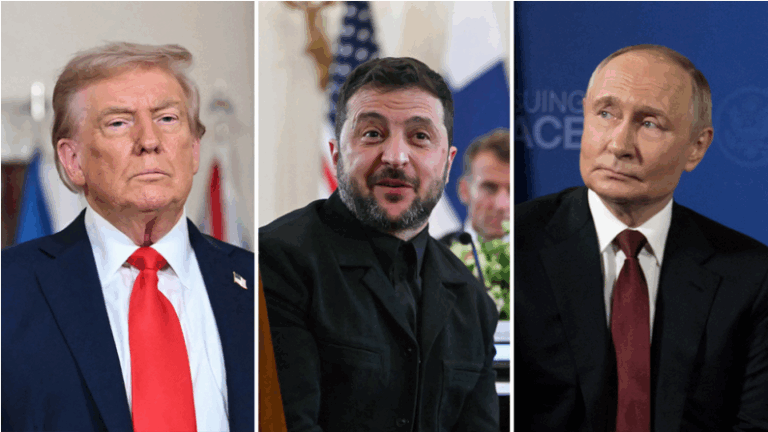
U.S. President Donald Trump is seeking to add a new diplomatic success to his record, as his political capital has grown significantly following the ceasefire agreement between Israel and Hamas in Gaza. Although the deal is under pressure, with Hamas continuing its operations, the prospect of resolving the “frozen” conflict in Ukraine is motivating the American President, offering a second chance for peace in 2025.
In this context, the 47th President of the United States will host his Ukrainian counterpart, Volodymyr Zelensky, at the White House today. It is more than clear that during their bilateral meeting, Mr. Trump will once again be confronted with Ukraine’s request for American Tomahawk missiles, as this weapons system is capable of striking deep into Russian territory.
From this perspective, the Tomahawk missiles have become one of the key bargaining tools of the White House and a lever of pressure on Russian President Vladimir Putin. The U.S. side is seeking another personal triumph that would further enhance Trump’s leadership image. For this reason, after the Anchorage, Alaska “Waterloo,” President Trump is reportedly planning a new “Peace Summit,” similar to the one that led to the Gaza Agreement in Egypt. This time, however, the new meeting between the American and Russian Presidents is expected to take place in Budapest, which is already preparing, according to Hungarian Prime Minister Viktor Orban.
Following a phone call between the U.S. and Russian Presidents that lasted more than two and a half hours yesterday, the path to Budapest is open—but far from smooth—since thorny issues remain regarding:
- the occupation of Ukrainian territories
- Ukraine’s NATO membership veto
- the demilitarization of Ukraine
At the same time, the American President has not hidden his disappointment over the “Waterloo” in Anchorage, Alaska, as his Russian counterpart placed him in an extremely difficult position. Despite the warm atmosphere, the press conference turned into two parallel monologues, with Vladimir Putin reiterating his revisionist arguments without showing any willingness to negotiate or make concessions for the sake of peace.
Nevertheless, Donald Trump described his lengthy communication with President Putin as “productive,” while the Kremlin warned that any U.S. decision to send Tomahawk missiles to Ukraine would be seen as a provocation. Meanwhile, several U.S. allies believe that the missiles are the White House’s only strong card to push Putin toward a peace deal, as the potential losses for Russia would multiply if the system were deployed.
Both Putin and Trump are expected to sit down at the negotiating table in Hungary to see “whether we can end this ‘inglorious’ war between Russia and Ukraine,” as President Trump stated on Truth Social, adding that “great progress was made in today’s phone call.” According to The Washington Post, Putin also tried to convince Trump that Russia had the upper hand on the battlefield, although the exact number of casualties remains a tightly guarded secret on the Russian side.
Optimism from Ukraine
Given these developments, Ukrainian President Volodymyr Zelensky expressed hope that “the momentum to curb terrorism and war achieved in the Middle East will help end Russia’s war against Ukraine.”
“Putin is certainly no braver than Hamas or any other terrorist organization. The language of strength and justice will inevitably work against Russia as well. We can already see that Moscow rushed to resume dialogue as soon as it heard about the Tomahawks,” Zelensky said.
The Ukrainian President emphasized that there should be no alternative to peace and reliably guaranteed security, stressing the need “to protect people from Russian attacks and strikes as soon as possible.”
Ask me anything
Explore related questions




