





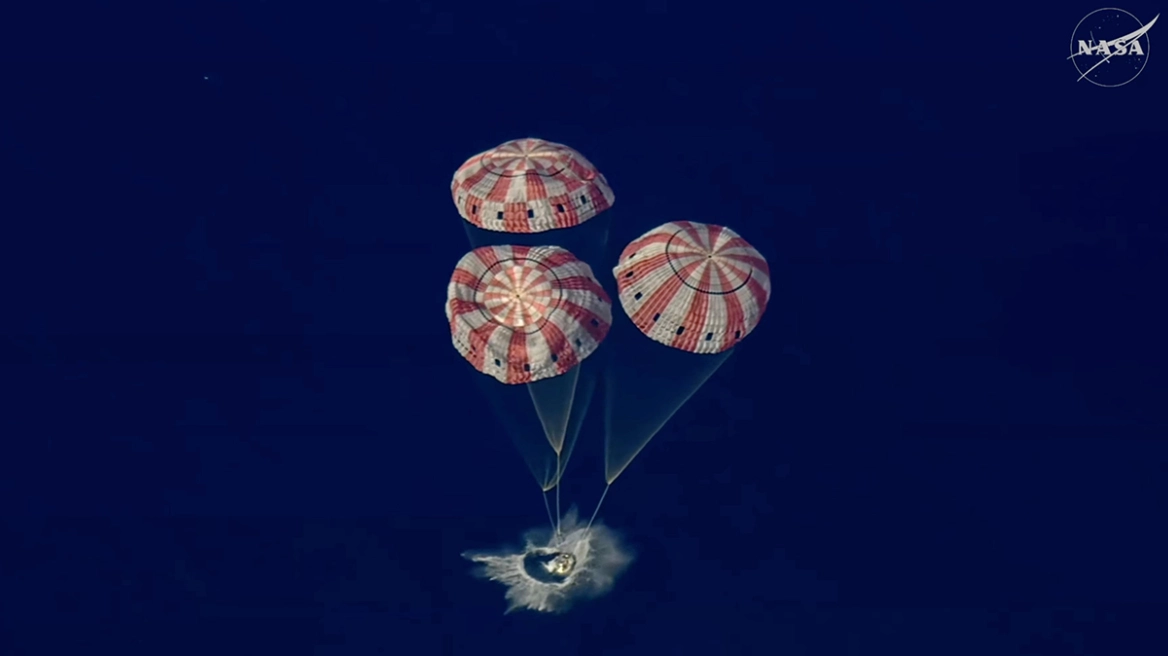
Mankind returned to orbit around the Moon for the first time in more than 50 years, as the Artemis II crew safely splashed down in the Pacific Ocean, completing a journey considered a milestone for the future of space exploration.
Astronauts Reid Wiseman, Victor Glover, Christina Koch, and Jeremy Hansen remained in space for nearly ten days in a mission that the entire planet followed with great interest on a daily basis.
During the mission, the spacecraft traveled approximately 694,000 miles in total, journeying from Earth to the Moon and back.
At the farthest point of the trajectory, the crew reached a distance of 252,756 miles from Earth, setting a new record for crewed flight, surpassing even the Apollo 13 mission.
The Orion spacecraft re-entered Earth’s atmosphere in the early hours at speeds exceeding 38,000 kilometers per hour, developing extremely high temperatures above 2,700°C due to intense friction. According to experts, this was the most difficult and critical phase of the mission.
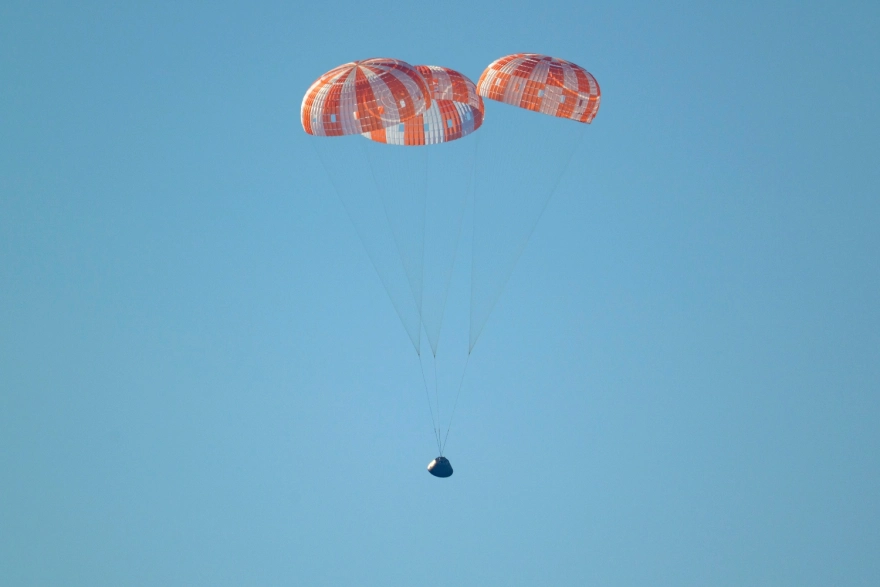
“The Artemis II crew has returned ‘home’ to Earth, completing a nearly 10-day journey around the Moon. Their mission took them farther into space than any humans have ever gone, and they are now safely back near us,” NASA said in a post on X.
Despite the extreme conditions, the capsule slowed down with the help of large parachutes and safely splashed down in the Pacific Ocean, using a procedure similar to that of the Apollo program missions.
They took over 7,000 photographs
The launch took place on April 1 from the Kennedy Space Center using the Space Launch System rocket, carrying the Orion spacecraft toward the Moon.
Orion approached within approximately 4,067 miles of the Moon’s surface, allowing astronauts to conduct critical tests of the spacecraft’s systems.
According to NASA, the mission was primarily a test mission aimed at checking life support, navigation, and safety systems that will be used in future lunar landing missions. The astronauts also performed manual maneuvers of Orion, collecting data to be used in future missions.
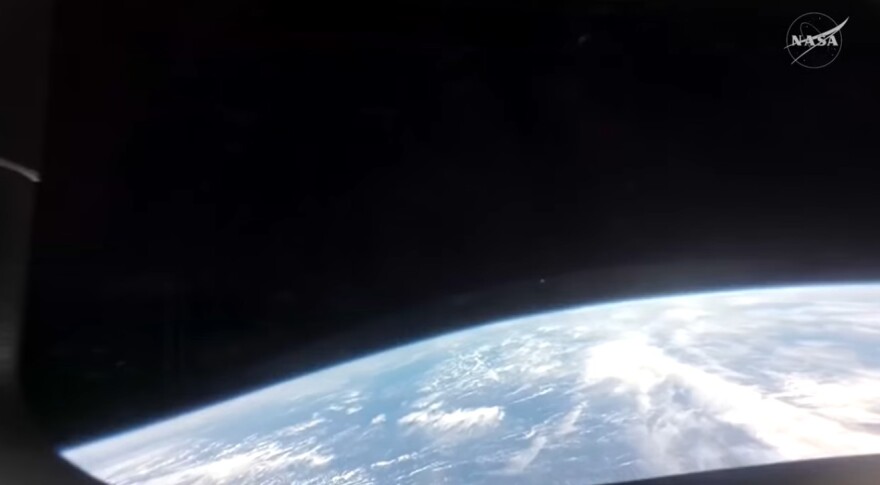
At the same time, scientific experiments were conducted to understand the effects of microgravity and space radiation on the human body, while the crew captured more than 7,000 images of the lunar surface, including craters, geological formations, and areas being considered as potential landing sites.
The mission also had an international character, as a Canadian Space Agency astronaut participated in the crew, confirming the collaboration of multiple countries in the Artemis program.
Next steps: Is the path opening toward Mars?
With the successful completion of Artemis II, attention now turns to the next mission, Artemis III, which is expected to return humans to the surface of the Moon and serve as the first step toward establishing a permanent base.
Humanity’s return to the Moon is considered crucial for scientific research and the development of new technologies, as well as for the future exploration of Mars, opening a new chapter in the history of space.
“We will do it again soon,” says Trump
The U.S. President, Donald Trump, congratulated the four astronauts of the mission via Truth Social after their return to Earth.
“Congratulations to the great and very talented crew of Artemis II. The entire journey was spectacular, the splashdown was perfect, and as President of the United States, I could not be more proud!” he said.
“We will do it again, and then the next step will be American astronauts traveling to Mars!” he added.
Ask me anything
Explore related questions




