





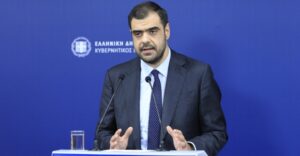
Pavlos Marinakis launched criticism against PASOK during the political editors’ briefing, on the occasion of the Areios Pagos ruling on the wiretapping case. He insisted on the line of absolute respect for the judiciary and directed his criticism at those who, as he said, choose to treat judicial rulings selectively.
The government spokesperson argued that the government did not comment on previous court rulings and will maintain exactly the same stance now, stressing that judicial decisions must be respected in their entirety by the political system.
In the same context, Mr. Marinakis placed particular emphasis on the fact that, as he stated, these are judgments by senior judges that reach the same conclusions, indirectly rejecting scenarios that question the court’s ruling.
He also pointedly noted that one of the senior judges aligned with this approach was not, as he said, “appointed by the government,” but had emerged as the top choice through the judicial process itself—an argument aimed at responding to claims of government influence.
He appeared particularly sharp toward PASOK, describing as “dangerous” the logic of separating judicial decisions depending on whether they serve political aims. According to him, such a stance directly undermines the separation of powers and weakens the country’s institutional functioning. The government spokesperson referred specifically to PASOK’s headquarters (Charilaou Trikoupi), noting that despite major political differences, the party had not shown similar behavior in the past and should not, as he said, imitate other political forces.
Response to Alexis Tsipras on PPC
Pavlos Marinakis launched a strong attack against Alexis Tsipras, responding to the former prime minister’s claims regarding the share capital increase of Public Power Corporation, accusing him of attempting to distort reality.
As he said, in 2019 PPC was essentially on the verge of bankruptcy, with debts reaching €4 billion, warning that a potential collapse would not only cause a “big bang” for the company but also serious shocks to the banking system. He added that the company owed more than €2.5 billion to its suppliers, remarking pointedly that this also does not seem to concern Mr. Tsipras.
The government spokesperson continued in the same sharp tone, saying that if PPC had collapsed, those who would have benefited would have been private energy providers, “whom Mr. Tsipras has been fighting since he was young.” At the same time, he attributed political motives to the former prime minister’s intervention, claiming that he appears with a “sense of a comeback,” but will not succeed in “turning black into white.” He also made pointed remarks, wondering whether Alexis Tsipras ultimately “acts as a sponsor in certain matters without us realizing it.”
Ask me anything
Explore related questions




